
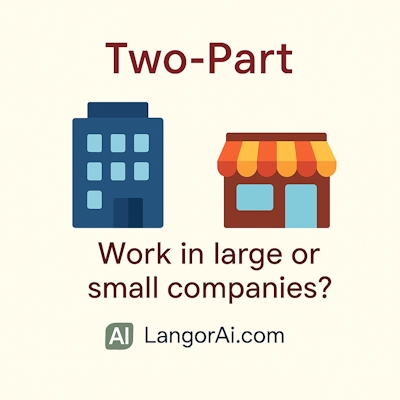
IELTS Academic Writing Task 2 – Large vs Small Companies
Why is this the case, and is this a positive or negative development?
Model Essay (Band 8–8.5)
In many modern economies, a growing number of workers tend to seek employment in large corporations instead of small businesses. This preference is largely driven by financial security, career stability, and structured professional development. While this trend offers clear advantages for individuals, I believe it represents a mixed development rather than a purely positive one.
One major reason for this shift is job security. Large companies usually provide stable salaries, long-term contracts, health insurance, and retirement benefits, which small firms often struggle to offer. In addition, multinational corporations typically have well-defined career ladders, regular training programs, and international promotion opportunities. For ambitious young professionals seeking rapid career advancement, these features make large organizations particularly attractive.
Another important factor is economic uncertainty. In periods of financial instability, small businesses are more vulnerable to market fluctuations and bankruptcy. Employees, therefore, naturally gravitate toward employers that appear financially resilient. Furthermore, working for a well-known company carries social prestige and enhances an individual’s professional profile, which can be highly valuable in competitive labor markets.
However, this trend also produces negative consequences. If too many skilled workers avoid small businesses, entrepreneurship and innovation may decline. Small firms play a critical role in job creation, economic diversity, and local development. A workforce overly concentrated in large corporations can weaken economic flexibility and limit opportunities for independent enterprise.
In conclusion, people prefer large companies mainly due to financial security, career growth, and economic stability. Although this trend benefits individual employees, it may negatively affect entrepreneurship and long-term economic balance. Therefore, it should be regarded as both a positive and negative development.
Analytical Review – Strengths, Weaknesses & Improvements
- Clear cause–evaluation structure aligned perfectly with the task.
- Strong academic vocabulary such as “financial resilience,” “career advancement,” “labor markets,” “economic diversity”.
- Balanced evaluation instead of one-sided judgment.
- Logical progression from causes → impacts → overall assessment.
- No real-world example of a startup ecosystem is mentioned.
- The innovation argument could be slightly more developed.
- Add a brief example (e.g., tech startups vs global corporations).
- Include one short statistic on small-business employment.
- job security
- career ladder
- economic uncertainty
- entrepreneurial growth
- economic stability
- Use one mixed conditional about long-term innovation decline.
- Add a short counter-argument about startup risk-taking and rebut it.
- Introduce one advanced concept such as “labor market concentration.”