
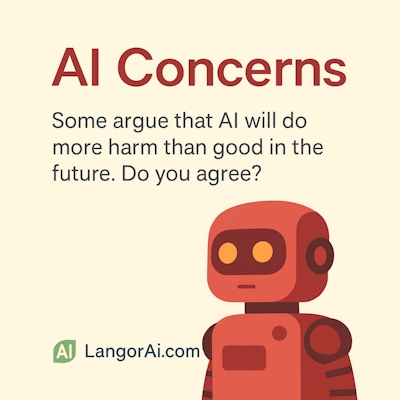
IELTS Academic Writing Task 2 – Artificial Intelligence
To what extent do you agree or disagree?
Model Essay (Band 8–8.5)
Artificial intelligence is rapidly transforming nearly every aspect of modern life, ranging from healthcare and education to transportation and communication. While some people argue that AI will cause more harm than benefit in the long run, I strongly disagree and believe that its overall impact will be overwhelmingly positive if managed responsibly.
On the one hand, concerns about artificial intelligence are not entirely unfounded. Many workers fear job displacement as automation replaces repetitive manual and cognitive tasks. In addition, ethical issues such as data privacy, algorithmic bias, and the misuse of surveillance technologies pose serious risks. If left unchecked, these developments could widen social inequality and undermine public trust in technology.
On the other hand, the benefits of artificial intelligence far outweigh its potential drawbacks. AI has already revolutionized medical diagnosis, allowing diseases to be detected earlier and treated more accurately. In education, intelligent learning systems personalize instruction and help students progress at their own pace. Moreover, AI-driven systems improve energy efficiency, traffic management, and disaster prediction, all of which significantly enhance quality of life.
In my view, the real issue is not whether artificial intelligence is harmful or beneficial, but how it is governed and implemented. Through strict ethical regulations, transparent algorithms, and continuous human oversight, it is entirely possible to maximize its advantages while minimizing its dangers.
In conclusion, although artificial intelligence presents legitimate challenges, I firmly believe that its long-term benefits will surpass its risks. With responsible development and global cooperation, AI has the potential to become one of humanity’s greatest assets rather than its greatest threat.
Analytical Review – Strengths, Weaknesses & Improvements
- Clear balanced argument and strong opinion consistency.
- Advanced academic vocabulary such as “job displacement,” “algorithmic bias,” “ethical regulations,” “global cooperation”.
- Excellent paragraph structure: claim → explanation → example.
- High-level cohesion using transitions like “On the one hand,” “On the other hand,” “In my view”.
- Could include one concrete numerical or country-based example.
- One sentence in paragraph three is long and could be slightly tighter.
- Add one real-world case (e.g., AI in cancer detection or autonomous vehicles).
- Compress compound sentences to enhance clarity under exam pressure.
- job displacement
- ethical regulations
- algorithmic bias
- human oversight
- quality of life
- long-term consequences
- Insert one data-based micro example (even hypothetical).
- Use slightly more complex conditional structures.
- Add one contrasting academic counter-argument with refutation.