
IELTS Academic Writing Task 1 – Sample Test 47 (Line + Bar Chart)
Task Question
The chart below illustrates the average monthly rainfall (in millimeters) and the average monthly temperature (in degrees Celsius) in a particular city over the course of one year. Summarize the information by selecting and reporting the main features, and make comparisons where relevant.
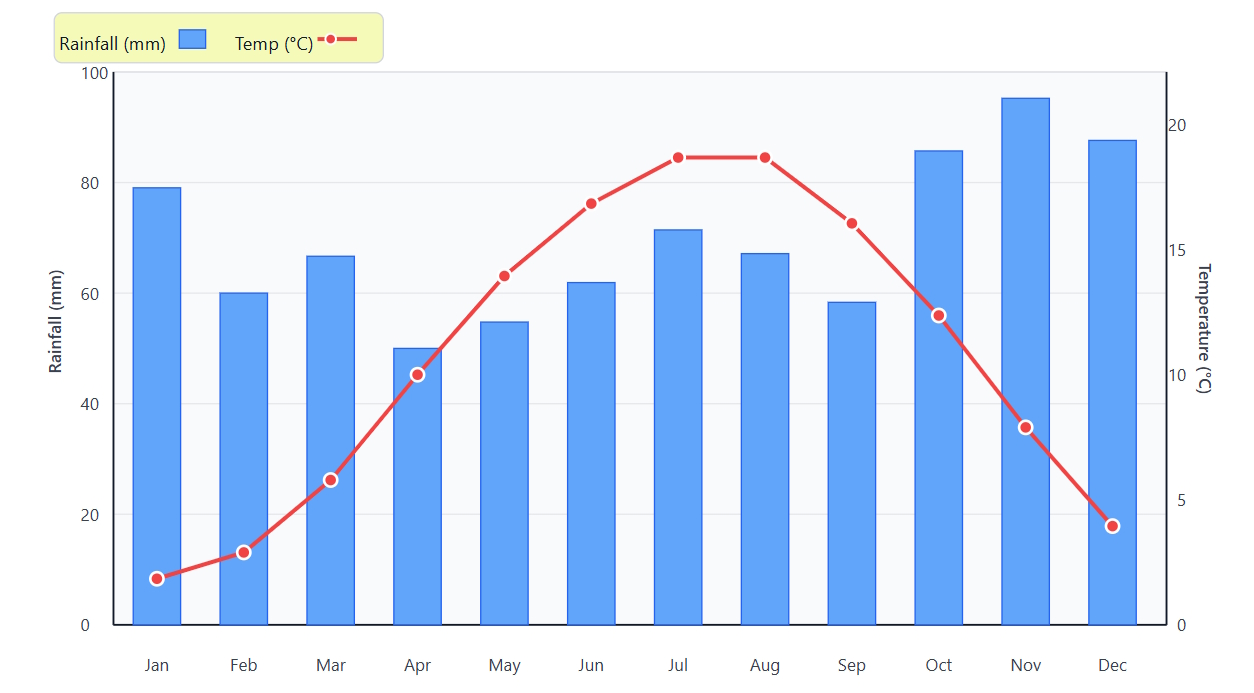
Figure: Average monthly rainfall (bar) and temperature (line) — LangorAi.com
Sample Answer (Band 8.5–9.0)
The combination chart presents data on average monthly rainfall and average monthly temperature in a specific city throughout a one-year period. Overall, rainfall demonstrates significant fluctuations, whereas temperature follows a more predictable seasonal pattern: rising steadily towards summer and falling again in the colder months.
Rainfall is relatively high at the beginning and end of the year. January records approximately 78 mm, followed by a decrease to around 55–62 mm between February and March. The lowest levels occur from April to September, with April receiving just below 50 mm. Although rainfall rises slightly in June and July (to about 60–70 mm), it remains moderate until September. A sharp increase begins in October, peaking in November at nearly 95 mm, before falling slightly to around 88 mm in December.
In contrast, temperature exhibits a smooth upward trend, starting from roughly 3°C in January and increasing to a peak of approximately 20°C in both July and August. It subsequently declines, returning to around 4°C by December. The inverse relationship between the two variables is notable: periods of higher temperature correspond to moderate rainfall, while heavier precipitation occurs during cooler seasons.
In summary, the climate pattern shown suggests a region with mild summers and wet autumn–winter conditions, which is characteristic of many temperate coastal environments.
Word count: 191 words
Analytical Review – IELTS Academic Writing Task 1 (Test 47, Line + Bar Chart)
Overall Verdict
Indicative Band: 8.5 – 9.0
- Task Achievement: The essay clearly highlights the overall climate pattern (mild summers, wet autumn–winter), and selects representative data precisely.
- Coherence & Cohesion: Well-organized paragraphing: Overview → Early-year → Mid-year → End-of-year contrast.
- Lexical Resource: Strong topic-specific vocabulary such as "inverse relationship," "precipitation levels," "seasonal pattern," and "moderate rise."
- Grammar: Uses advanced comparative clauses, variation in sentence length, and consistent control of tense and aspect.
Key Weaknesses
- Lack of causal interpretation: The essay describes the pattern but does not hypothesize why rainfall peaks during cooler months.
- Repetition of structural phrases: Sentences describing seasonal changes could vary more in rhythm and connectors.
- Limited quantitative comparison: Some rainfall and temperature figures could be related to one another directly (e.g., “when rainfall peaks, temperature is at its lowest”).
Actionable Improvements (High-Impact)
- Add interpretive reasoning: Explain the climatic logic, e.g., “Cooler air masses in late autumn bring heavier moisture condensation.”
- Sharpen contrasts: Use direct relational language: “As rainfall increased sharply, temperature fell correspondingly.”
- Highlight pace of change: Use terms such as “gradual climb,” “abrupt decline,” and “sharp upturn.”
- Include proportional comparisons: E.g., “November’s rainfall is nearly twice that of April.”
- End with an interpretive insight: Conclude with what the climate pattern implies about the region (coastal, temperate, monsoon-influenced, etc.).
Stronger Synonyms (Topic-Fit)
- rainfall → precipitation rain volume
- temperature → thermal level ambient heat
- increase → climb intensify
- decrease → decline drop off
- high → pronounced elevated
- low → modest subdued
Linking Devices (Cohesion Boost)
- Contrast: whereas, in contrast, conversely
- Trend Shifts: gradually, sharply, progressively
- Time Markers: initially, mid-year, toward the end of the period
- Interpretive: this indicates that, this suggests, this reflects
High-Value Collocations (Band 8+)
- inverse climate relationship
- seasonal precipitation cycle
- moderate upward temperature trajectory
- pronounced late-autumn rainfall surge
- climatic oscillation pattern
Band-9 Rewrite Upgrades
-
Original: “A sharp increase is observed in October.”
Upgrade: “Rainfall surges abruptly in October, marking the onset of a distinctly wetter seasonal phase.” -
Original: “Temperature starts to fall after August.”
Upgrade: “Following its midsummer peak, the temperature declines progressively as cooler air masses settle in.” -
Original: “Rainfall is highest in November.”
Upgrade: “November registers the most pronounced precipitation volume of the year.”
Band Justification & How to Reach 9.0
The essay is already strong and near Band 9 due to clarity, precision, and structural balance. What prevents a perfect score is the lack of deeper climatic explanation. Band 9 answers do not only describe what changes, but clarify why the pattern occurs and what it implies. Adding concise causal reasoning will consistently lift the writing into the upper 9 range.
تحلیل دوزبانه – (Test 47: Line + Bar Chart)
ارزیابی کلی
نمره تقریبی: 8.5 تا 9.0
- توصیف روند کلی اقلیم (تابستانهای ملایم، پاییز و زمستانهای پرباران) بهدرستی و بدون اغراق انجام شده است.
- گزارشدهی دادهها از اوایل سال به اواخر سال ساختار منطقی و روان دارد.
- واژگان تخصصیِ مرتبط با آبوهوا و روندها بهصورت دقیق و بدون تکرار استفاده شدهاند.
- کنترل گرامر و تنوع ساختارهای مقایسهای قوی و بدون خطا است.
Overall Verdict
Indicative Band: 8.5 – 9.0
- Task Achievement: Accurate trend coverage with precise data highlights.
- Coherence & Cohesion: Logical sequencing (early → mid-year → late-year).
- Lexical Resource: Strong use of topic-specific climate vocabulary.
- Grammar: Advanced comparative and descriptive clauses with stable accuracy.
نقاط ضعف
- عدم اشاره به دلیل علمی افزایش بارش در ماههای سرد.
- برخی جملات انتقالی در بخشهای توصیفی مشابهاند.
- مقایسهها میتوانستند نسبتها را دقیقتر بیان کنند («دو برابر»، «تقریباً نصف» و ...).
- ریتم چند جمله پشتسرهم مشابه است و میتواند متنوعتر شود.
Key Weaknesses
- Lack of concise causal climate reasoning.
- Some transitions repeat similar phrasing.
- Comparisons could emphasize ratios more clearly.
- Sentence rhythm slightly uniform in parts.
پیشنهادهای بهبود
- افزودن توضیح کوتاه درباره چرایی تغییر الگوهای بارش با دما.
- استفاده از مقایسههای نسبتی («تقریباً دو برابرِ»، «نصفِ»).
- تنوعدهی به الگوهای جمله برای جلوگیری از یکنواختی.
- تأکید روی ارتباط بین قله بارش و افت دما.
Actionable Improvements
- Add brief climatic reasoning for rainfall-temperature contrast.
- Strengthen ratio-based comparisons (e.g., “nearly twice as high”).
- Vary sentence rhythm (long–short–long patterning).
- Explicitly link rainfall peaks with temperature decline.
مترادفهای قوی
- بارش → بارندگی / میزان بارش / بارش سالیانه
- دمـا → حرارت / گرمای محیط
- افزایش → روند افزایشی / صعودی
- کاهش → افت / نزول تدریجی
Stronger Synonyms
- rainfall → precipitation / rain volume
- temperature → ambient heat / thermal level
- increase → climb / intensify
- decrease → drop off / decline
حروف ربط پیشنهادی
- تضاد: در حالی که / اما / از سوی دیگر
- تغییر روند: بهتدریج / ناگهانی / پیوسته
- توضیح: یعنی / درواقع / به عبارتی
Linking Devices
- Contrast: whereas, however, in contrast
- Trend Shift: gradually, progressively, sharply
- Clarification: in other words, this indicates
چطور نمره را به 9 برسانیم؟
برای رسیدن به 9 لازم است علاوه بر توصیف، چرایی رخداد این الگوهای اقلیمی توضیح داده شود.
How to Reach Band 9
Band 9 answers explain why patterns occur, not only what changed.