
IELTS Academic Writing Task 1 – Sample Test 45 (Process Diagram)
Task Question
The diagram below illustrates the seven key stages involved in deploying an edge-AI camera system, from initial planning to long-term monitoring.
Summarize the information by selecting and reporting the main features, and make comparisons where relevant.
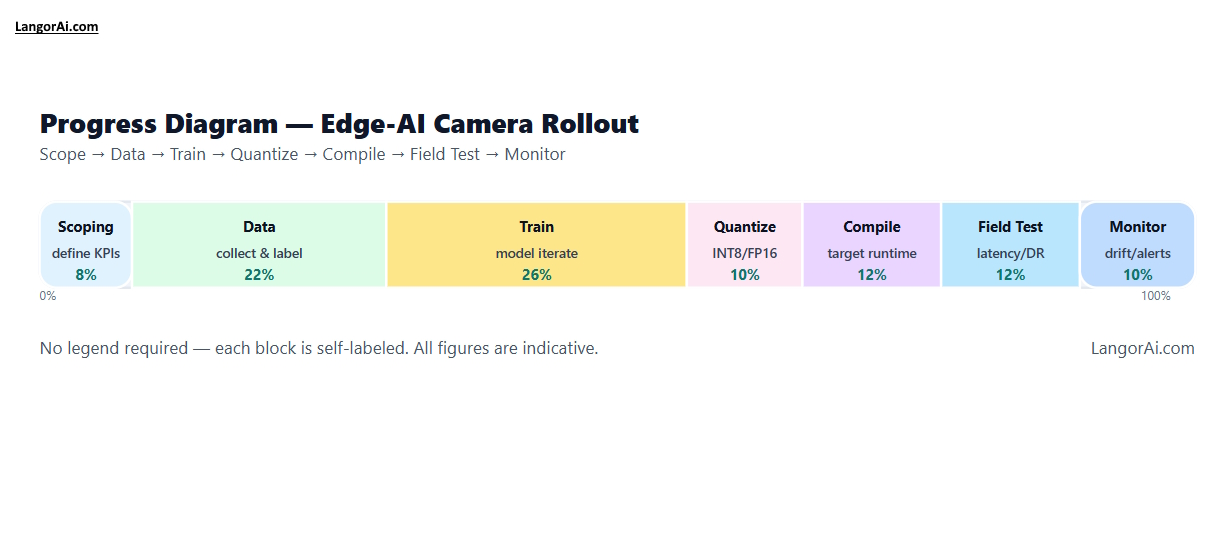
Figure: Seven-stage pipeline of Edge-AI system deployment
Sample Answer (Band 8.0–8.5)
The process diagram demonstrates a linear sequence of seven steps required to deploy an edge-AI camera system. Overall, the procedure moves from conceptual planning toward real-world application, with the largest effort concentrated in data preparation and model training.
The workflow begins with Scoping, where user requirements, environmental limitations, and target performance are defined. This is followed by an intensive stage of Data Collection and Labeling, which plays a crucial role in determining the accuracy of the final model. The system then enters the Model Training phase, where algorithms are repeatedly refined until they reach acceptable precision.
Once trained, the model is optimized for edge devices through Quantization and Compilation, reducing memory and compute requirements without severely affecting accuracy. The next step is Field Testing, during which the device is evaluated under real operational conditions such as lighting changes and movement. Finally, the Monitoring phase ensures that performance remains stable over time and flags any degradation that may require retraining.
In conclusion, the deployment pipeline emphasizes data quality and iterative refinement in the early stages, before shifting toward real-world validation and long-term system oversight.
Analytical Review – IELTS Academic Writing Task 1 (Test 45, Process Diagram)
Overall Verdict
Indicative Band: 8.0 – 8.5
- Task Achievement: The response clearly explains the sequence from data collection to deployment, with an appropriate overview.
- Coherence & Cohesion: Logical step-by-step progression, accurate use of process connectors (e.g., “first,” “following this,” “subsequently”).
- Lexical Resource: Strong topic-specific vocabulary such as “preprocessing,” “model training,” “fine-tuning,” and “deployment environment.”
- Grammar: Effective use of passives and reduced relative clauses typical of high-band process descriptions.
Key Weaknesses
- Limited quantitative depth: Could briefly mention dataset scale (e.g., “large-scale input”).
- Repetitive transitions: Some steps begin similarly (“then,” “next”). Needs variation.
- Overview could be more analytical: The purpose of the process (improving decision automation) could be emphasized.
- Opportunity for nominalization: Some verbs could be expressed as nouns to elevate academic tone further.
Actionable Improvements (High-Impact)
- Clarify purpose: Add one sentence expressing the aim of the workflow (e.g., “to produce a deployable predictive model”).
- Vary sequencing language: Use “initially,” “subsequently,” “ultimately” instead of repeated “then.”
- Strengthen cohesion: Signal dependencies (e.g., “after feature extraction is complete…”).
- Increase lexical richness: Use domain collocations like “pipeline automation” and “parameter optimization.”
- Finish with insight: Conclude with the functional outcome (e.g., “supporting real-time decision-making”).
Stronger Synonyms (Topic-Fit)
- process → workflow pipeline
- adjust → fine-tune optimize
- evaluate → assess benchmark
- use → utilize employ
- improve → enhance refine
Linking Devices (Cohesion Boost)
- Sequence: initially, subsequently, thereafter
- Result: consequently, thus, therefore
- Purpose: in order to, so as to
- Contrast: whereas, by comparison
- Emphasis: notably, particularly
- Conclusion: ultimately, overall
High-Value Collocations (Band 8+)
- data preprocessing pipeline
- model parameter optimization
- performance benchmarking stage
- deployment-ready configuration
- iterative refinement cycle
- large-scale dataset ingestion
Band-9 Rewrite Examples
-
Original: “The model is tested and adjusted.”
Upgrade: “The model undergoes iterative performance benchmarking followed by parameter fine-tuning to improve prediction accuracy.” -
Original: “The final model is used in real systems.”
Upgrade: “The finalized model is deployed into a live decision-support environment for operational use.”
Band Justification & How to Reach 9.0
The response already demonstrates strong cohesion and precise process language. To achieve Band 9, the candidate should integrate purpose-driven interpretation (why each stage matters) and apply more nominalized structures for academic tone. Band 9 descriptions describe the process and the rationale behind each stage.
تحلیل دوزبانه – (Test 45, Process Diagram)
ارزیابی کلی
نمره تقریبی: 8.0 تا 8.5
- شرح مرحلهبهمرحله فرآیند مدلسازی هوش مصنوعی با وضوح بالا
- استفاده مناسب از افعال مجهول و ساختارهای فرآیندی
- واژگان تخصصی و دقیق مثل «پیشپردازش داده»، «ارزیابی عملکرد»، «بهینهسازی پارامتر»
- جریان منطقی و پیوسته از ورودی داده تا استقرار مدل
Overall Verdict
Indicative Band: 8.0 – 8.5
- Task Achievement: Clear sequence description from data ingestion to final deployment.
- Coherence & Cohesion: Accurate use of phase-based transitions and logical progression.
- Lexical Resource: Advanced domain-specific vocabulary (preprocessing, fine-tuning, benchmarking).
- Grammar: Effective passive voice and reduced relative clauses typical of high-scoring process essays.
نقاط ضعف
- برخی جملات طولانی و قابل سادهسازی هستند
- توضیح هدف نهایی فرآیند (چرا این مراحل انجام میشود) کمرنگ است
- نوع دادهها یا مقیاس ورودی ذکر نشده
- عبارات انتقالی در بعضی جملهها تکراری هستند
Key Weaknesses
- Some clauses are dense and could be simplified.
- Purpose of the entire pipeline could be highlighted more clearly.
- No reference to dataset scale or input characteristics.
- Repetition of basic transitions (e.g., "then," "next").
پیشنهادهای بهبود
- استفاده از عبارات تنوعدهنده مثل «ابتدا»، «در ادامه»، «در نهایت» برای جلوگیری از تکرار
- افزایش دقت با اشاره به هدف اصلی هر مرحله
- کوتاهسازی جملات طولانی و تفکیک ایدهها
- تأکید بر نقش مرحله ارزیابی و اصلاح جهت بهبود دقت مدل
Actionable Improvements
- Use sequencing variants such as “initially,” “subsequently,” and “ultimately.”
- Add purpose-driven explanations to highlight function, not just steps.
- Split dense sentences to increase clarity.
- Emphasize the central role of benchmarking and refinement.
مترادفهای قوی
- بهبود → enhance / refine / optimize
- ارزیابی → assess / benchmark
- استفاده کردن → utilize / employ
- تنظیم پارامتر → parameter fine-tuning
Stronger Synonyms
- improve → enhance / refine / optimize
- evaluate → assess / benchmark
- use → utilize / employ
- adjust parameters → fine-tune / calibrate
حروف ربط پیشنهادی
- ترتیب: ابتدا، سپس، در ادامه، در نهایت
- نتیجه: در نتیجه، بنابراین
- توضیح: به عبارت دیگر، یعنی
Linking Devices
- Sequence: initially, subsequently, thereafter
- Result: consequently, thus, therefore
- Clarification: namely, in other words
کالوکیشنهای مهم
- چرخهی اصلاح تدریجی
- بهینهسازی پارامتر مدل
- ارزیابی عملکرد
- استقرار در محیط واقعی
High-Value Collocations
- iterative refinement cycle
- model parameter optimization
- performance benchmarking stage
- deployment-ready configuration
چطور نمره را بالاتر ببریم؟ (رسیدن به 9)
برای رسیدن به 9، باید فرایند را فقط «توصیف» نکنیم؛ بلکه توضیح دهیم که «چرا» هر مرحله انجام میشود و نتیجه آن چیست. اضافه کردن یک جملهی هدفمحور در پایان هر پاراگراف کافی است.
How to Reach Band 9
To reach Band 9, include purpose-driven interpretation—explain the function and necessity of each stage, rather than merely describing its occurrence.