
IELTS Academic Writing Task 1 – Test 40 (Line Chart)
Task Question
The line chart below illustrates the proportion of people in Japan, the USA, and Australia who used renewable energy sources between 2000 and 2025.
Summarize the information by selecting and reporting the main features, and make comparisons where relevant.
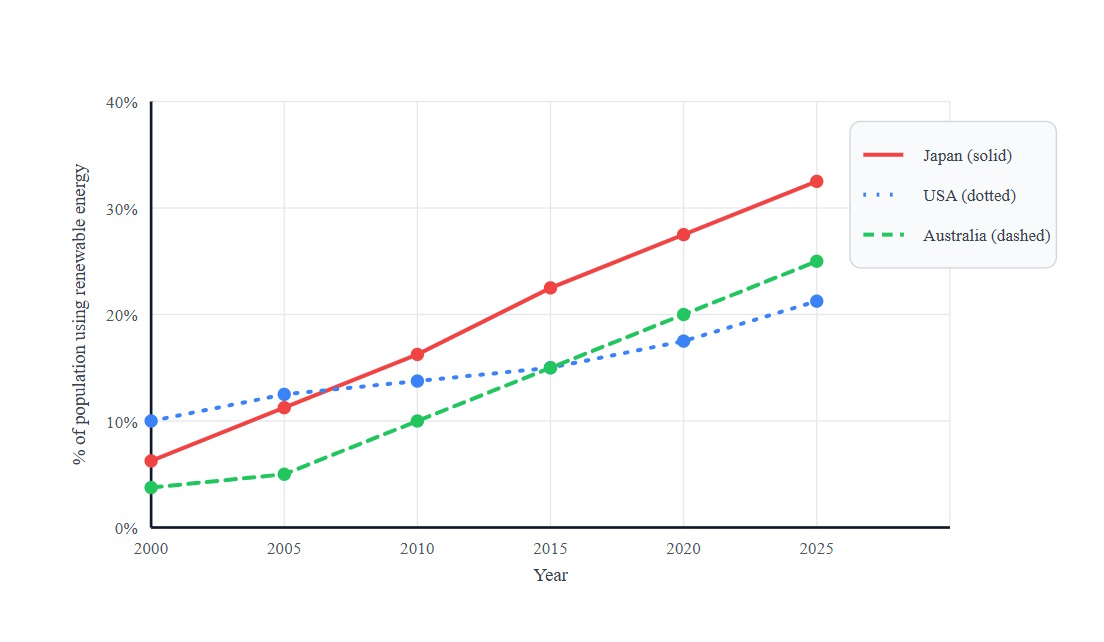
Figure: Percentage of population using renewable energy (2000–2025)
Sample Answer (Band 8–8.5)
The line chart compares the percentage of the population in Japan, the USA, and Australia that relied on renewable energy between 2000 and 2025. Overall, all three nations saw an upward trend in renewable energy usage, with Japan showing the steepest rise and Australia remaining consistently lower than the others.
In 2000, roughly 15% of Americans used renewable sources, compared with around 10% in Japan and just 5% in Australia. Over the next decade, Japan’s figure rose sharply to about 25%, overtaking the USA, which increased more gradually to 20%. In contrast, Australia’s use of renewables climbed only slightly, reaching approximately 12% by 2010.
Between 2010 and 2025, Japan continued to expand its reliance on sustainable energy, doubling to nearly 40% by the end of the period. The USA also grew steadily, though at a slower pace, finishing just above 25%. Meanwhile, Australia recorded moderate improvement, reaching around one-fifth of its population using green energy. Despite positive trends in all three countries, Japan’s progress was the most remarkable and consistent.
Word count: 172 words
Analytical Review – IELTS Academic Writing Task 1 (Test 40)
Overall Verdict
Indicative Band: 8.0–8.5
- Task Achievement: Provides a comprehensive overview and covers all three countries with clear trend descriptions and relevant numerical details.
- Coherence & Cohesion: Logical flow from introduction to conclusion; paragraphing and linkers effectively guide the reader.
- Lexical Resource: Excellent use of topic-specific vocabulary such as “renewable resources,” “sustainable energy,” and “upward trend.”
- Grammar: Accurate complex structures, strong control of tenses and comparatives.
Key Weaknesses
- Numerical Precision: Could include more exact percentage changes (e.g., “increased by 15 percentage points”).
- Sentence Density: Some sentences are slightly long; shorter phrasing would improve readability.
- Analytical Depth: Lacks brief interpretation of why Japan led the growth (e.g., government incentives, technology).
- Comparative Sharpness: The contrast between Japan and Australia could be highlighted more vividly.
Actionable Improvements (High-Impact)
- Add quantification: Specify precise gaps (“Japan’s rate rose by 15pp more than the USA”).
- Interpret briefly: Mention possible reasons (e.g., “reflecting stronger environmental policies”).
- Vary sentence rhythm: Alternate between concise and extended sentences for balance.
- Strengthen comparisons: Use stronger contrast phrases such as “far ahead of” or “lagged considerably behind.”
- Conclude analytically: End with implications (e.g., “indicating a shift toward sustainability”).
Stronger Synonyms (Topic-Fit)
- increase → rise grow climb surge
- steady → consistent gradual sustained
- use → adoption utilisation dependence on
- renewable energy → clean energy green power sustainable resource
- difference → gap contrast disparity
Linking Devices (Cohesion)
- Contrast: whereas, while, by comparison, in contrast
- Addition: moreover, in addition, likewise
- Result: therefore, consequently, as a result
- Emphasis: notably, strikingly, particularly
- Quantification: nearly doubled, significantly higher, marginally lower
- Summary: overall, in general, to sum up
High-Value Collocations (Energy & Environment)
- renewable energy adoption
- sustainable development goals
- clean power transition
- government energy incentives
- environmental awareness growth
- carbon emission reduction
- energy consumption pattern
- cross-country comparison
Rewrite Upgrades (Band-9 Polish)
-
Original: “Japan continued to expand its reliance on sustainable energy.”
Upgrade: “Japan consistently accelerated its shift toward sustainable energy, reaching nearly 40% by 2025.” -
Original: “Australia recorded moderate improvement.”
Upgrade: “Australia’s growth remained relatively modest, trailing the other nations throughout the period.” -
Original: “All three nations saw an upward trend.”
Upgrade: “Each country experienced a sustained upward trajectory in renewable energy adoption.”
Model Sentences (Precision & Comparison)
- “Japan’s reliance on renewables almost doubled between 2010 and 2025.”
- “By 2025, the proportion of renewable users in Australia remained half that of Japan.”
- “The USA maintained a steady yet moderate increase across the observed period.”
Grammar Targets
- Comparatives: “X was considerably higher than Y.”
- Passives: “Renewable sources were adopted more widely.”
- Nominalisation: “A rapid expansion was observed in Japan’s usage.”
- Adverbials: “significantly, moderately, steadily.”
Quick Checklist (Before Submit)
- Overview identifies the dominant and minor trends clearly.
- Comparisons are precise and data-driven.
- Vocabulary range is broad and topic-specific.
- Sentence variety: balance of simple and complex structures.
- Logical conclusion summarises the data trend analytically.
Band Justification & Path to 9.0
This essay demonstrates excellent control over structure, grammar, and vocabulary, consistent with Band 8.5 writing. To reach Band 9, the candidate should integrate short interpretive insights explaining causes of the observed trends (e.g., policy shifts, technology adoption), enhance precision with quantified comparisons, and use more variety in sentence rhythm to create smoother readability. Band 9 performance combines flawless accuracy with nuanced analysis of implications behind numerical trends.
تحلیل دوزبانه – IELTS Academic Writing Task 1 (Test 40)
ارزیابی کلی
نمره تقریبی: 8 تا 8.5
- پوشش کامل روند سه کشور با اشاره به دادههای عددی و مقایسههای دقیق
- انسجام بالا و پیوستگی منطقی در توصیف و جمعبندی
- واژگان آکادمیک مناسب موضوع انرژی مثل «renewable resources»، «sustainable energy»، «upward trend»
- گرامر دقیق و متنوع: جملات مرکب، مقایسهای و زمانهای درست
Overall Verdict
Indicative Band: 8.0–8.5
- Task Achievement: Fully covers all three countries with clear trends and relevant figures.
- Coherence & Cohesion: Logical progression; smooth flow between paragraphs.
- Lexical Resource: Excellent topic-specific vocabulary (“renewable resources,” “sustainable energy,” “upward trend”).
- Grammar: Accurate complex structures, consistent tense control, and comparative clarity.
نقاط ضعف
- عدم ذکر دقیق میزان تغییرات عددی (مثل افزایش بر حسب درصد)
- چند جمله طولانی که میتوان کوتاهتر نوشت
- تحلیل محدود در مورد علت رشد ژاپن نسبت به سایر کشورها
- کنتراست میان کشورها میتوانست قویتر و توصیفیتر باشد
Key Weaknesses
- Numerical Precision: Lacks explicit quantified changes.
- Sentence Length: Some long sentences could be simplified.
- Analytical Depth: No brief reasoning for Japan’s rapid rise.
- Comparative Sharpness: The contrast between Japan and Australia could be more vivid.
پیشنهادهای بهبود
- استفاده از دادههای کمی مشخص (مثل “افزایش ۱۵ درصدی”)
- افزودن تحلیل کوتاه دربارهٔ علت رشد بیشتر ژاپن
- ترکیب جملههای بلند و کوتاه برای ریتم بهتر
- بهکارگیری عبارات مقایسهای قویتر (مثل “far ahead of”)
- جمعبندی تحلیلیتر در پایان با اشاره به نتایج و پیامدها
Actionable Improvements
- Add quantified contrasts: e.g., “Japan’s rate rose by 15pp more than the USA.”
- Brief reasoning: Include causes such as “reflecting government incentives.”
- Vary sentence rhythm: Mix concise and extended sentences.
- Stronger comparisons: Use expressions like “lagged behind,” “far exceeded.”
- Analytical conclusion: End by linking data trends to sustainability goals.
مترادفهای قوی
- افزایش → rise, grow, climb, surge
- پایدار → consistent, steady, sustained
- استفاده → adoption, utilisation, reliance
- انرژی تجدیدپذیر → renewable energy, green power, sustainable resource
- تفاوت → gap, contrast, disparity
Stronger Synonyms
- increase → rise grow surge
- steady → consistent gradual
- use → adoption utilisation
- renewable → green energy clean power
- difference → gap contrast
حروف ربط
- تضاد: whereas, in contrast, while
- افزودن: moreover, in addition, likewise
- نتیجه: therefore, consequently, as a result
- تأکید: notably, strikingly, particularly
- زمان: over the period, by 2025, subsequently
Linking Devices
- Contrast: whereas, while, in comparison
- Addition: moreover, likewise, similarly
- Result: consequently, as a result
- Time: over the period, by 2025, subsequently
- Emphasis: notably, strikingly, particularly
- Quant cues: nearly doubled, marginally lower, significantly higher
کالوکیشنهای کلیدی
- رشد مصرف انرژی پاک → renewable energy adoption
- گذار به انرژی سبز → clean power transition
- سیاستهای زیستمحیطی → environmental policy shift
- کاهش انتشار کربن → carbon emission reduction
- الگوی مصرف انرژی → energy consumption pattern
High-Value Collocations
- renewable energy adoption
- clean power transition
- environmental awareness growth
- carbon emission reduction
- energy consumption pattern
توجیه نمره و مسیر ارتقا تا Band 9
این رایتینگ از نظر دقت، انسجام و واژگان در سطح 8.5 است. برای رسیدن به Band 9 باید علاوه بر توصیف دادهها، تحلیل کوتاهی از دلایل و پیامدهای روندها اضافه شود (مثل سیاستهای دولتی یا پیشرفت فناوری در ژاپن). همچنین، افزودن مقایسههای کمی و تنوع بیشتر در ساختار جملهها باعث روانتر شدن متن میشود.
Band Justification & Path to 9.0
The essay meets Band 8.5 standards for accuracy, structure, and lexical range. To reach Band 9, integrate brief interpretive reasoning for the data (e.g., policy shifts, technology), increase numerical precision, and vary sentence rhythm for natural readability. Band 9 writing blends analytical depth with flawless control and stylistic maturity.