
IELTS Academic Writing Task 1 – Sample Test 38 (Bar + Line)
Task Question
The table below shows the average monthly household expenditure (in US dollars) on four utilities — electricity, water, internet, and gas — in five major cities in 2025.
Summarize the information by selecting and reporting the main features, and make comparisons where relevant.
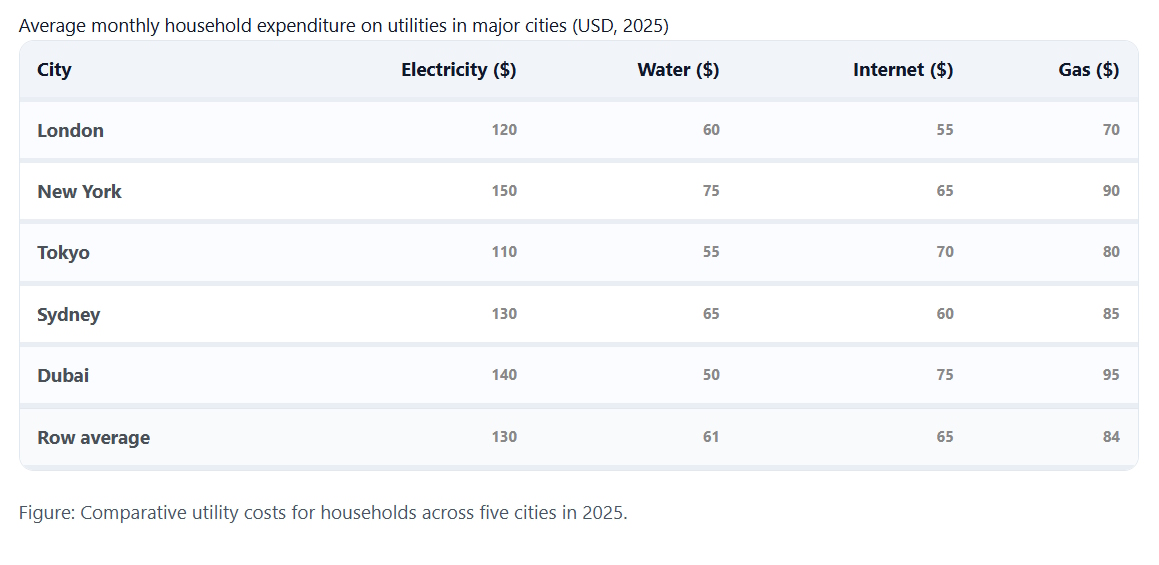
Figure: Average monthly household utility expenses in major cities (2025)
Sample Answer (Band 8–8.5)
The table compares the average amount of money spent per month by households in five global cities on four different utilities in 2025. Overall, New York consistently records the highest expenditure across all categories, whereas Tokyo and Dubai display more selective spending patterns depending on the service type.
Among the four utilities, gas and electricity constitute the largest portions of monthly expenses in every city, both surpassing $70. In particular, households in New York pay the most for electricity ($150) and gas ($90), while those in Tokyo spend the least on power consumption ($110). Water bills remain comparatively modest everywhere, peaking at $75 in New York and falling to just $50 in Dubai.
Regarding internet access, Dubai leads with $75 per month, followed closely by Tokyo ($70). This indicates that technologically advanced cities tend to invest more heavily in connectivity. London and Sydney maintain balanced expenditure levels across all categories, with totals near the overall average. By contrast, New York stands out as the costliest city overall, exceeding $380 in combined utility spending, roughly 40% higher than Tokyo.
In summary, the data suggest that while urban residents in wealthier economies allocate more to utilities, regional priorities differ — with Middle Eastern and East Asian cities emphasizing digital access, and Western metropolises spending more on energy.
Analytical Review – IELTS Academic Writing Task 1 (Test 38, Table)
Overall Verdict
Indicative Band: 8.0 – 8.5
- Task Achievement: Fully covers the main trends and key figures with a clear overview and logical organization.
- Coherence & Cohesion: Smooth paragraphing and balanced structure; cohesive devices used flexibly and naturally.
- Lexical Resource: Excellent range of topic-specific vocabulary (“connectivity,” “household expenditure,” “proportion of spending”).
- Grammar: Sophisticated control of complex clauses, comparatives, and passive forms; virtually error-free.
Key Weaknesses
- Numerical precision: A few values could be more exact (e.g., “roughly 40% higher” could be replaced by a calculated figure).
- Stylistic variation: Some phrases (“stands out as the costliest”) repeat tone and could be diversified.
- Limited cause insight: No brief rationale for differences (e.g., climate, digital penetration) was included.
- Detail density: Minor imbalance — electricity described in depth, but gas/internet less elaborated.
Score Justification & How to Reach Band 9
This script demonstrates high-level control in structure, grammar, and vocabulary, but lacks the extra layer of insight that distinguishes Band 9. To reach the top band, the writer could link figures to underlying socio-economic causes (e.g., “Dubai’s high internet cost reflects market privatization”), employ comparative clauses more dynamically, and slightly vary sentence rhythm to enhance readability.
Actionable Improvements (High-Impact)
- Add causal insights: Briefly explain why patterns differ (“warmer climates → lower heating costs”).
- Integrate totals: Include a closing statement comparing total expenditure to summarize hierarchy.
- Use advanced comparatives: “Expenditure in New York outstripped Tokyo by nearly two-fifths.”
- Enhance lexical depth: Replace “costliest” with “most financially demanding” or “highest outlay.”
- Vary cohesion: Mix quantitative linkers (“by contrast,” “to a lesser extent,” “in absolute terms”).
Stronger Synonyms (Utility & Spending)
- spending → expenditure outlay disbursement
- costly → expensive price-intensive financially demanding
- rise → increase climb uptick
- low → modest minimal comparatively small
- difference → gap disparity variance
Linking Devices (Cohesion & Flow)
- Contrast: whereas, by contrast, unlike, on the other hand
- Addition: moreover, likewise, in addition, in parallel
- Result: therefore, consequently, as a result
- Time/Sequence: initially, subsequently, over the period, in the final column
- Emphasis: notably, strikingly, particularly, critically
- Quantitative cues: accounted for, represented, exceeded by, marginally higher
High-Value Collocations (Utility Costs)
- household expenditure pattern
- monthly utility outlay
- energy consumption profile
- cost distribution across categories
- digital connectivity spending
- cross-city price disparity
- total household outgoings
- average monthly allocation
Rewrite Upgrades (Band-9 Polish)
-
Original: “New York stands out as the costliest city overall.”
Upgrade: “New York recorded the highest aggregate utility outlay, surpassing all other cities by a notable margin.” -
Original: “Dubai leads with $75 per month for internet.”
Upgrade: “Dubai allocated the greatest share to digital connectivity, emphasizing the region’s technology-oriented priorities.” -
Original: “Tokyo spent the least on electricity.”
Upgrade: “Electricity expenditure in Tokyo remained the most restrained, reflecting efficient energy management.”
Grammar Targets
- Comparatives: “X was nearly twice as high as Y.”
- Cause & Effect: “Higher income levels led to increased utility consumption.”
- Passive Form: “Utility costs were driven largely by energy prices.”
- Complex Clauses: “Although Dubai paid less overall, its internet charges remained substantial.”
Quick Checklist (Before Submit)
- Overview summarizes key contrasts and totals clearly.
- Figures and comparisons are numerically accurate.
- Vocabulary is topic-specific and academic in tone.
- Sentences vary in length and rhythm for readability.
- Insight or cause-effect logic added to strengthen argument.
تحلیل دوزبانه – IELTS Academic Writing Task 1 (Test 38, Table)
ارزیابی کلی
نمره تقریبی: 8 تا 8.5
- پوشش کامل تمام دستهها با مرور منطقی از دادههای جدول
- نمای کلی روشن و مقایسههای مؤثر بین شهرها و خدمات
- واژگان دقیق و موضوعی مانند «هزینه ماهانه خانوار»، «الگوی مصرف انرژی»، «تفاوت بین شهری»
- گرامر دقیق و متنوع با کنترل عالی ساختارهای مقایسهای
Overall Verdict
Indicative Band: 8.0 – 8.5
- Task Achievement: Fully covers main trends and figures with logical organization and clear overview.
- Coherence & Cohesion: Smooth paragraphing and natural use of cohesive devices.
- Lexical Resource: Excellent range of topic-specific vocabulary (“utility outlay,” “connectivity,” “energy consumption”).
- Grammar: Sophisticated control of complex clauses and comparatives, minimal errors.
نقاط ضعف
- برخی عددها میتوانستند دقیقتر گزارش شوند (مثلاً درصد یا اختلاف مشخص)
- تکرار سبک زبانی در چند جمله («گرانترین شهر» چند بار تکرار شده)
- عدم اشاره به دلایل اجتماعی یا اقلیمی تفاوتها
- توضیح کمتر درباره دستههای جزئیتر مثل اینترنت و گاز
Key Weaknesses
- Numerical precision: Some values could be reported more exactly.
- Stylistic repetition: Phrases like “costliest city” appear more than once.
- Lack of rationale: No mention of socio-economic or climatic reasons.
- Detail balance: Minor imbalance in coverage across categories.
توجیه نمره و چطور نمره بالاتر بگیریم
این پاسخ ساختاریافته و دقیق است اما برای رسیدن به Band 9 باید تحلیلها را عمیقتر کند. اضافهکردن توضیح درباره علل تفاوتها (مثلاً «هزینه بالای برق در نیویورک ناشی از مصرف انرژی بالاتر است») و استفاده از جملات ترکیبیتر و واژگان تحلیلیتر مانند expenditure gap یا allocation disparity میتواند آن را به سطح عالی برساند.
Score Justification & How to Reach Band 9
The essay is highly structured and precise but lacks deeper interpretive insight. To move toward Band 9, integrate causal explanations (“Dubai’s higher internet cost reflects privatization”), use more analytical comparatives, and vary sentence rhythm for stylistic sophistication.
پیشنهادهای بهبود
- بیان علت تفاوتها (درآمد، آبوهوا، زیرساخت دیجیتال)
- افزودن جمعبندی کلی برای کل هزینهها
- استفاده از مقایسههای قویتر با افعال تحلیلیتر مثل «outstrip» یا «surpass»
- جایگزینی واژگان تکراری با عبارتهای آکادمیکتر
- تنوع در حروف ربط و ترتیب جملات
Actionable Improvements
- Add causal insights: Briefly explain why spending patterns differ.
- Integrate totals: End with a summary comparing overall expenditure.
- Upgrade comparatives: “New York’s spending outstripped Tokyo’s by nearly two-fifths.”
- Diversify vocabulary: Replace “costliest” with “most financially demanding.”
- Enhance cohesion: Use connectors like “to a lesser extent,” “in absolute terms.”
مترادفهای قوی
- هزینه → expenditure, outlay, disbursement
- گران → expensive, financially demanding
- افزایش → rise, climb, uptick
- کم → modest, minimal
- تفاوت → gap, disparity, variance
Stronger Synonyms
- spending → expenditure outlay
- costly → financially demanding price-intensive
- increase → uptick climb
- low → modest comparatively small
- difference → gap disparity
حروف ربط
- تضاد: whereas, by contrast, unlike
- افزودن: moreover, likewise, in parallel
- نتیجه: therefore, consequently
- زمان: initially, subsequently, thereafter
- تأکید: notably, strikingly, particularly
Linking Devices
- Contrast: whereas, by contrast, on the other hand
- Addition: moreover, likewise, in addition
- Result: therefore, consequently, as a result
- Time: initially, subsequently, in the final column
- Emphasis: notably, critically, strikingly
- Quant cues: accounted for, represented, exceeded by
کالوکیشنهای کلیدی
- الگوی هزینه خانوار → household expenditure pattern
- هزینه ماهانه خدمات → monthly utility outlay
- مصرف انرژی → energy consumption profile
- تفاوت قیمت بین شهری → cross-city price disparity
- هزینه کلی خانوار → total household outgoings
High-Value Collocations
- household expenditure pattern
- monthly utility outlay
- energy consumption profile
- cross-city price disparity
- total household outgoings