
IELTS Academic Writing Task 1 – Sample Test 34 (Pie Chart)
Task Question
The pie chart illustrates how IELTS candidates distributed their study time among six major skill areas in 2025. These include Listening, Reading, Writing, Speaking, Vocabulary, and Grammar.
Summarize the information by selecting and reporting the main features, and make comparisons where relevant.
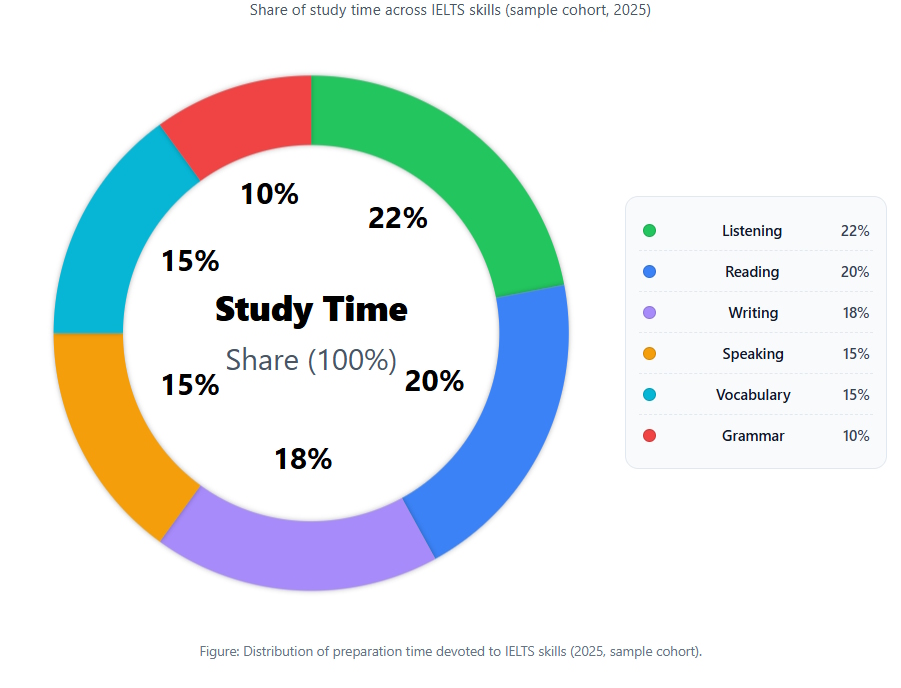
Figure: Distribution of preparation time devoted to IELTS skills (2025, sample cohort).
Sample Answer (Band 8–8.5)
The pie chart provides a breakdown of how IELTS learners allocated their total study time across six skill areas in 2025. Overall, it is clear that receptive skills—Listening and Reading—accounted for the largest proportion of study time, while Grammar received the least attention. The data highlights a preference for task-oriented preparation, emphasizing comprehension and production rather than language structure.
Listening occupied the greatest share, at 22%, followed closely by Reading at 20%. Productive skills such as Writing and Speaking made up a combined 33%, with Writing representing 18% and Speaking 15%. Vocabulary study also accounted for 15%, suggesting that many candidates regarded it as equally essential to communication. By contrast, Grammar was allocated only 10% of total time, implying that most learners considered it a supporting rather than central skill.
In summary, IELTS learners in 2025 appear to have adopted a modern approach that prioritizes real communication and exam performance over traditional rule-based learning. The balance between receptive and productive skills demonstrates an awareness of exam requirements and a shift toward integrated language competence.
Analytical Review – IELTS Academic Writing Task 1 (Test 34, Pie Chart)
Overall Verdict
Indicative Band: 8.0–8.5
- Task Achievement: Fully describes proportions and contrasts among six categories with a clear overview and accurate grouping.
- Coherence & Cohesion: Logical flow from higher to lower segments; effective paragraphing and varied cohesive devices.
- Lexical Resource: Excellent thematic range (“allocation,” “distribution,” “prioritize,” “receptive skills”).
- Grammar: Wide variety of sentence types; balanced use of comparatives and superlatives; consistent accuracy.
Key Weaknesses
- Limited quantification: Percentages are given but without deeper numerical comparison (e.g., total share of productive vs receptive).
- Stylistic density: Some long clauses could be simplified for better readability.
- Interpretive depth: Lacks mention of possible causes for learners’ prioritization choices.
- Range of linkers: Could include more discourse markers for contrast and reasoning.
Actionable Improvements (High-Impact)
- Integrate comparisons: Add phrases like “receptive skills together accounted for over 40%.”
- Enhance interpretation: Briefly comment on why Listening might dominate (exam weight, input exposure).
- Expand cohesion: Use transition markers such as by contrast and in parallel to connect findings.
- Vary sentence rhythm: Alternate between concise data-driven lines and analytical reflections.
- Elevate precision: Replace generic verbs (“show,” “illustrate”) with academic ones (“demonstrate,” “reveal,” “indicate”).
Stronger Synonyms (Topic-Fit)
- proportion → share percentage segment
- compare → contrast differentiate draw distinctions
- increase → rise expand grow
- decrease → decline drop fall
- show → illustrate reveal demonstrate
Linking Devices (Cohesion)
- Addition: moreover, likewise, in addition
- Contrast: whereas, by contrast, unlike, conversely
- Result: therefore, consequently, as a result
- Focus: notably, particularly, especially
- Summary: overall, to conclude, in short
- Quant cues: together accounted for, made up approximately, represented nearly
High-Value Collocations (Education & Skills)
- time allocation pattern
- exam-oriented preparation
- skill-based distribution
- receptive vs productive balance
- language proficiency gap
- strategic prioritization
- learning focus shift
- curriculum emphasis
Band Justification & Path to Band 9
The essay demonstrates excellent structural control, clear comparison, and precise language use—solidly within Band 8–8.5. To reach Band 9, the candidate should integrate more interpretive reasoning (why learners allocate time as they do), employ a broader range of academic connectors, and introduce subtle lexical variations to replace recurring terms. A short meta-commentary linking study strategy to exam performance would add a near-native analytical tone.
Grammar Targets
- Comparatives: “Listening took a larger share than any other skill.”
- Superlatives: “Grammar received the smallest proportion of study time.”
- Nominalization: “The prioritization of receptive skills reflects exam design.”
- Passive use: “More time was devoted to comprehension-based tasks.”
Quick Checklist (Before Submit)
- Overview summarizes main proportions accurately.
- Comparisons made between at least three categories.
- Vocabulary precise and non-repetitive.
- Grammar range broad (comparatives, nominalization, passives).
- Analytical conclusion ties data to insight.
تحلیل دوزبانه – Test 34, Pie Chart
ارزیابی کلی
نمره تقریبی: 8.0 تا 8.5
- پوشش کامل نسبتهای شش مهارت اصلی با توضیح منظم از بیشترین تا کمترین
- ساختار منطقی و انسجام قوی با پیوندهای روان بین جملات
- واژگان آکادمیک مناسب مانند «تخصیص»، «توزیع»، «مهارتهای دریافتی»
- کنترل خوب ساختارهای مقایسهای و مجهول، بدون خطای دستوری
Overall Verdict
Indicative Band: 8.0–8.5
- Task Achievement: Fully describes proportions and contrasts among six categories with a clear overview and accurate grouping.
- Coherence & Cohesion: Logical flow from higher to lower segments; effective paragraphing and varied cohesive devices.
- Lexical Resource: Excellent thematic range (“allocation,” “distribution,” “prioritize,” “receptive skills”).
- Grammar: Wide variety of sentence types; balanced use of comparatives and superlatives; consistent accuracy.
نقاط ضعف
- نبود تحلیل عمیق از دلیل تمرکز بیشتر داوطلبان بر مهارت شنیداری
- برخی جملات طولانی که میتوانند خلاصهتر شوند
- کمبود مقایسهی کمی بین مهارتهای دریافتی و تولیدی
- استفاده محدود از حروف ربط تضاد و نتیجه
Key Weaknesses
- Interpretive depth: Lacks exploration of reasons behind skill prioritization.
- Stylistic density: Some long clauses could be simplified for readability.
- Limited quantification: Missing aggregate comparisons between receptive and productive skills.
- Linker range: Could use more contrasting and causal connectors.
پیشنهادهای بهبود
- اضافه کردن مقایسههای تجمیعی (مثلاً مجموع مهارتهای دریافتی حدود ۴۰٪)
- توضیح علت احتمالی تمرکز بر Listening (اهمیت بیشتر در آزمون یا ورودیهای زیاد)
- بهکارگیری حروف ربط متنوع مانند by contrast و in parallel
- کاهش تراکم نوشتاری با ترکیب جملههای کوتاه و بلند
- جایگزینی افعال عمومی با واژههای تحلیلی مانند reveal، demonstrate، indicate
Actionable Improvements
- Add interpretive reasoning: Briefly explain why Listening dominates time allocation.
- Integrate numerical contrasts: Mention total shares of receptive vs productive skills.
- Expand cohesion: Use connectors such as by contrast, in parallel, consequently.
- Enhance sentence rhythm: Mix analytical and short factual sentences.
- Upgrade lexis: Replace generic verbs (“show”) with analytical ones (“demonstrate,” “reveal”).
مترادفهای قوی
- درصد / سهم → proportion, share, segment
- افزایش → rise, grow, expand
- کاهش → decline, drop, fall
- مقایسه → contrast, differentiate, draw distinctions
- نشان دادن → demonstrate, illustrate, reveal
Stronger Synonyms
- proportion → share percentage segment
- compare → contrast differentiate
- increase → rise expand grow
- decrease → decline drop fall
- show → demonstrate reveal illustrate
حروف ربط و انسجام
- تضاد: whereas, by contrast, unlike
- افزودن: moreover, likewise, in addition
- نتیجه: therefore, consequently, as a result
- تأکید: notably, particularly, especially
- جمعبندی: overall, to conclude, in short
Linking Devices (Cohesion)
- Addition: moreover, likewise, in addition
- Contrast: whereas, by contrast, conversely
- Result: therefore, consequently, as a result
- Emphasis: notably, particularly, especially
- Summary: overall, to conclude, in short
- Quant cues: accounted for, represented, made up approximately
کالوکیشنهای کلیدی
- الگوی تخصیص زمان → time allocation pattern
- آمادگی مبتنی بر آزمون → exam-oriented preparation
- توزیع مبتنی بر مهارت → skill-based distribution
- تعادل مهارتهای دریافتی و تولیدی → receptive vs productive balance
- شکاف مهارت زبانی → language proficiency gap
- اولویتبندی راهبردی → strategic prioritization
- تغییر تمرکز آموزشی → learning focus shift
High-Value Collocations
- time allocation pattern
- exam-oriented preparation
- skill-based distribution
- receptive vs productive balance
- language proficiency gap
- strategic prioritization
- learning focus shift
توجیه نمره و مسیر تا Band 9
این پاسخ از نظر ساختار، واژگان و انسجام در سطح 8 تا 8.5 قرار دارد. برای رسیدن به نمره 9، باید توضیح تفسیری عمیقتر درباره دلایل انتخاب مهارتها اضافه شود، از واژگان متنوعتر و تحلیلیتر استفاده گردد، و با آوردن جملههای تحلیلی کوتاه، میان دادهها و درک انسانی از آزمون ارتباط ایجاد شود.
Band Justification & Path to Band 9
The response achieves Band 8–8.5 through clarity, coherence, and lexical precision. To move toward Band 9, include deeper interpretive commentary on learner motivations, enrich lexical range with analytical phrasing, and end with a concise meta-insight linking data interpretation to exam performance.