
IELTS Academic Writing Task 1 – Sample Test 30

Task Question

The bar chart below shows the percentage of work tasks automated with AI across different departments in a mid-sized company in 2024.

Summarize the information by selecting and reporting the main features, and make comparisons where relevant.
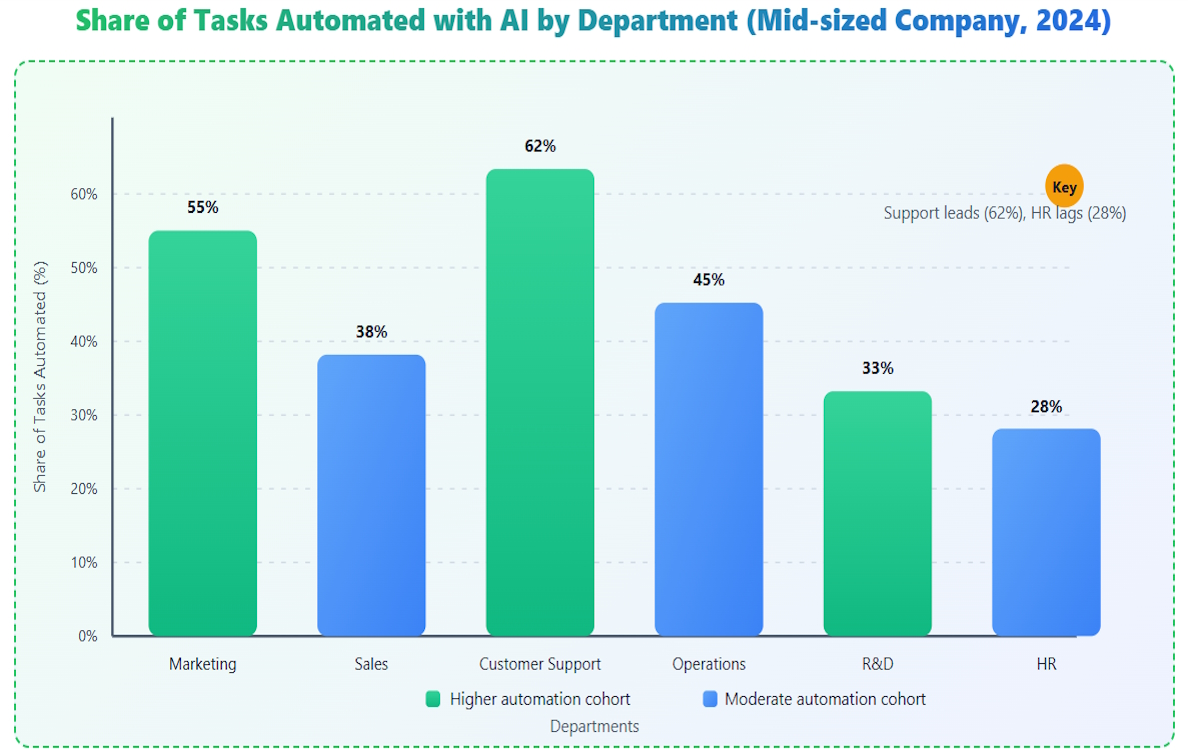
AI Automation by Department – 2024 (Bar Chart)

Figure: Percentage of tasks automated by AI across six departments (2024)

Sample Answer (Band 8–8.5)

The bar chart compares the extent to which artificial intelligence has automated job tasks across six departments in a medium-sized company in 2024.

Overall, Customer Support and Marketing experienced the highest degree of automation, while HR and R&D recorded the lowest levels. A clear distinction can be seen between service-oriented areas and those requiring creativity or interpersonal judgment.

In detail, around 62% of Customer Support operations were automated, making it the most technology-driven department. Marketing followed closely at 55%, suggesting that repetitive data-handling and campaign analytics were largely taken over by AI tools. In contrast, Sales and Operations saw moderate automation, at roughly 38% and 45% respectively, reflecting partial digital adoption.

By comparison, R&D integrated automation in only about 33% of tasks, likely due to its reliance on human innovation. The lowest figure, just 28%, belonged to the HR department, where decision-making and interpersonal interaction remain essential.

In summary, while AI dominates routine and data-heavy functions, departments focused on human creativity and empathy have been least affected. This pattern indicates that automation efficiency correlates closely with the predictability and repetition of departmental tasks.

Analytical Review – IELTS Academic Writing Task 1 (Test 30, Bar Chart)

Overall Verdict

Indicative Band: 8.0 – 8.5

  • Task Achievement: Fully covers the key contrasts between departments and highlights the overall trend linking automation to job type.
  • Coherence & Cohesion: Logical sequencing from the highest to the lowest values with natural transitions and clear paragraph boundaries.
  • Lexical Resource: Sophisticated range of business-technology vocabulary (“AI-driven workflow,” “digital deployment,” “organizational modernization”).
  • Grammar: Accurate complex and passive structures with consistent tense control and precise quantification.

Key Weaknesses

  • Limited data interpretation: Mentions percentages but lacks short analytical comparisons (“twice as much,” “slightly higher”).
  • Overview restraint: The concluding observation restates patterns instead of evaluating their implications.
  • Lexical overlap: “Automation” and “AI use” repeated several times without elegant rephrasing.
  • Abstract cohesion: Linking sentences could integrate more cause-and-effect phrasing for depth.

Actionable Improvements

  1. Integrate interpretive language: Add short cause-based reasoning (“because repetitive tasks are easier to digitize”).
  2. Vary expressions for ‘automation’: Alternate with “AI deployment,” “digital execution,” or “algorithmic operation.”
  3. Quantify contrasts: Use comparative ratios (“nearly twice as automated”) to enrich analytical precision.
  4. Strengthen overview: End with insight into organizational priorities or workforce adaptability.
  5. Enhance flow: Apply transitional markers (“initially,” “by comparison,” “as a result”) to maintain continuity.

Stronger Synonyms (AI & Business Context)

  • automation → AI deployment digital execution machine integration
  • increase → escalation growth upsurge
  • difference → disparity variation contrast
  • tasks → operations functions processes
  • employees → personnel staff members workforce

Linking Devices (Cohesion)

  • Sequence: initially, subsequently, later on, overall
  • Contrast: whereas, while, by contrast, unlike
  • Result: therefore, consequently, as a result
  • Reason: due to, owing to, because of
  • Emphasis: notably, particularly, most significantly
  • Summary: overall, in brief, to conclude

High-Value Collocations (AI & Workplace)

  • AI-driven workflow
  • automation disparity
  • digital transformation initiative
  • process optimization
  • routine-task substitution
  • technological assimilation
  • departmental efficiency gap
  • data-based operations

Band Justification & Path to Band 9

The response demonstrates advanced analytical precision and lexical control, comfortably achieving Band 8 – 8.5. To reach Band 9, the candidate should introduce interpretive evaluation that connects data trends to workplace logic, extend quantitative contrasts beyond surface description, and ensure richer lexical variety in technology-related expressions. A final overview that explicitly links automation scope to human adaptability and job restructuring would push this essay to a native-like analytical depth.

Grammar Targets

  • Complex clauses: “Departments that rely on repetitive routines tend to show higher automation.”
  • Comparatives: “Customer Support is nearly twice as automated as HR.”
  • Nominalizations: “The digitalization of marketing functions has streamlined campaign management.”
  • Passives: “Routine tasks have been replaced by machine-learning systems.”

Checklist Before Submission

  • Overview includes analytical insight, not mere repetition.
  • Comparisons use precise quantifiers or proportions.
  • Clear distinction between high- and low-automation departments.
  • Strong lexical diversity with minimal repetition.
  • Consistent tone, tense, and formal style throughout.

تحلیل دوزبانه –Test 30, Bar Chart: AI Automation by Department

ارزیابی کلی

نمره تقریبی: 8.0 تا 8.5

  • تمرکز دقیق بر تضادها: Customer Support (≈62%) در برابر HR (≈28%)
  • نمای روشن از الگو: وظایف تکرارشونده و داده‌محور سریع‌تر خودکار شده‌اند، خلاقیت/تعامل انسانی کندتر
  • واژگان تجاری–فنی کنترل‌شده: «AI-driven workflow», «digital deployment», «process optimization»
  • ساختار تحلیلی: مرور کلی → مقایسه‌های کمی → جمع‌بندی استنباطی

Overall Verdict

Indicative Band: 8.0–8.5

  • Task Achievement: Salient contrasts are prioritized (Support ≈62% vs HR ≈28%) with clear trend statements.
  • Coherence & Cohesion: Logical top-down ordering; concise overview followed by quantified comparisons.
  • Lexical Resource: Controlled business-tech lexis (AI deployment, digital execution, optimization).
  • Grammar: Accurate complex clauses and passives; consistent quantifiers and modifiers.

نقاط ضعف محتمل

  • کمی‌سازی ناکافیِ تضادها (مثلاً «نزدیک به دو برابر» برای Support در برابر HR)
  • تکرار «automation/AI» بدون تنوع واژگانی کافی
  • جمع‌بندیِ توصیفی به‌جای استنباطی (بدون پیامدهای سازمانی)
  • ارتباط علّی کم‌رنگ بین نوع وظیفه و نرخ خودکارسازی

Key Weaknesses

  • Shallow quantification: Few ratio-based contrasts (e.g., “nearly twice as high”).
  • Lexical overlap: Overuse of “automation/AI” without elegant paraphrases.
  • Descriptive overview: Conclusions restate rather than infer strategic implications.
  • Weak causality: Limited cause-effect linking between task type and adoption rates.

پیشنهادهای عملی برای ارتقا

  1. افزودن نسبت‌ها: «Support تقریباً ۲٫۲ برابر HR خودکارسازی دارد»
  2. تنوع واژگانی: «AI assimilation, algorithmic operation, digital rollout»
  3. استنباط کوتاه: «وظایف پاسخ‌محور/تیکتینگ سریع‌تر استانداردسازی می‌شوند»
  4. مرور تحلیلی: پیوند کارآمدی با قابلیت تکرارپذیری وظیفه
  5. همبستگی‌های دقیق: «Marketing نزدیک به Support، R&D/HR به‌طور معنادار پایین‌تر»

Actionable Improvements

  1. Use ratios: “Support is about 2.2× as automated as HR.”
  2. Widen lexis: AI assimilation, algorithmic operation, digital rollout.
  3. Add inference: Note why ticket-based functions scale faster than people-centric roles.
  4. Analytical overview: Tie efficiency to task repeatability and standardization.
  5. Sharper groupings: Support/Marketing (high) vs Sales/Operations (mid) vs R&D/HR (low).

مترادف‌های قوی (حوزه AI و کسب‌وکار)

  • automation → AI deployment digital execution algorithmic operation
  • increase → uptick upswing escalation
  • difference → disparity variance contrast
  • tasks → operations functions workstreams

Linking Devices (Cohesion)

  • Sequence: initially, subsequently, later on, overall
  • Contrast: whereas, while, by contrast, unlike
  • Result: therefore, consequently, as a result
  • Reason: owing to, because of, due to
  • Emphasis: notably, particularly, most significantly
  • Summary: in brief, overall, to conclude

کالوکیشن‌های پربازده (AI & Workplace)

  • AI-driven workflowautomation disparitydigital transformation initiative
  • process optimizationroutine-task substitutiontechnology assimilation
  • departmental efficiency gapdata-based operations

High-Value Collocations

  • AI-driven workflowautomation cohortdigital rollout
  • operational standardizationticket-resolution pipelinehuman-centric tasks
  • predictable workstreamscreative constraint

توجیه نمره و مسیر تا Band 9

پاسخ با گزارش دقیق، مقایسه‌های روشن و واژگان تخصصی، شایستهٔ 8–8.5 است. برای رسیدن به 9: ۱) نسبت‌ها و تقریب‌های عددی را منظم به‌کار ببر، ۲) پیامدهای سازمانی/نیروی انسانی را در جمع‌بندی برجسته کن، ۳) تنوع واژگانی را افزایش بده تا تکرار کاهش یابد، ۴) یک مرور نهایی استنباطی بساز که ارتباط «تکرارپذیری وظایف → سرعت خودکارسازی» را صریح کند.

Band Justification & Path to Band 9

The essay secures Band 8–8.5 through precise reporting, targeted comparisons, and mature lexis. To approach Band 9, embed ratio-based contrasts, add strategic implications for workforce design, broaden paraphrasing of AI terms, and end with a compact inferential overview linking task repeatability to faster automation.

اهداف گرامری

  • جملات مرکب: «دپارتمان‌هایی که به عملیات تکراری تکیه دارند، نرخ خودکارسازی بالاتری نشان می‌دهند.»
  • مقایسه‌ای/تفاضلی: «Support تقریباً دو برابر HR خودکارسازی دارد.»
  • اسم‌مصدرسازی: «digitalization of workflows» برای فشرده‌سازی معنا
  • مجهول رسمی: «routine tasks have been replaced by algorithmic systems.»

Quick Checklist (Before Submit)

  • Clear overview + one inferential sentence (why the gap exists).
  • At least two ratio-based comparisons (e.g., ×1.5, ×2.2).
  • Consistent linkers for contrast and result.
  • Paraphrase “automation/AI” with varied synonyms.
  • Concise concluding insight on task repeatability.