
IELTS Academic Writing Task 1 – Sample Test19 (Process Diagram)

Task Question

The diagram below illustrates the process of producing instant coffee from raw beans.

Summarize the information by selecting and reporting the main features, and make comparisons where relevant.
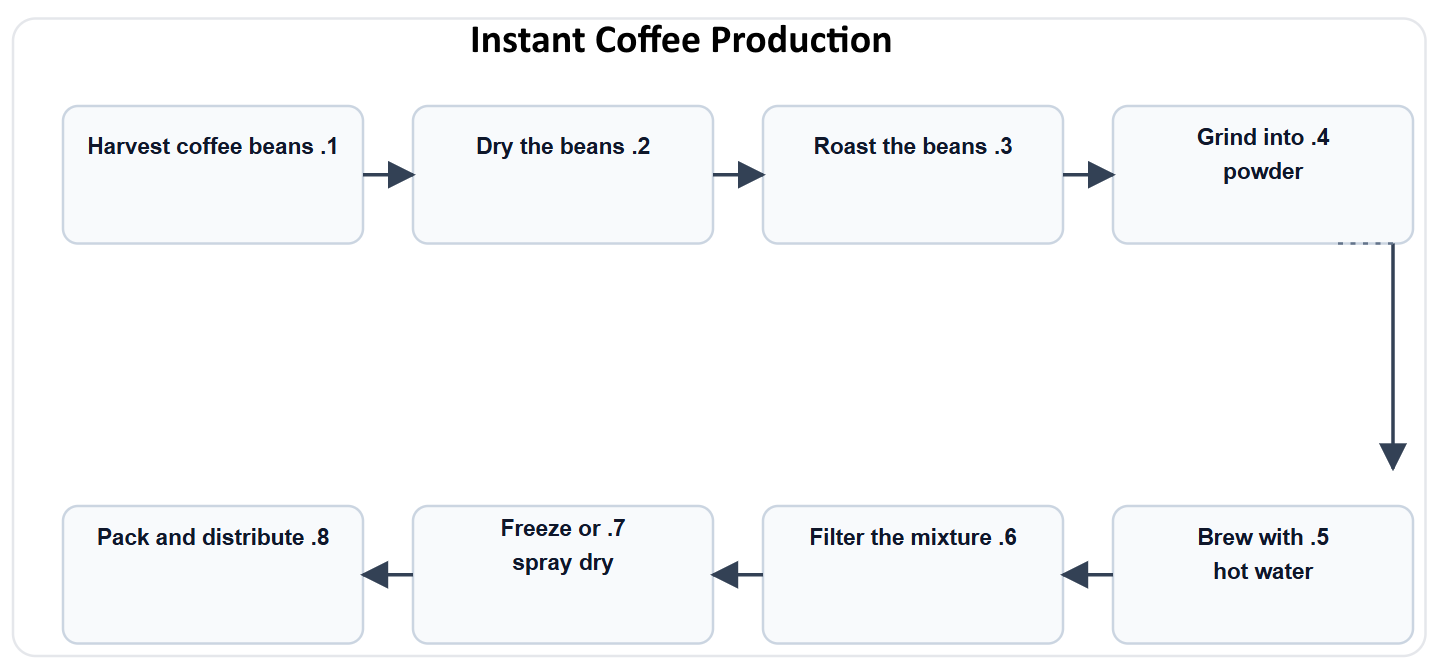
IELTS Writing Task 1 Test 19 – Instant Coffee Production (8-stage process)

Figure: Eight-stage process of instant coffee production

Sample Answer (Band 8.0–8.5)

The process diagram demonstrates the sequence of eight stages involved in producing instant coffee from harvested beans, beginning with raw material collection and ending with distribution.

Initially, ripe coffee beans are gathered from plants and subsequently dried in the sun to reduce their moisture content. Following this, the beans undergo roasting, which enhances their flavor, before being ground into a fine powder. This completes the first row of steps.

After grinding, the powder is brewed with hot water to extract the soluble elements, and the resulting mixture is then filtered to remove unwanted residues. The clarified liquid is subsequently dried, either by freezing or by spray-drying techniques, to create soluble coffee granules. Finally, these granules are packed into containers and distributed for commercial sale.

Overall, the process is linear, moving from natural raw beans to a packaged consumer product. It combines physical treatments (such as drying, roasting, and grinding) with chemical changes (brewing and filtering), ensuring that the coffee is both flavorful and convenient for instant use.

```
```html

Analytical Review – IELTS Academic Writing Task 1 (Test 19)

Overall Verdict

Indicative band: 7.5–8.0

  • Task Achievement: The eight stages are fully covered with a clear beginning (harvesting) and end (distribution).
  • Coherence & Cohesion: Logical sequencing; transitions like “Initially,” “Following this,” and “Finally” guide the reader well.
  • Lexical Resource: Solid use of topic-specific vocabulary (“roasting,” “granules,” “spray-drying”) and academic phrasing.
  • Grammar: Range of tenses and passives; accurate overall with minor room for conciseness.

Key Weaknesses

  • Some overuse of formulaic connectors (“subsequently,” “finally”) without variety.
  • Limited numerical or qualitative detail (e.g., no indication of time/temperature in stages).
  • Sentences could be more concise—several contain multiple clauses.
  • Stronger contrasts between physical and chemical processes could enrich the overview.

Actionable Improvements

  1. Vary sequencing devices: Use alternatives like “thereafter,” “at the next stage,” or “in the subsequent phase.”
  2. Add technical nuance: Mention drying methods (“sunlight” vs “mechanical”) or approximate outcomes to show precision.
  3. Tighten phrasing: Break multi-clause sentences into shorter, clearer ones.
  4. Enhance contrasts: Explicitly differentiate mechanical vs chemical steps in the overview.

Stronger Synonyms (Topic-Fit)

  • process → procedure sequence workflow
  • stage → phase step level
  • produce → manufacture generate yield
  • mix → blend combine fusion

Linking Devices (Cohesion)

  • Sequence: initially, subsequently, thereafter, in the final stage
  • Contrast: whereas, in contrast, on the other hand
  • Addition: moreover, in addition, likewise
  • Result: therefore, consequently, as a result

High-Value Collocations (Process Writing)

  • moisture reduction of beans
  • flavor enhancement through roasting
  • soluble granules formation
  • commercial distribution phase
  • mechanical treatment vs chemical transformation

Rewrite Upgrades (Band-8 polish)

  • Original: “Following this, the beans undergo roasting, which enhances their flavor.”
    Upgrade: “In the subsequent phase, beans are subjected to roasting, a process that intensifies aroma and taste.”
  • Original: “Finally, these granules are packed into containers and distributed for commercial sale.”
    Upgrade: “At the final stage, soluble coffee granules are sealed in packages and dispatched to retail markets.”
```
```html

تحلیل دوزبانه – IELTS Academic Writing Task 1 (Test 19, Process Diagram)

ارزیابی کلی

نمره تقریبی: 7.5 تا 8

  • توصیف کامل هشت مرحله، از برداشت دانه‌ها تا توزیع محصول
  • جریان منسجم با استفاده از واژه‌های پیوندی مانند «ابتدا»، «در ادامه»، «در نهایت»
  • به‌کارگیری واژگان تخصصی مثل «بو دادن»، «ذرات محلول»، «خشک‌کردن با اسپری»
  • گرامر متنوع همراه با جملات معلوم و مجهول

Overall Verdict

Indicative band: 7.5–8.0

  • Task Achievement: Eight stages are fully described, from harvesting beans to commercial distribution.
  • Coherence & Cohesion: Clear logical flow; connectors like “Initially,” “Following this,” and “Finally” ensure progression.
  • Lexical Resource: Accurate topic vocabulary (“roasting,” “granules,” “spray-drying”) and academic tone.
  • Grammar: Good control of passives and sequencing; minor conciseness issues.

نقاط ضعف

  • تکرار بیش از حد برخی اتصال‌دهنده‌ها مثل «سپس»، «در نهایت»
  • کمبود جزئیات عددی یا کیفی مثل دما یا مدت زمان مراحل
  • جملات طولانی که می‌توانند ساده‌تر و کوتاه‌تر شوند
  • تفاوت مراحل فیزیکی و شیمیایی به‌طور کامل برجسته نشده

Key Weaknesses

  • Over-reliance on standard linkers (“subsequently,” “finally”) without variety.
  • Lack of technical detail (e.g., no mention of time or temperature).
  • Some sentences are overly long with multiple clauses.
  • Physical vs. chemical process distinction is not strongly highlighted.

پیشنهادهای بهبود

  1. استفاده از اتصال‌دهنده‌های متنوع‌تر مانند «در گام بعدی»، «پس از آن»
  2. افزودن جزئیات تخصصی برای نشان دادن دقت بیشتر
  3. کوتاه‌کردن جملات پیچیده به دو جمله ساده‌تر
  4. تأکید بر تفاوت میان تغییرات فیزیکی و شیمیایی

Actionable Improvements

  1. Use a wider range of sequencing devices (“thereafter,” “at the next stage”).
  2. Include technical nuances (sun-drying vs. mechanical drying, spray vs. freeze drying).
  3. Break down dense sentences for clarity.
  4. Highlight contrast between physical and chemical transformations.

مترادف‌های قوی

  • فرآیند → procedure, sequence, workflow
  • مرحله → phase, step, level
  • تولید → manufacture, yield, generate
  • ترکیب → blend, combine, fusion

Stronger Synonyms

  • process → procedure, sequence, workflow
  • stage → phase, step, level
  • produce → manufacture, yield, generate
  • mix → blend, combine, fusion

حروف ربط

  • ترتیب: ابتدا، سپس، در گام بعدی
  • تضاد: در حالی که، برعکس
  • افزودن: همچنین، علاوه بر این
  • نتیجه: بنابراین، در نتیجه

Linking Devices

  • Sequence: initially, subsequently, thereafter, in the final stage
  • Contrast: whereas, in contrast
  • Addition: moreover, likewise
  • Result: therefore, consequently

کالوکیشن‌های کلیدی

  • کاهش رطوبت دانه‌ها → moisture reduction of beans
  • افزایش طعم → flavor enhancement through roasting
  • تشکیل ذرات محلول → formation of soluble granules
  • مرحله توزیع تجاری → commercial distribution phase
  • فرآیند مکانیکی و شیمیایی → mechanical treatment vs. chemical transformation

High-Value Collocations

  • moisture reduction of beans
  • flavor enhancement through roasting
  • formation of soluble granules
  • commercial distribution phase
  • mechanical treatment vs. chemical transformation
```