
IELTS Academic Writing Task 1 – Sample Test12 (Pie + Table)

Task Question

The pie chart below shows the distribution of electricity generation by fuel type in Country X in 2010. The table provides a forecast of changes in the proportion of each source by 2030.

Summarize the information by selecting and reporting the main features, and make comparisons where relevant.
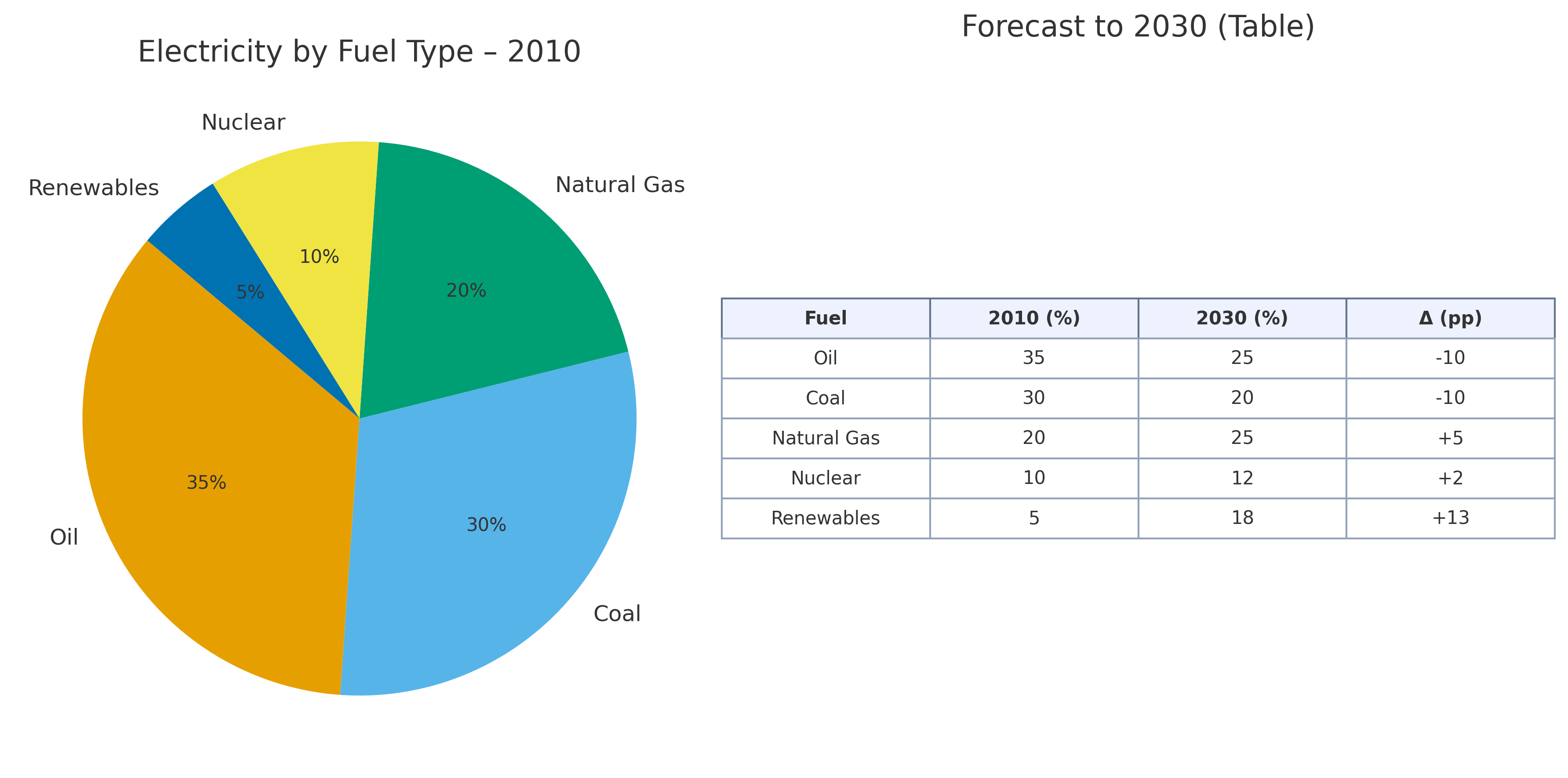
IELTS Writing Task 1 Test 12 – Pie chart (2010) and Table (2030 forecast)

Figure: Electricity by fuel (2010) and projected changes by 2030

Sample Answer (Band 7.5–8)

The pie chart illustrates how electricity generation was distributed across five fuel types in 2010, while the accompanying table forecasts changes in these proportions by 2030. Overall, a clear shift away from conventional fossil fuels towards cleaner sources is anticipated, with renewables becoming far more prominent by the end of the period.

In 2010, oil and coal dominated the mix at 35% and 30%, respectively, whereas natural gas accounted for a fifth. Nuclear was relatively minor at 10%, and renewables contributed only 5%. By contrast, the 2030 projection suggests marked reductions in both oil (−10pp) and coal (−10pp), falling to 25% and 20%. Natural gas is expected to rise modestly to 25%, while nuclear edges up to 12%.

The most dramatic change concerns renewables, which are predicted to more than triple to 18% (+13pp). This implies a structural rebalancing of the generation portfolio in favour of lower-carbon options. In short, although fossil fuels are likely to remain significant in 2030, their combined share is projected to contract substantially, with the expansion of renewables and, to a lesser extent, nuclear filling the gap.

Analytical Review – IELTS Academic Writing Task 1 (Test 12)

Overall Verdict

Indicative band: 7.5–8.0

  • Task Achievement: Both the pie chart (2010) and the table (2030 forecast) are described with clear overview and contrasts.
  • Coherence & Cohesion: The answer moves logically from the present distribution to projected changes; cohesive devices are used appropriately.
  • Lexical Resource: Strong topical vocabulary (“fossil fuels,” “structural shift,” “anticipated expansion”) with some repetition of “share” and “proportion.”
  • Grammar: Range of complex clauses and passive forms; a few sentences are long and could be tightened.

Key Weaknesses

  • Quantification: Phrases like “dramatic change” could be paired with exact numbers (+13pp renewables).
  • Repetition: Frequent reuse of “increase” and “decrease”; needs more variation.
  • Sentence density: Some sentences cover too many contrasts, making them heavy.
  • Comparative clarity: Links between fossil fuels’ decline and renewables’ rise could be stated more explicitly.

Actionable Improvements (High-Impact)

  1. Add precise deltas: Example: “Renewables are projected to grow from 5% to 18%, an increase of +13 percentage points.”
  2. Strengthen contrasts: Pair declines with rises (e.g., “Oil falls by 10pp, while renewables surge by 13pp”).
  3. Lexical range: Replace repeated “increase/decrease” with synonyms (see list below).
  4. Concise phrasing: Break dense sentences into two shorter ones.
  5. Future emphasis: Use forecasting verbs (“expected to,” “anticipated to,” “projected to”) more consistently.

Stronger Synonyms (Topic-Fit)

  • increase → expand rise grow gain ground
  • decrease → decline fall shrink diminish
  • remain stable → hold steady stay constant plateau
  • fossil fuels → conventional sources carbon-intensive fuels
  • renewables → clean energy sustainable sources

Linking Devices (Cohesion)

  • Contrast: whereas, by contrast, in opposition
  • Addition: furthermore, in addition, likewise
  • Result: as a result, therefore, consequently
  • Time/Sequence: initially, subsequently, by 2030
  • Emphasis: notably, in particular, critically
  • Forecasting: projected to, expected to, anticipated to

High-Value Collocations (Energy & Forecasts)

  • anticipated expansion of renewables
  • structural shift in the energy mix
  • decline in fossil dependency
  • projected rebalancing of sources
  • marked contraction in oil/coal shares
  • clean energy trajectory
  • forecasted growth of sustainable fuels

Rewrite Upgrades (Band-8 polish)

  • Original: “The most dramatic change is seen in renewables.”
    Upgrade: “Renewables are projected to experience the most pronounced expansion, climbing from 5% in 2010 to 18% in 2030 (+13pp).”
  • Original: “Oil and coal are expected to decrease.”
    Upgrade: “Both oil and coal are anticipated to contract significantly, shedding around 10pp each by 2030.”
  • Original: “Nuclear shows a small rise.”
    Upgrade: “Nuclear power is forecast to edge upward from 10% to 12%, a modest yet steady gain.”

Model Sentences (Precise Quantification)

  • “By 2030, renewables will account for nearly one-fifth of electricity, compared with just 5% in 2010.”
  • “Oil’s share is expected to decline from 35% to 25%, indicating a marked contraction.”
  • “Natural gas is projected to overtake coal by 5pp, reaching a quarter of the total mix.”

Grammar Targets

  • Forecasting verbs: “is projected to…,” “is expected to…,” “is anticipated to…”
  • Comparatives: “X will be nearly twice Y,” “A surpasses B by 5pp.”
  • Passives: “the share is forecast to be reduced…”
  • Nominalization: “a notable contraction in coal consumption is forecast.”

Quick Checklist (Before Submit)

  • Overview compares 2010 vs 2030 with clear trends.
  • Numbers given with exact figures or pp changes.
  • Lexical variety beyond “increase/decrease.”
  • Sentences concise; avoid heavy clustering.
  • Forecasting verbs and linkers varied.

تحلیل دوزبانه – IELTS Academic Writing Task 1 (Test 12)

ارزیابی کلی

نمره تقریبی: 7.5 تا 8

  • پوشش هم‌زمان پای‌چارت ۲۰۱۰ و جدول پیش‌بینی ۲۰۳۰
  • مرور کلی واضح و منسجم از تغییرات سوخت‌های فسیلی و انرژی‌های نو
  • واژگان تخصصی مثل «کاهش وابستگی»، «تغییر ساختاری»، «رشد پیش‌بینی‌شده»
  • گرامر متنوع با جملات مرکب و فعل‌های مجهول

Overall Verdict

Indicative band: 7.5–8.0

  • Task Achievement: Both 2010 pie and 2030 forecast table are covered with clear overview and contrasts.
  • Coherence & Cohesion: Smooth flow from present to future; linkers used effectively.
  • Lexical Resource: Strong vocabulary (“fossil dependency,” “structural shift,” “anticipated expansion”).
  • Grammar: Wide range; occasional long sentences could be tightened.

نقاط ضعف

  • استفاده مکرر از increase/decrease بدون تنوع
  • جملات طولانی و فشرده که فهم را دشوار می‌کند
  • کمبود مقایسه‌های دقیق با اعداد (pp)
  • رابطه مستقیم کاهش سوخت‌های فسیلی و افزایش انرژی نو به‌قدر کافی پررنگ نشده

Key Weaknesses

  • Overuse of “increase”/“decrease” without variation.
  • Dense long sentences reduce clarity.
  • Lack of explicit quantified contrasts (+/− percentage points).
  • Weaker connection drawn between fossil decline and renewable growth.

پیشنهادهای بهبود

  1. استفاده از اختلاف‌های دقیق عددی (pp) برای مقایسه
  2. به‌کارگیری مترادف‌های متنوع برای افزایش و کاهش
  3. تقسیم جمله‌های طولانی به دو جمله کوتاه‌تر
  4. تأکید بیشتر بر رشد سریع انرژی‌های تجدیدپذیر

Actionable Improvements

  1. Report precise deltas (e.g., +13pp renewables).
  2. Vary synonyms for “increase/decrease.”
  3. Break dense clauses into shorter sentences.
  4. Stress renewable surge as central narrative.

مترادف‌های قوی

  • افزایش → expand, grow, gain ground
  • کاهش → contract, diminish, fall
  • ثابت ماندن → plateau, hold steady
  • سوخت فسیلی → conventional fuels
  • انرژی نو → clean energy, sustainable sources

Stronger Synonyms

  • increase → expand, rise, gain ground
  • decrease → decline, shrink, diminish
  • remain stable → plateau, hold steady
  • fossil fuels → conventional sources, carbon-intensive fuels
  • renewables → clean energy, sustainable sources

حروف ربط

  • تضاد: whereas, by contrast
  • افزودن: moreover, likewise
  • نتیجه: therefore, consequently
  • زمان: initially, by 2030

Linking Devices

  • Contrast: whereas, by contrast
  • Addition: moreover, likewise
  • Result: therefore, consequently
  • Time: initially, subsequently, by 2030

کالوکیشن‌های کلیدی

  • کاهش وابستگی به سوخت فسیلی → decline in fossil dependency
  • تغییر ساختاری → structural shift
  • رشد پیش‌بینی‌شده → anticipated expansion
  • بازتوزیع انرژی → projected rebalancing

High-Value Collocations

  • decline in fossil dependency
  • structural shift in the mix
  • anticipated expansion of renewables
  • projected rebalancing of sources