
IELTS Academic Writing Task 1 – Sample Test 48 (Multi Pie Chart)
Task Question
The charts below compare the daily time allocation of individuals before and after the shift to remote work. The categories are Work Tasks, Meetings, Commuting, Household/Personal, and Leisure/Exercise. Summarize the information by selecting and reporting the main features, and make comparisons where relevant.
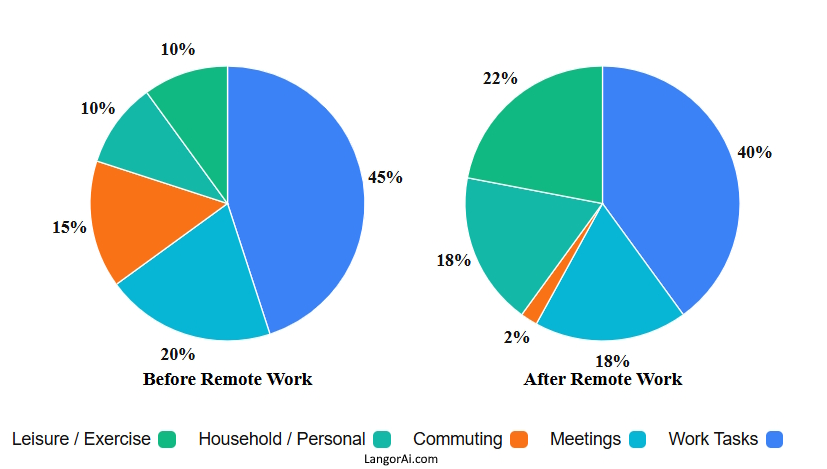
Figure: Distribution of daily time before vs after remote work — LangorAi.com
Sample Answer (Band 8.5–9.0)
The two pie charts compare how people distributed their daily time prior to and following the adoption of remote work. Overall, the dominant change is the near removal of commuting, with the recovered time reallocated chiefly to leisure/exercise and household or personal activities, while core work duties remained broadly stable.
Before the shift, work tasks constituted the largest share at 45%, and meetings took another 20%. A notable 15% was spent on commuting, whereas both household/personal and leisure accounted for only 10% each. After remote work began, the proportion for work tasks edged down slightly to 40%, and meetings fell to 18%.
The most dramatic shift was in commuting, which declined from 15% to just 2%—a reduction of over eighty percent. This time appears to have been redistributed toward household/personal commitments, rising to 18%, and especially to leisure/exercise, which more than doubled to 22%. These changes indicate a rebalancing of daily routines that favors well-being and domestic responsibilities without materially altering productive work time.
Word count: 174 words
Analytical Review – IELTS Academic Writing Task 1 (Test 48: Multi Pie Chart)
Overall Verdict
Indicative Band: 8.5 – 9.0
- Task Achievement: The main changes in time distribution are clearly highlighted, especially the sharp decline in commuting and rise in leisure/household time.
- Coherence & Cohesion: Logical sequencing from “before → after,” with smooth progression and appropriate paragraphing.
- Lexical Resource: Effective use of topic-related expressions such as “time allocation,” “redistribution of hours,” and “balanced daily routine.”
- Grammar: Accurate use of comparative forms and complex sentence patterns.
Key Weaknesses
- Limited interpretive depth: The essay describes the shift but does not explore the social/work-life context behind it.
- Repetition of numerical comparisons: Some sentences follow a similar “X decreased to Y” structure; rhythm could be more varied.
- Minimal emphasis on proportional contrast: Could highlight *degree of change* more strongly (e.g., “commuting time almost eliminated”).
Actionable Improvements (High-Impact)
- Add cause-based explanation: Briefly mention why remote work reduces commuting and increases personal/leisure time.
- Use stronger contrastive framing: E.g., “While commuting nearly disappeared, leisure time expanded substantially.”
- Vary sentence rhythm: Alternate short numeric statements with longer interpretive sentences.
- Highlight proportional shifts: Note that leisure time more than doubled and commuting dropped by over 85%.
- Conclude with insight: Explain what the change implies about lifestyle or work–life balance.
Stronger Synonyms (Topic-Fit)
- time allocation → daily scheduling time distribution
- leisure → recreational time personal downtime
- commuting → travel-to-work time daily transit
- increase → expand intensify
- decrease → decline drop sharply
Linking Devices (Cohesion Boost)
- Contrast: whereas, by comparison, on the other hand
- Trend Emphasis: significantly, marginally, substantially
- Time/Process: before the shift, following the transition, afterward
- Interpretive: this suggests that, this indicates, this reflects
High-Value Collocations (Band 8+)
- redistribution of daily hours
- work–life balance reinforcement
- pronounced reduction in commuting
- personal well-being prioritization
- lifestyle restructuring due to remote work
Band-9 Rewrite Upgrades
-
Original: “Commuting decreased to 2%.”
Upgrade: “Commuting time was almost eliminated, falling dramatically from 15% to just 2%.” -
Original: “Leisure time increased to 22%.”
Upgrade: “Leisure and exercise time more than doubled, rising to 22% and reflecting greater focus on personal health.” -
Original: “Work tasks fell slightly.”
Upgrade: “Core work responsibilities remained relatively stable, indicating that productivity demands were largely unchanged.”
Band Justification & How to Reach 9.0
The essay is already strong, with precise data handling and clear structural logic. To achieve a consistent Band 9, the response should include brief interpretive reasoning to explain the broader implications of the shift, such as increased autonomy, reduced stress, and improved lifestyle balance. Band 9 writing does not only describe *what changed* — it clarifies why it matters.
تحلیل دوزبانه – IELTS Academic Writing Task 1 (Test 48: Multi Pie Chart)
ارزیابی کلی
نمره تقریبی: 8.5 تا 9.0
- توصیف تغییرات اصلی بین دو نمودار (قبل و بعد از دورکاری) واضح و منسجم است.
- جریان متن ساختار منطقی دارد (مرور کلی → مقایسه مستقیم → جمعبندی).
- واژگان تخصصی درباره مدیریت زمان، توازن کار-زندگی و سبک کاری بهدرستی استفاده شدهاند.
- تنوع جمله و کنترل دقیق ساختارهای مقایسهای قابل توجه است.
Overall Verdict
Indicative Band: 8.5 – 9.0
- Task Achievement: Clear presentation of key proportional changes.
- Coherence & Cohesion: Logical sequencing and effective linking.
- Lexical Resource: Precise vocabulary related to scheduling and work–life dynamics.
- Grammar: Accurate comparative structures and balanced sentence length.
نقاط ضعف
- عدم اشاره کوتاه به دلایل اجتماعی/فردی پشت تغییرات.
- برخی مقایسهها میتوانستند شدت تفاوت را روشنتر نشان دهند.
- ریتم بعضی جملات شبیه هم است و میتواند تنوع بیشتری داشته باشد.
- عدم اشاره به پیامدهای بلندمدت سبک زندگی.
Key Weaknesses
- Lack of brief causal insight behind pattern shifts.
- Some comparisons could emphasize scale more strongly.
- Sentence rhythm slightly repetitive in a few sections.
- No long-term lifestyle interpretation included.
پیشنهادهای بهبود
- افزودن یک جمله کوتاه توضیحی برای دلیل جابهجایی زمانها.
- استفاده از مقایسههای نسبتی مثل «تقریباً دو برابر» یا «تقریباً حذف شده».
- تنوع ریتم جمله با ترکیب جملههای کوتاه دادهمحور + جملههای تحلیلی.
- اشاره به تأثیرات بلندمدت روی رفاه، انرژی، و تمرکز.
Actionable Improvements
- Add concise causal framing (e.g., reduced commute = more personal time).
- Use proportional comparisons (“nearly doubled,” “significantly reduced”).
- Alternate numerical statements with interpretive commentary for rhythm.
- Conclude with a lifestyle or productivity implication.
مترادفهای قوی
- جلسات → هماهنگی تیمی / تعامل کاری
- تفریح → زمان استراحت / فعالیتهای بازیابی انرژی
- تمرکز کاری → توجه متمرکز / کار عمیق
- رفتوآمد → تردد روزانه / جابهجایی کاری
Stronger Synonyms
- meetings → collaborative coordination / work interaction
- leisure → personal downtime / restorative activity
- focused work → deep work / concentrated task time
- commute → daily transit / travel-to-work routine
حروف ربط پیشنهادی
- تضاد: در حالی که / اما / از سوی دیگر
- روند: بهتدریج / به طور محسوس / چشمگیر
- توضیحی: یعنی / درواقع / به عبارت دیگر
Linking Devices
- Contrast: whereas, however, on the other hand
- Trend Shift: progressively, noticeably, sharply
- Clarification: in other words, this indicates that
چطور نمره را به 9 برسانیم؟
برای نمره 9 باید نشان دهیم «چرا» تغییر اتفاق افتاده و این تغییر چه تأثیری دارد؛ نه فقط اینکه «چه چیزی تغییر کرده».
How to Reach Band 9
Band 9 responses explain why the pattern matters — linking time redistribution to well-being, productivity, or stress reduction.