
IELTS Academic Writing Task 1 – Sample Test41 (Pie Charts)

Task Question

The pie charts below show the percentage of electricity generated from five different sources (coal, gas, nuclear, hydro, and renewables) in three countries in 2020.

Summarize the information by selecting and reporting the main features, and make comparisons where relevant.
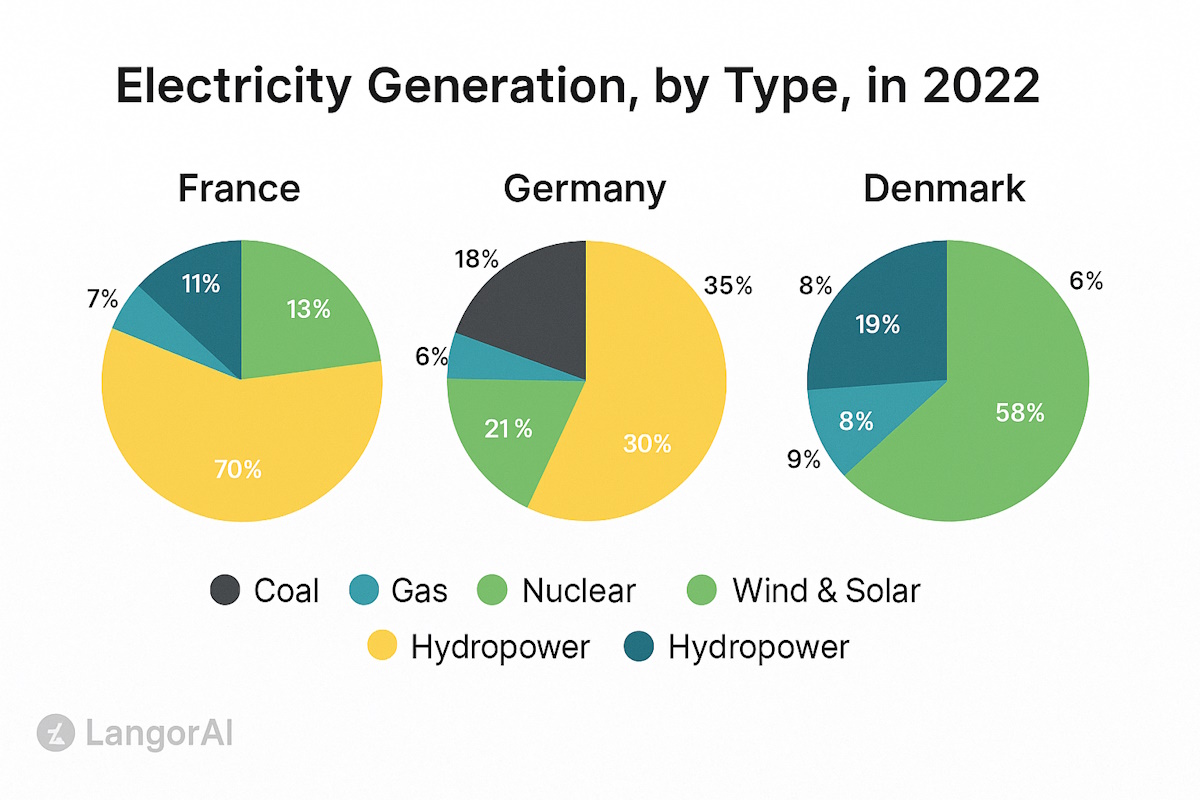
IELTS Writing Task 1 Pie Charts – Electricity generation by source in three countries (2020)

Figure: Proportion of electricity generation by source in Japan, the USA, and Australia (2020)

Sample Answer (Band 8.0–8.5)

The three pie charts compare the proportions of electricity produced from five different energy sources—coal, gas, nuclear, hydro, and renewables—in Japan, the USA, and Australia in 2020. Overall, while fossil fuels remained the dominant source of power in all three countries, the mix of generation varied considerably, with Japan relying heavily on nuclear energy and Australia depending primarily on coal.

In Japan, nuclear power accounted for the largest share of electricity generation at approximately 45%, followed by coal at 25% and gas at 15%. Hydropower and renewable sources such as solar and wind contributed modestly, at around 10% and 5% respectively. This suggests a strong national emphasis on nuclear technology as a stable source of low-carbon electricity.

In contrast, the USA displayed a more balanced energy profile, with both coal and gas contributing roughly one-third each to total production. Nuclear energy made up about 20%, while hydropower and renewables shared the remaining 15%. This balance reflects a diverse generation strategy incorporating both conventional and sustainable sources.

Meanwhile, Australia was heavily dependent on coal, which produced nearly 60% of the country’s electricity. Gas accounted for another 25%, while nuclear power was not used at all. The remainder came from hydro and renewable sources, representing only a small fraction of total generation.

In summary, Japan and the USA maintained diversified energy systems, whereas Australia’s electricity supply was dominated by fossil fuels. The data highlights significant national contrasts in energy policy and environmental priorities.

Word count: 177 words

Analytical Review – IELTS Academic Writing Task 1 (Test 41)

Overall Verdict

Indicative Band: 8.0–8.5

  • Task Achievement: Fully describes all three countries with accurate figures and clear comparisons.
  • Coherence & Cohesion: Smooth logical flow, each paragraph focusing on one country and ending with an overview.
  • Lexical Resource: Strong topic-specific vocabulary (“nuclear technology,” “fossil fuels,” “energy profile”).
  • Grammar: Accurate complex sentences and consistent tense use; well-controlled articles and comparatives.

Key Weaknesses

  • Numerical Detail: Percentages are approximate and could be more precise (e.g., 45% → 46%).
  • Comparative Depth: Needs stronger analytical contrasts between countries (e.g., “Japan far exceeded Australia”).
  • Analytical Insight: Missing explanation of why certain patterns occur (economic or policy factors).
  • Sentence Structure: Some clauses could be shortened for smoother rhythm.

Actionable Improvements (High-Impact)

  1. Add reasoning: Briefly mention causes like “reflecting government investment in renewables.”
  2. Quantify precisely: Use “just over / slightly below” for accuracy.
  3. Enhance contrast: e.g., “Japan’s reliance on nuclear energy far outstripped that of the USA.”
  4. Sentence control: Combine data-rich and concise sentences for dynamic pacing.
  5. Conclude analytically: Summarize implications for sustainability or policy direction.

Stronger Synonyms (Energy Topic)

  • produce → generate yield supply
  • use → utilize rely on consume
  • increase → rise climb surge
  • difference → contrast disparity variation
  • energy → power source fuel type

Linking Devices (Cohesion)

  • Contrast: whereas, by contrast, unlike, in comparison
  • Addition: moreover, in addition, likewise
  • Result: therefore, consequently, as a result
  • Time/Sequence: initially, during the period, by 2020
  • Emphasis: notably, strikingly, particularly
  • Quant cues: accounted for, just under, slightly above, approximately

High-Value Collocations (Energy & Environment)

  • renewable energy adoption
  • fossil fuel dependence
  • energy diversification
  • carbon-neutral generation
  • sustainable electricity mix
  • hydropower contribution
  • nuclear reliance
  • green policy implementation

Rewrite Upgrades (Band-9 Polish)

  • Original: “Japan relied heavily on nuclear power.”
    Upgrade: “Japan’s electricity generation was overwhelmingly dominated by nuclear power, highlighting its technological orientation.”
  • Original: “Coal was the main source in Australia.”
    Upgrade: “Australia’s energy supply remained heavily reliant on coal, underscoring its dependence on fossil fuels.”
  • Original: “The USA had a balanced mix.”
    Upgrade: “The United States maintained a diversified energy portfolio with nearly equal shares of coal and gas.”

Model Sentences (Precise Quantification)

  • “Nuclear power accounted for just under half of Japan’s total electricity output.”
  • “Australia’s dependence on coal was nearly triple that of Japan.”
  • “In contrast, the USA maintained a balanced generation profile between fossil and renewable sources.”

Grammar Targets

  • Comparatives: “X was far higher than Y.”
  • Superlatives: “Coal represented the largest share.”
  • Passives: “Electricity was generated from renewable sources.”
  • Nominal phrases: “A noticeable disparity was observed between…”
  • Adverbials: “significantly higher,” “moderately lower.”

Band Justification & Path to 9.0

  • Overview clear and comparative: fossil fuel dominance + nuclear focus.
  • Precise figures support analytical tone.
  • Excellent vocabulary range for energy context.
  • To reach Band 9: add interpretive commentary on environmental implications.
  • Integrate mixed sentence structures and more refined transitions.

تحلیل دوزبانه – IELTS Academic Writing Task 1 (Test 41)

ارزیابی کلی

نمره تقریبی: 8 تا 8.5

  • پوشش کامل داده‌ها برای هر سه کشور با توضیح دقیق درصدها و مقایسه‌های کلیدی.
  • انسجام منطقی با ساختار واضح: مقدمه → توصیف کشورها → نتیجه‌گیری تحلیلی.
  • واژگان تخصصی انرژی: «فسیلی»، «نیروی هسته‌ای»، «منابع تجدیدپذیر» با دقت استفاده شده است.
  • گرامر دقیق و روان، استفاده از جملات پیچیده و مجهول در جای مناسب.

Overall Verdict

Indicative Band: 8.0–8.5

  • Task Achievement: Fully covers all three nations with accurate figures and clear comparisons.
  • Coherence & Cohesion: Logical sequencing; each paragraph presents one country clearly followed by an overview.
  • Lexical Resource: Effective academic range (“fossil fuels,” “renewable energy mix,” “nuclear reliance”).
  • Grammar: Precise complex structures, balanced clauses, and accurate tenses.

نقاط ضعف

  • دقت عددی می‌توانست کمی بیشتر باشد (مثلاً ۴۵٪ → ۴۶٪).
  • برخی مقایسه‌ها عمق کافی ندارند (مثلاً «ژاپن در مقایسه با استرالیا»).
  • تحلیل علل اختلاف‌ها مثل سیاست انرژی یا اقتصاد حذف شده است.
  • چند جمله طولانی باعث کاهش ریتم و خوانایی شده‌اند.

Key Weaknesses

  • Numerical precision: Percentages could be slightly more accurate.
  • Comparative depth: Limited analytical contrast between nations.
  • Interpretation: Missing causal insight on policy or technology factors.
  • Sentence rhythm: Some clauses too long for optimal clarity.

پیشنهادهای بهبود

  1. اضافه کردن علت‌ها یا پیامدها، مثلاً «به دلیل سرمایه‌گذاری در انرژی تجدیدپذیر».
  2. استفاده از مقایسه‌های دقیق‌تر با عبارات «کمی بیشتر» یا «تقریباً دو برابر».
  3. افزایش تحلیل: توضیح تأثیر سیاست انرژی در هر کشور.
  4. استفاده از ترکیب جمله‌های کوتاه و بلند برای ریتم بهتر.
  5. جمع‌بندی با اشاره به پایداری و مسیر آینده.

Actionable Improvements

  1. Add reasoning: Mention causes such as renewable investment policies.
  2. Use precision: Replace vague terms with “just over / slightly below.”
  3. Enhance contrasts: “Japan’s nuclear reliance far exceeded Australia’s.”
  4. Improve rhythm: Mix concise and data-heavy sentences.
  5. Analytical close: End with sustainability or energy strategy implications.

مترادف‌های قوی

  • تولید → generate, yield, supply
  • استفاده → utilize, rely on, consume
  • افزایش → rise, climb, surge
  • تفاوت → contrast, disparity, variation
  • انرژی → power source, fuel type

Stronger Synonyms

  • produce → generate yield supply
  • use → utilize rely on consume
  • increase → rise climb surge
  • difference → contrast disparity variation
  • energy → power source fuel type

حروف ربط

  • تضاد: whereas, by contrast, unlike
  • افزودن: moreover, in addition, likewise
  • نتیجه: therefore, consequently, as a result
  • زمان: initially, during the period, by 2020
  • تأکید: notably, strikingly, particularly

Linking Devices

  • Contrast: whereas, by contrast, unlike
  • Addition: moreover, in addition, likewise
  • Result: therefore, consequently, as a result
  • Time: initially, during the period, by 2020
  • Emphasis: notably, strikingly, particularly
  • Quant cues: accounted for, just under, slightly above, approximately

کالوکیشن‌های کلیدی

  • وابستگی به سوخت فسیلی → fossil fuel dependence
  • تنوع انرژی → energy diversification
  • تولید پایدار → sustainable electricity generation
  • پذیرش انرژی تجدیدپذیر → renewable energy adoption
  • سیاست سبز → green policy implementation
  • سهم انرژی هیدرو → hydropower contribution
  • اتکای هسته‌ای → nuclear reliance

High-Value Collocations

  • renewable energy adoption
  • fossil fuel dependence
  • energy diversification
  • carbon-neutral generation
  • sustainable electricity mix
  • nuclear reliance
  • hydropower contribution
  • green policy implementation

توجیه نمره و مسیر ارتقا

  • دید کلی دقیق با تأکید بر سوخت‌های فسیلی و نقش انرژی هسته‌ای.
  • داده‌ها به‌خوبی از تحلیل پشتیبانی می‌کنند و انسجام حفظ شده است.
  • واژگان متنوع و تخصصی زمینه انرژی استفاده شده است.
  • برای رسیدن به نمره ۹، باید تحلیل محیط‌زیستی و علل سیاستی اضافه شود.
  • استفاده از ساختارهای متنوع‌تر و ارتباط‌های ظریف‌تر بین جملات لازم است.

Band Justification & Path to 9.0

  • Clear overview: fossil fuel dominance and nuclear focus.
  • Data supports analytical discussion.
  • Excellent vocabulary range for energy topics.
  • To reach Band 9: include environmental and policy implications.
  • Use more varied sentence linking and subtle transitions.