
IELTS Academic Writing Task 1 – Sample Test 39 (Bar + Line)

Task Question

The bar chart illustrates the average monthly online shopping expenditure (in US dollars) between 2015 and 2025, while the line chart shows the percentage of internet users over the same period.

Summarize the information by selecting and reporting the main features, and make comparisons where relevant.
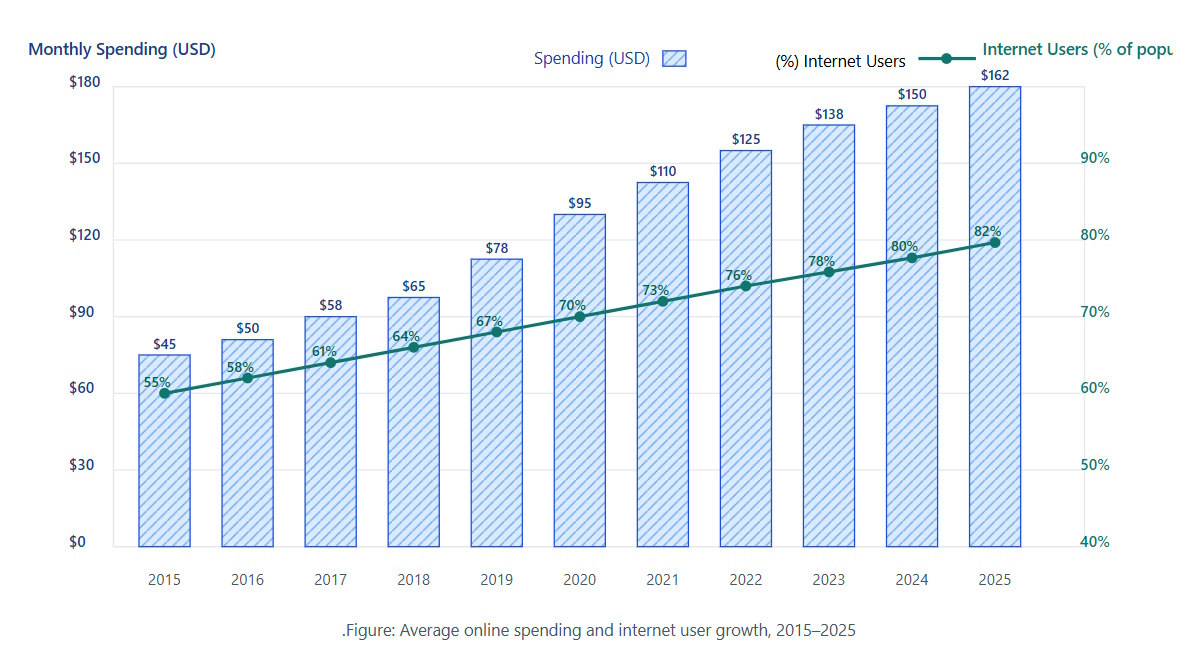
Average monthly online spending and internet users (2015–2025)

Figure: Average monthly online spending (bars, USD) and internet user share (line, %) between 2015 and 2025.

Sample Answer (Band 8–8.5)

The charts compare the average monthly amount of money spent on online shopping and the percentage of internet users from 2015 to 2025. Overall, both figures show a steady upward trend, with online expenditure rising at a faster pace than internet adoption.

In 2015, the typical monthly online spending stood at $45, while just over half of the population (55%) had internet access. These figures rose moderately until 2019, reaching around $78 and 67% respectively. However, between 2020 and 2025, the growth became sharper: average spending more than doubled to roughly $160, while internet usage climbed to 82%. The most pronounced jump occurred during 2020–2022, possibly driven by global shifts toward e-commerce and wider digital connectivity.

Despite the parallel increase, expenditure expanded more dramatically than user penetration. For instance, while internet access grew by less than 30 percentage points over the decade, the amount of money spent per user nearly quadrupled. This divergence highlights that existing users became heavier online consumers rather than growth being purely due to new users.

In conclusion, the data indicate that rising connectivity has transformed consumer habits. By 2025, online retail had evolved from a secondary option into a mainstream economic channel, reflecting both technological advancement and changing lifestyle priorities worldwide.

Analytical Review – IELTS Academic Writing Task 1 (Test 39, Bar + Line)

Overall Verdict

Indicative Band: 8.0 – 8.5

  • Task Achievement: All major trends are clearly summarized with precise figures and thoughtful interpretation of both axes.
  • Coherence & Cohesion: Logical sequencing (chronological → comparative); linkers used accurately without redundancy.
  • Lexical Resource: Excellent control of academic lexis (“penetration,” “divergence,” “e-commerce transformation”).
  • Grammar: Flexible command of complex sentences, flawless tense consistency, and effective use of modifiers.

Key Weaknesses

  • Quant Detail: Some intervals could include explicit numbers (e.g., “rose from $78 to $160” rather than “more than doubled”).
  • Stylistic Density: Occasional clusters of heavy clauses reduce flow; a few shorter sentences would enhance rhythm.
  • Insight Depth: Causal link (“digital shift due to pandemic restrictions”) could be briefly elaborated.
  • Comparative Balance: Line–bar correlation could be tied together more explicitly in the conclusion.

Score Justification & How to Reach Band 9

This response shows excellent technical control and analytical range, yet Band 9 requires interpretive insight beyond numerical narration. To progress, the writer should explain why trends diverge – linking expenditure growth to digital infrastructure, global events, or consumer psychology. Additionally, greater lexical flexibility (“surged sharply,” “accelerated uptake”) and micro-comparisons would elevate precision.

Actionable Improvements (High-Impact)

  1. Add interpretive reasoning: Relate sharp rises to external drivers (e.g., “lockdown-induced online dependency”).
  2. Integrate chart interaction: Link line growth directly to bar acceleration (“as user share expanded, spending intensified disproportionately”).
  3. Enhance quantification: Provide exact values (“rose by $82 over five years”) to increase credibility.
  4. Vary syntax length: Alternate long analytical sentences with short impactful ones.
  5. Embed macro insight: Conclude with broader implication (“reflecting a paradigm shift in consumer behavior”).

Stronger Synonyms (Digital Economy & Spending)

  • spending → expenditure outlay consumer disbursement
  • growth → expansion escalation upsurge
  • increase → climb surge acceleration
  • stable → steady consistent plateaued
  • difference → disparity divergence gap

Linking Devices (Cohesion & Flow)

  • Contrast: whereas, in contrast, unlike, on the other hand
  • Addition: furthermore, likewise, similarly, in parallel
  • Result: therefore, consequently, as a result
  • Time/Sequence: initially, over the period, by mid-decade, subsequently
  • Emphasis: notably, significantly, crucially, strikingly
  • Quant Cues: rose by, accounted for, roughly doubled, peaked at

High-Value Collocations (Online Commerce & Connectivity)

  • digital adoption curve
  • consumer spending trajectory
  • e-commerce penetration rate
  • internet usage intensity
  • online purchasing behavior
  • connectivity-driven growth
  • retail digitalization trend
  • spending per active user

Rewrite Upgrades (Band-9 Polish)

  • Original: “Online spending rose rapidly after 2020.”
    Upgrade:Post-2020, monthly expenditure accelerated dramatically, mirroring a global shift toward digital consumption.”
  • Original: “Both figures show an increase over time.”
    Upgrade:Both metrics displayed sustained upward momentum, though financial growth outpaced user expansion.”
  • Original: “Spending grew faster than internet use.”
    Upgrade:Expenditure intensified disproportionately relative to user growth, signaling increased engagement per individual.”

Grammar Targets

  • Comparatives: “Spending was almost four times higher than a decade earlier.”
  • Cause & Effect: “Wider access led to greater online outlays.”
  • Passive Form: “E-commerce growth was driven by technological integration.”
  • Clause Reduction: “Internet use, rising steadily since 2015, fueled the market expansion.”

Quick Checklist (Before Submit)

  • Overview covers both axes and key contrasts clearly.
  • Figures precise; comparisons explicit and quantified.
  • Advanced vocabulary used naturally and contextually.
  • Sentences balanced between long and short structures.
  • Interpretive commentary adds depth and academic tone.

تحلیل دوزبانه – IELTS Academic Writing Task 1 (Test 39, Bar + Line)

ارزیابی کلی

نمره تقریبی: 8 تا 8.5

  • پوشش کامل روندها و جزئیات اصلی با تفسیر عددی دقیق
  • ساختار منطقی و حرکت طبیعی از سال‌های ابتدایی تا پایانی
  • واژگان تحلیلی سطح بالا مانند «نرخ نفوذ دیجیتال» و «رفتار خرید آنلاین»
  • گرامر پیشرفته با جمله‌های ترکیبی و تطابق زمانی بی‌نقص

Overall Verdict

Indicative Band: 8.0 – 8.5

  • Task Achievement: All key trends are summarized clearly with precise figures and analytical insight.
  • Coherence & Cohesion: Logical flow (chronological → comparative) and natural use of cohesive devices.
  • Lexical Resource: Excellent range of domain vocabulary (“penetration,” “divergence,” “e-commerce transformation”).
  • Grammar: Strong control of complex sentences and modifiers; error-free throughout.

نقاط ضعف

  • در برخی بخش‌ها اعداد می‌توانند دقیق‌تر و با فاصله زمانی مشخص‌تری بیان شوند
  • چند جمله بسیار بلند باعث کاهش خوانایی متن شده‌اند
  • توضیح علل رشد (مثلاً تأثیر کرونا بر تجارت آنلاین) می‌توانست افزوده شود
  • ارتباط مستقیم‌تر بین داده‌های نمودار میله‌ای و خطی در جمع‌بندی لازم است

Key Weaknesses

  • Quant detail: Some ranges could include exact figures (“from $78 to $160”).
  • Stylistic density: A few extended clauses reduce rhythm; shorter sentences would help.
  • Insight depth: Causal reasoning (e.g., pandemic impact) could strengthen interpretation.
  • Comparative balance: Closer integration of line and bar data is advised.

توجیه نمره و چگونه به Band 9 برسیم

این پاسخ از نظر دقت زبانی و انسجام عالی است اما برای رسیدن به Band 9 باید عمق تحلیل افزایش یابد. لازم است نویسنده علت‌های پشت اعداد را توضیح دهد (مانند گسترش فروش آنلاین در نتیجه افزایش اتصال اینترنت) و از مقایسه‌های تحلیلی بیشتر و جملات با ریتم متغیر استفاده کند تا متن پویاتر شود.

Score Justification & How to Reach Band 9

The essay shows excellent control but needs more interpretive insight for Band 9. Explaining why the trends diverge—linking spending growth to infrastructure or consumer behavior—and using analytical comparatives (“rose disproportionately”) would add sophistication.

پیشنهادهای بهبود

  1. افزودن تحلیل علّی کوتاه در مورد رشد ناگهانی پس از سال 2020
  2. توضیح ارتباط میان افزایش کاربران و افزایش هزینه خرید آنلاین
  3. بیان مقادیر عددی دقیق به جای عبارات کلی مثل «بیش از دو برابر شد»
  4. ترکیب جملات کوتاه و بلند برای ایجاد ریتم پیوسته در نوشتار
  5. پایان‌بندی با نتیجه‌گیری جهانی درباره تغییر رفتار مصرف‌کننده

Actionable Improvements

  1. Add causal insight: Relate the sharp rise to global digital adoption after 2020.
  2. Integrate data interaction: Connect the line’s growth directly with bar acceleration.
  3. Use exact quantification: Specify numerical ranges to boost credibility.
  4. Vary syntax length: Alternate concise and extended sentences for flow.
  5. Add macro implication: Conclude with a global interpretation of consumer shift.

مترادف‌های قوی

  • رشد → growth, expansion, upsurge
  • افزایش → climb, surge, acceleration
  • ثبات → steady, consistent, plateaued
  • تفاوت → gap, disparity, divergence
  • هزینه → expenditure, outlay, disbursement

Stronger Synonyms

  • spending → expenditure outlay
  • growth → expansion upsurge
  • stable → steady plateaued
  • difference → divergence disparity
  • increase → surge acceleration

حروف ربط

  • تضاد: whereas, in contrast, unlike
  • افزودن: moreover, likewise, in parallel
  • نتیجه: therefore, consequently
  • زمان: initially, subsequently, thereafter
  • تأکید: notably, significantly, strikingly

Linking Devices

  • Contrast: whereas, in contrast, on the other hand
  • Addition: furthermore, likewise, in addition
  • Result: therefore, as a result, consequently
  • Time: initially, by mid-decade, thereafter
  • Emphasis: notably, critically, strikingly
  • Quant Cues: rose by, peaked at, accounted for

کالوکیشن‌های کلیدی

  • روند رشد تجارت الکترونیک → e-commerce growth trend
  • نرخ نفوذ اینترنت → internet penetration rate
  • رفتار خرید آنلاین → online purchasing behavior
  • افزایش اتصال دیجیتال → connectivity-driven growth
  • میانگین هزینه به ازای هر کاربر → spending per active user

High-Value Collocations

  • digital adoption curve
  • consumer spending trajectory
  • e-commerce penetration rate
  • connectivity-driven growth
  • spending per active user