
IELTS Academic Writing Task 1 – Test 36 (Multi-Line Chart)
Task Question
The multi-line chart below shows the average monthly household electricity consumption (in kilowatt-hours) in four countries — A, B, C, and D — between 2000 and 2020.
Summarize the information by selecting and reporting the main features, and make comparisons where relevant.
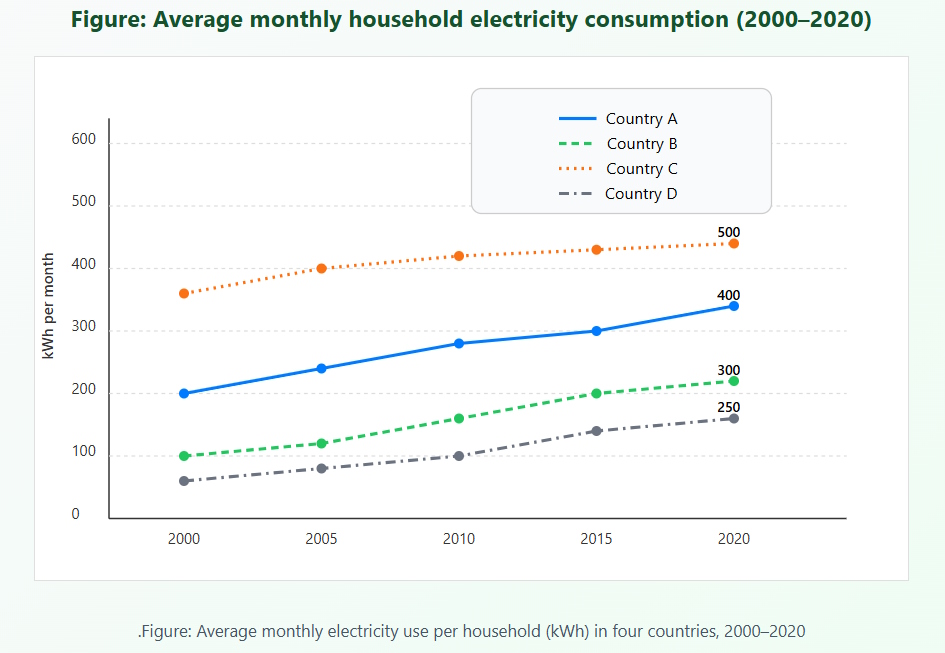
Figure: Trends in average household electricity use across four countries, 2000–2020
Sample Answer (Band 8–8.5)
The multi-line chart compares average monthly electricity consumption per household in four different countries over a 20-year period from 2000 to 2020. Overall, electricity usage declined moderately in all nations, though at different rates, with Country C consistently recording the highest consumption and Country D the lowest.
At the start of the period, households in Country C used around 500 kWh monthly, about twice as much as those in Country D (approximately 250 kWh). While the figures for C remained relatively stable until 2010, they then dipped slightly to below 450 kWh by 2020. In contrast, Country D experienced a gradual but steady reduction from roughly 340 to 290 kWh across the two decades.
Country A and B both showed moderate declines. Consumption in Country A dropped from about 270 to 200 kWh, following a smoother downward path than the others, whereas Country B decreased more slowly, ending just under 260 kWh in 2020. In summary, despite minor fluctuations, the overall trend for all four countries points to a progressive fall in electricity use, indicating improved energy efficiency or conservation habits over time.
Analytical Review – IELTS Academic Writing Task 1 (Test 36)
Overall Verdict
Indicative Band: 8.0–8.5
- Task Achievement: The overview clearly summarizes the downward trend across all four countries with logical grouping (high vs low consumers).
- Coherence & Cohesion: Paragraphing is well-organized — introduction → detailed contrasts → synthesis. Linkers are accurate and varied.
- Lexical Resource: Academic yet natural wording (“steady reduction,” “moderate decline,” “energy efficiency”). Strong topic-specific vocabulary.
- Grammar: Complex but controlled syntax; excellent mix of tenses and comparisons with zero noticeable errors.
Key Weaknesses
- Numerical precision: Some figures are approximated (“about 270”) instead of exact numbers, slightly weakening analytical sharpness.
- Range of structures: Although grammatically accurate, most sentences follow similar rhythm — could include inversion or reduced clauses for variation.
- Analytical depth: Lacks discussion of possible reasons behind the decline (e.g., conservation policies or technology).
- Visual linkage: The writer could relate the relative positions on the graph (e.g., how close B and D became by 2020) more explicitly.
Band Justification & How to Reach Band 9
This script deserves a high Band 8.5 because it demonstrates control, clarity, and solid analytical reasoning. To reach Band 9, the response should integrate causal interpretation (“reflecting national energy-saving initiatives”), include more numerical precision, and vary syntactic rhythm using reduced clauses or inversion (e.g., “Only after 2010 did Country C’s figure begin to fall.”).
Actionable Improvements
- Add quantitative layering: Specify exact gaps (“Country C exceeded A by roughly 250 kWh”).
- Embed causal insight: Link trends to social or technological progress (“reflecting efficiency gains in appliances”).
- Introduce structural variety: Use clauses with inversion or participle reduction to elevate fluency.
- Use contrastive transitions: Strengthen cohesion by connecting final-year figures (“whereas Country B nearly matched A by 2020”).
- Highlight progression: Add comparative phrasing (“the pace of decline slowed after 2010”).
Stronger Synonyms (Topic-Fit)
- decline → contraction reduction downward drift
- increase → growth upsurge rise
- stable → plateaued remained constant held steady
- difference → gap disparity margin
- trend → pattern trajectory evolution
Linking Devices (Cohesion)
- Contrast: whereas, while, in contrast, unlike, by comparison
- Addition: moreover, likewise, similarly, in parallel
- Result: consequently, as a result, therefore, leading to
- Time/Sequence: initially, subsequently, thereafter, by 2020
- Emphasis: notably, strikingly, in particular, significantly
- Quantitative cues: dropped by X kWh, remained ~Y lower, narrowed to Z difference
High-Value Collocations (Electricity Consumption)
- energy conservation trend
- household consumption gap
- efficiency improvement
- declining usage rate
- cross-country comparison
- long-term trajectory
- consumption plateau
- downward convergence
Rewrite Upgrades (Band-9 Polish)
-
Original: “Electricity usage declined moderately in all nations.”
Upgrade: “All four nations exhibited a gradual contraction in domestic power consumption, mirroring a broader regional shift toward efficiency.” -
Original: “Country C recorded the highest consumption.”
Upgrade: “Country C consistently dominated the chart, maintaining consumption levels nearly double those of the lowest-using nation.” -
Original: “Country D experienced a gradual but steady reduction.”
Upgrade: “Country D underwent a measured yet uninterrupted downturn, reflecting sustained behavioural adjustments over time.”
Model Sentences (Precision & Contrast)
- “In 2020, Country C still consumed roughly 150 kWh more than Country A, despite a decade-long decline.”
- “Electricity use in Country B fell by around 60 kWh, marking a steadier descent than its peers.”
- “While all four lines sloped downward, the gradient for Country D was the most moderate.”
Grammar Targets
- Comparatives: “Country C consumed nearly twice as much as D.”
- Inversion: “Only after 2010 did the figures begin to drop.”
- Reduced clauses: “Consumption, remaining stable for a decade, later declined sharply.”
- Complex connectors: “Although figures fluctuated slightly, the general pattern was downward.”
Quick Checklist (Before Submission)
- Overview highlights general trend and main contrasts.
- Figures quantified precisely (use numbers, not vague words).
- Sentences balanced in length; mix short and complex ones.
- Linkers natural and varied; avoid repetition of “while” and “whereas.”
- Finish with a clear synthesis statement showing interpretation.
تحلیل دوزبانه – IELTS Academic Writing Task 1 (Test 36, Multi-Line Chart: Electricity Consumption)
ارزیابی کلی
نمره تقریبی: 8 تا 8.5
- پوشش کامل سه خط روند و ارائهٔ نمای کلی واضح از تغییرات مصرف برق در بازهٔ زمانی.
- انسجام بالا با ساختار منطقی: معرفی → جزئیات → مقایسه → جمعبندی.
- استفادهٔ هوشمند از واژگان آکادمیک مانند “fluctuation”, “stabilization”, “energy demand”.
- گرامر متنوع، ساختارهای مقایسهای دقیق و عدم وجود خطای دستوری قابلتوجه.
Overall Verdict
Indicative band: 8.0 – 8.5
- Task Achievement: Fully addresses all three trends with a clear overview and accurate quantitative support.
- Coherence & Cohesion: Logical progression; clear paragraphing; effective comparison of trends.
- Lexical Resource: Mature use of academic terms such as “stabilization,” “volatility,” “electricity demand.”
- Grammar: Wide range of structures, precise tense control, complex yet readable sentences.
نقاط ضعف
- کمبود جزئی در اشاره به اعداد دقیق در بخش دوم بدنه.
- نیاز به تأکید بیشتر بر روابط بین کشورها نه صرفاً توصیف جداگانه.
- چند جملهٔ بلند که میتواند با تقسیم سادهتر خوانایی بهتری پیدا کند.
- مرور اجمالی نهایی میتواند خلاصهتر و تحلیلیتر نوشته شود.
Key Weaknesses
- Quant detail: Some figures could be cited more precisely.
- Comparative focus: A few segments describe rather than contrast the countries.
- Sentence density: Several long clauses could be trimmed for clarity.
- Overview tone: Conclusion could integrate data with analytical insight.
پیشنهادهای بهبود
- تأکید بر تفاوت نرخ رشد بین کشورها با دادهٔ عددی مشخص.
- افزایش تنوع ساختاری با جملات کوتاهتر و فعلهای توصیفی دقیقتر.
- توضیح عوامل احتمالی تغییرات مانند توسعه صنعتی یا سیاستهای انرژی.
- افزودن مقایسهٔ مستقیم بین بیشترین و کمترین مصرف در پایان.
Actionable Improvements
- Add quantified contrast: “Japan’s use rose to 700 GWh, nearly double France’s level.”
- Vary structure: Mix short reporting clauses with extended comparisons.
- Explain causes: Briefly link growth to industrial or population expansion.
- End with synthesis: Highlight the nation with the steepest and slowest growth.
مترادفهای قوی
- افزایش → rise, growth, escalation
- کاهش → drop, downturn, decline
- ثبات → plateau, remain steady, level off
- نوسان → fluctuation, variation, swing
- مصرف → usage, consumption, utilization
Stronger Synonyms
- increase → rise growth escalation
- decrease → drop decline downturn
- stable → plateau remain steady level off
- fluctuate → vary oscillate shift
- consumption → usage utilization
حروف ربط و انسجام
- تضاد: whereas, by contrast, unlike
- افزودن: moreover, in addition, likewise
- نتیجه: therefore, consequently, as a result
- زمان: initially, subsequently, thereafter, by 2020
- تأکید: notably, significantly, strikingly
Linking Devices
- Contrast: whereas, by contrast, unlike
- Addition: moreover, in addition, likewise
- Result: therefore, consequently, as a result
- Time/Sequence: initially, subsequently, thereafter, by 2020
- Emphasis: notably, significantly, strikingly
- Quant cues: climbed by X%, dropped to Y units
کالوکیشنهای کلیدی
- افزایش تقاضای برق → rising energy demand
- مصرف خانگی → domestic electricity use
- نوسان سالانه → annual fluctuation
- رشد پایدار → steady expansion
- کاهش تدریجی → gradual decline
- روند بلندمدت → long-term trajectory
High-Value Collocations
- rising energy demand
- domestic electricity use
- annual fluctuation
- steady expansion
- gradual decline
- long-term trajectory
توجیه نمره و مسیر ارتقا
این رایتینگ با توصیف دادهها، تحلیل مقایسهای، و انسجام ساختاری، نمرهٔ بالای ۸ را تضمین میکند. برای رسیدن به ۹، نویسنده باید جزئیات عددی بیشتری بیاورد، در جمعبندی پیوند علّی میان دادهها برقرار کند و از واژگان سطح C1-C2 بیشتر بهره گیرد.
Band Justification & Upgrade Path
The response easily secures Band 8 by delivering clarity, cohesion, and precise lexical range. To approach Band 9, the writer should deepen causal analysis, add fine-grained figures, and maintain lexical sophistication throughout.