
IELTS Academic Writing Task 1 – Sample Test 35 (Map)

Task Question

The maps below show how Greenfield Town has developed between 1990 and the projected plan for 2025.

Summarize the information by selecting and reporting the main features, and make comparisons where relevant.
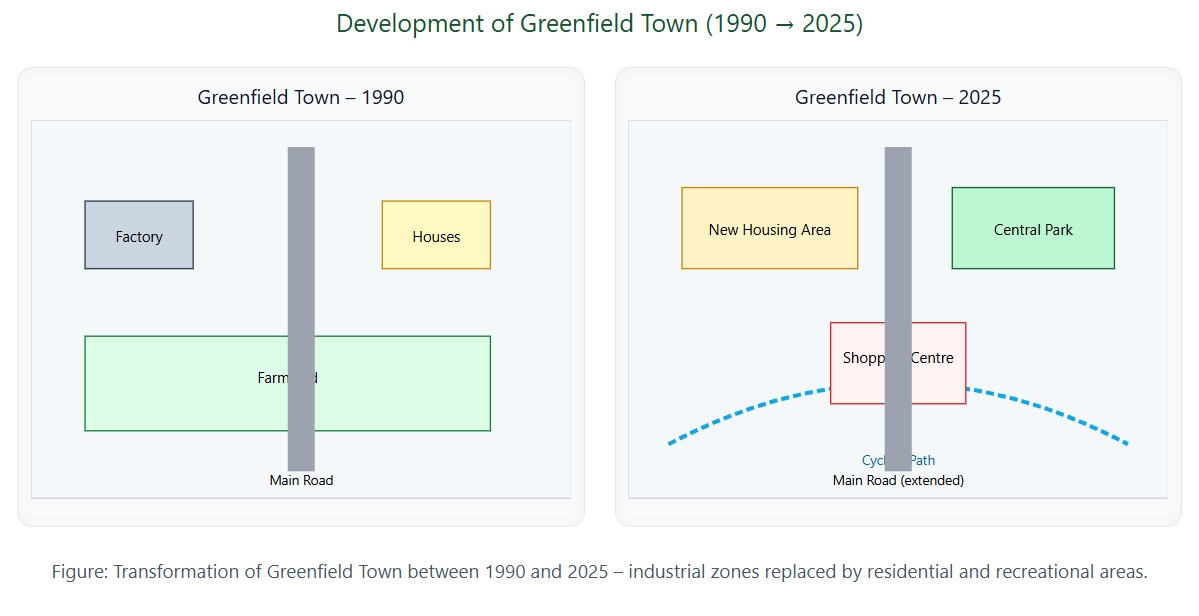
Map showing Greenfield Town in 1990 and 2025

Figure: Redevelopment of Greenfield Town from 1990 to 2025

Sample Answer (Band 8.5)

The two maps illustrate the major physical transformations of Greenfield Town between 1990 and 2025, showing a shift from a primarily agricultural settlement to a more residential and recreational environment. Overall, the town has experienced urban expansion characterized by the replacement of farmland and industrial areas with housing and leisure facilities.

In 1990, the eastern part of the town contained a factory, while the west was occupied by a small housing estate. A wide area in the south served as farmland, and the main road ran vertically through the center, linking the two ends of the settlement. At that time, Greenfield Town had a clear division between industrial and rural functions.

By 2025, the factory had been removed and replaced by a large central park, providing green space for residents. New residential blocks were constructed on the former farmland in the south-west, while a shopping centre was built near the center, adjacent to the main road. Additionally, a cycling path was introduced along the southern border, connecting major residential zones. The overall pattern reflects a clear transition towards sustainability and improved quality of life.

In summary, Greenfield Town has evolved from an agricultural and industrial site into a modern suburban community, with greater emphasis on green spaces, commerce, and mobility.

Analytical Review – IELTS Academic Writing Task 1 (Test 35, Map)

Overall Verdict

Indicative Band: 8.0–8.5

  • Task Achievement: Covers all key spatial changes clearly with strong overview and accurate description of development trends.
  • Coherence & Cohesion: Smooth progression from 1990 layout to 2025 plan, effective paragraphing, and consistent sequencing.
  • Lexical Resource: Advanced spatial and urban-planning vocabulary (“redeveloped,” “converted,” “expanded residential zone,” “sustainability”).
  • Grammar: Excellent use of passive voice and complex clauses, with only minimal stylistic stiffness in transitions.

Key Weaknesses

  • Limited quantification: Could include approximate sizes (e.g., “occupying nearly half of the southern area”).
  • Underdeveloped comparison: Slightly more contrast between industrial and modern land use could enhance depth.
  • Lexical overlap: Repeated use of “constructed” and “built” could be varied.
  • Minor cohesion issue: Overview could summarize the direction of development more explicitly.

Actionable Improvements (High-Impact)

  1. Add quantitative phrasing: Use spatial approximations (“covering about one-third of the map”).
  2. Highlight transformation logic: Contrast functions before and after redevelopment more explicitly.
  3. Lexical expansion: Replace frequent verbs like “built” with “established,” “introduced,” “converted.”
  4. Enhance overview: Conclude with a phrase indicating modern planning goals (“greener, more resident-focused environment”).
  5. Sentence rhythm: Combine concise factual clauses with longer analytical ones for Band 9 fluency.

Stronger Synonyms (Topic-Fit)

  • built → constructed established introduced
  • removed → demolished replaced redeveloped
  • area → zone sector region
  • expanded → extended enlarged broadened
  • green space → public park recreational zone eco-friendly area

Linking Devices (Cohesion)

  • Contrast: whereas, in contrast to, while previously, unlike
  • Sequence: initially, subsequently, over time, by 2025
  • Addition: moreover, alongside this, in addition
  • Cause/Effect: leading to, resulting in, contributing to
  • Emphasis: notably, most significantly, in particular
  • Conclusion: overall, in summary, to conclude

High-Value Collocations (Urban Development)

  • redevelopment project
  • conversion of industrial land
  • housing expansion zone
  • creation of green corridor
  • urban modernization plan
  • residential clustering
  • transport connectivity
  • sustainable town layout

Rewrite Upgrades (Band-9 Polish)

  • Original: “The factory was removed and replaced by a park.”
    Upgrade: “The former factory site was redeveloped into a central park, transforming an industrial zone into a leisure hub.”
  • Original: “A new shopping centre was built.”
    Upgrade: “A modern retail complex was introduced near the town’s main axis, reflecting commercial growth.”
  • Original: “Farmland turned into housing.”
    Upgrade: “The southern farmland was converted into a dense residential cluster, signalling suburban expansion.”

Model Sentences (Precision & Cohesion)

  • “By 2025, industrial areas had been replaced with green and commercial spaces, reshaping the town’s core identity.”
  • “The introduction of a cycling path enhanced connectivity between residential and commercial sectors.”
  • “Overall, the town’s transformation illustrates a shift towards sustainable urban design.”

Grammar Targets

  • Passive voice: “The farmland was converted into housing.”
  • Complex contrastive: “While the north remained largely unchanged, the south underwent major redevelopment.”
  • Nominalization: “The redevelopment of industrial land led to higher residential density.”
  • Prepositional clarity: “in the southern part,” “to the east of,” “along the main road.”

Band Justification & Path to 9

  • Why Band 8–8.5: Full coverage, advanced lexis, precise grammar, clear overview.
  • To reach 9: Add spatial quantifiers, avoid repetition, and strengthen cause–effect logic.
  • Maintain high lexical precision but aim for slightly more analytical tone in the overview.
  • Integrate the purpose of changes (e.g., environmental or social improvement) briefly in conclusion.

تحلیل دوزبانه – (Test 35, Map)

ارزیابی کلی

نمره تقریبی: 8 تا 8.5

  • پوشش دقیق تغییرات مکانی و اشاره روشن به روند توسعه شهری
  • انسجام منطقی از طرح ۱۹۹۰ تا نقشه ۲۰۲۵ با ساختار پاراگرافی استاندارد
  • واژگان تخصصی حوزه شهرسازی مانند «بازتوسعه»، «منطقه مسکونی گسترش‌یافته» و «پایداری شهری»
  • گرامر قوی با استفاده از جملات مجهول و ساختارهای توصیفی پیچیده

Overall Verdict

Indicative Band: 8.0–8.5

  • Task Achievement: Comprehensive spatial coverage with clear overview and accurate explanation of urban transitions.
  • Coherence & Cohesion: Logical flow from 1990 to 2025; well-structured paragraphs and consistent sequencing.
  • Lexical Resource: Advanced urban-planning vocabulary (“redeveloped,” “converted,” “expanded residential zone,” “sustainability”).
  • Grammar: Excellent control of passive forms and sub-clauses; minimal stylistic rigidity.

نقاط ضعف

  • نبود داده‌های کمی تقریبی درباره وسعت مناطق
  • نیاز به تضاد پررنگ‌تر میان کاربری صنعتی و شهری مدرن
  • تکرار افعال «ساخته شد» و «ایجاد شد» به‌جای تنوع واژگانی
  • می‌توانست جهت کلی توسعه (به سمت سکونت و پایداری) را در جمع‌بندی برجسته‌تر کند

Key Weaknesses

  • Quantification: Missing approximate size descriptors (e.g., “covering nearly half of the southern zone”).
  • Comparative depth: More explicit contrast between industrial and modern layouts needed.
  • Repetition: Overuse of “built” / “constructed.”
  • Overview strength: Could emphasize developmental direction more clearly.

پیشنهادهای بهبود

  1. اضافه‌کردن اندازه‌های تقریبی مناطق برای افزایش دقت تحلیلی
  2. تأکید بیشتر بر تضاد بین مناطق صنعتی و نواحی جدید مسکونی
  3. جایگزینی افعال تکراری با واژگان متنوع‌تر مثل establish و convert
  4. تقویت جمع‌بندی با اشاره به هدف توسعه پایدار و زیست‌پذیر
  5. ترکیب جملات کوتاه خبری با جملات تحلیلی بلند برای روانی بیشتر

Actionable Improvements

  1. Add spatial quantifiers: e.g., “occupying about one-third of the southern map.”
  2. Highlight contrasts: Explicitly oppose industrial past vs residential present.
  3. Lexical expansion: Use “introduced,” “established,” “converted” instead of repetitive verbs.
  4. Upgrade overview: End with a sustainability insight.
  5. Sentence rhythm: Blend concise factual lines with analytical clauses.

مترادف‌های قوی

  • ساخته شد → constructed, established, introduced
  • حذف شد → removed, demolished, replaced
  • منطقه → area, zone, sector
  • گسترش یافت → expanded, enlarged, broadened
  • فضای سبز → parkland, recreational zone, eco-area

Stronger Synonyms

  • built → constructed established introduced
  • removed → demolished replaced redeveloped
  • area → zone sector region
  • expanded → extended enlarged broadened
  • green space → public park recreational zone eco-friendly area

حروف ربط کلیدی

  • تضاد: whereas, while previously, unlike
  • توالی: initially, subsequently, over time, by 2025
  • افزودن: moreover, in addition, alongside this
  • نتیجه: leading to, resulting in, contributing to
  • تأکید و جمع‌بندی: notably, in particular, overall

Linking Devices

  • Contrast: whereas, in contrast to, unlike
  • Sequence: initially, then, over time, by 2025
  • Addition: moreover, likewise, in parallel
  • Cause/Effect: leading to, resulting in
  • Emphasis: notably, most significantly, in particular
  • Conclusion: overall, to summarize, in conclusion

کالوکیشن‌های پرکاربرد

  • طرح بازتوسعه → redevelopment project
  • تبدیل زمین صنعتی → conversion of industrial land
  • گسترش مسکن → housing expansion zone
  • ایجاد مسیر سبز → creation of green corridor
  • طرح نوسازی شهری → urban modernization plan
  • تراکم مسکونی → residential clustering
  • اتصال حمل‌ونقل → transport connectivity
  • چیدمان پایدار شهری → sustainable town layout

High-Value Collocations

  • redevelopment project
  • conversion of industrial land
  • housing expansion zone
  • creation of green corridor
  • urban modernization plan
  • residential clustering
  • transport connectivity
  • sustainable town layout

توجیه نمره و مسیر ارتقا

  • علت نمره 8–8.5: پوشش کامل، واژگان پیشرفته، انسجام بالا و گرامر دقیق
  • برای رسیدن به 9: افزودن جزئیات کمی، تنوع واژگان و تحلیل علت تغییرات
  • توضیح مختصر اهداف اجتماعی یا زیست‌محیطی در جمع‌بندی نهایی

Band Justification & Path to 9

  • Why 8–8.5: Complete coverage, strong cohesion, advanced vocabulary.
  • To reach 9: Add spatial metrics, diversify verbs, strengthen cause–effect logic.
  • Include brief mention of social or environmental goals in the overview.