
IELTS Academic Writing Task 1 – Test 32 (Process Diagram)

Task Question

The diagram below illustrates the five-stage recycling process through which raw materials are transformed into finished products and reintroduced into production after consumption.

Summarize the information by selecting and reporting the main features, and make comparisons where relevant.
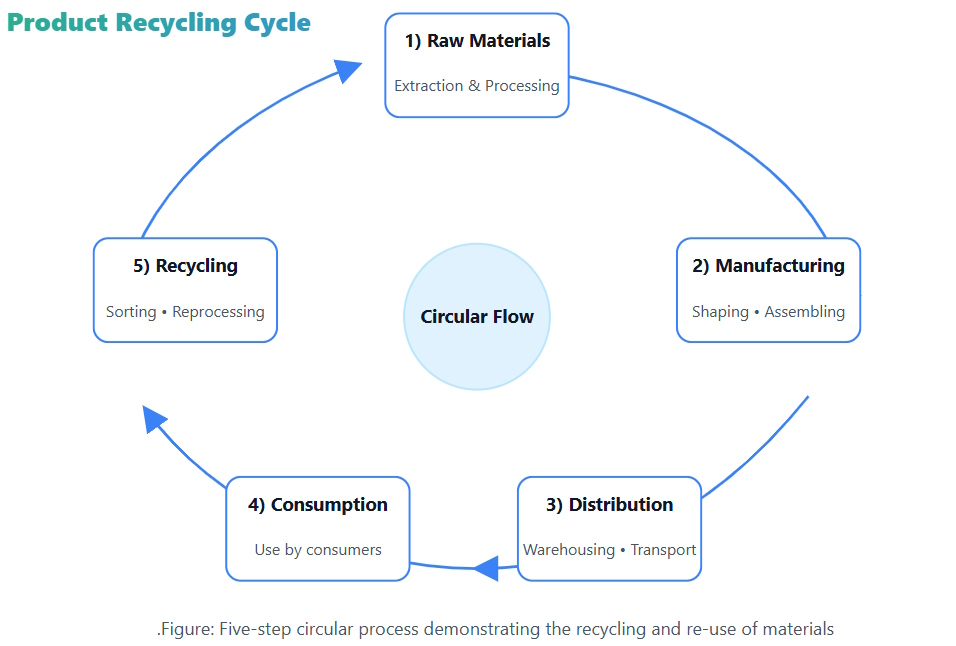
Five-step Product Recycling Cycle (Raw Materials → Manufacturing → Distribution → Consumption → Recycling)

Figure: The circular flow of production and recycling in five stages.

Sample Answer (Band 8–8.5)

The diagram illustrates a five-stage circular process in which raw materials are extracted, manufactured into products, distributed to consumers, and then reprocessed for reuse through recycling. Overall, the cycle demonstrates a sustainable approach that minimizes waste by returning used materials to the early stages of production.

In the first stage, raw materials such as metal ores, oil, and natural fibers are extracted from the environment and refined to obtain usable inputs. These are then passed to the manufacturing stage, where they are shaped, combined, and assembled into finished goods through industrial production.

Next, the goods enter the distribution phase, during which they are transported to warehouses and retail outlets for sale to consumers. Following purchase, they are consumed or used in households or businesses. Once their useful life ends, waste items are collected, sorted, and reprocessed at recycling facilities to recover valuable materials such as metals or plastics.

Finally, these recycled inputs are reintegrated into the production cycle, reducing dependence on virgin resources. The process as a whole highlights the importance of closed-loop manufacturing in achieving environmental sustainability and resource efficiency.

Analytical Review – IELTS Academic Writing Task 1 (Test 32, Process Diagram: Product Recycling Cycle)

Overall Verdict

Indicative Band: 8.0–8.5

  • Task Achievement: Fully describes all five stages with clear sequencing and accurate process logic.
  • Coherence & Cohesion: Smooth paragraph transitions; strong overview emphasizing sustainability.
  • Lexical Resource: Excellent use of technical and environmental vocabulary (“closed-loop,” “reprocessing,” “resource efficiency”).
  • Grammar: Highly controlled complex sentences with passive and nominalized forms.

Key Weaknesses

  • Lack of quantitative references: No approximate data or proportions mentioned.
  • Limited variety of linkers: Most transitions rely on “then” and “next.”
  • Repetition risk: Overuse of “stage” and “process” slightly weakens lexical flexibility.
  • Minimal conclusion: Final statement could summarize implications for sustainability more analytically.

Actionable Improvements

  1. Add brief quantifiers: e.g., “most raw materials,” “a small proportion of waste is reprocessed.”
  2. Increase lexical diversity: Replace repeated nouns (“process,” “stage”) with “phase,” “cycle,” or “step.”
  3. Expand conclusion: Include one sentence linking recycling to environmental or economic outcomes.
  4. Refine cohesion: Incorporate sequencing adverbs such as “subsequently,” “afterward,” or “ultimately.”
  5. Demonstrate analytical tone: Add brief interpretation (e.g., “This illustrates the efficiency of circular economies”).

Stronger Synonyms (Process Context)

  • process → cycle procedure sequence
  • stage → phase step segment
  • materials → inputs resources
  • product → output manufactured item
  • recycling → reprocessing material recovery

Linking Devices (Cohesion)

  • Sequence: initially, subsequently, afterward, eventually, ultimately
  • Contrast: whereas, while, unlike, in contrast
  • Result: therefore, consequently, as a result
  • Emphasis: notably, particularly, most significantly
  • Purpose: to reduce waste, to minimize raw material use
  • Summary: overall, to conclude, in summary

High-Value Collocations (Process & Sustainability)

  • closed-loop production
  • raw material extraction
  • industrial manufacturing phase
  • distribution network
  • consumer usage stage
  • recycling facility
  • material recovery system
  • environmental sustainability

Band Justification & Path to Band 9

The response clearly meets the Band 8–8.5 criteria by covering all process steps with precise sequencing and academic tone. To approach Band 9, the candidate should integrate approximate quantifiers to add realism, employ greater lexical flexibility across stages, and include a more interpretive overview linking recycling to long-term sustainability or circular economy principles. A stronger analytical conclusion reflecting environmental implications would elevate the insight to a near-native level.

Grammar Targets

  • Complex clauses: “Raw materials, which are extracted from natural sources, are refined before use.”
  • Passives: “Used items are collected and reprocessed into reusable materials.”
  • Nominalizations: “The reprocessing of waste contributes to sustainability.”
  • Comparatives: “This cycle is more efficient than traditional linear production.”

Checklist Before Submission

  • All five stages are described in logical order.
  • Overview includes sustainability insight.
  • Lexical variety maintained across paragraphs.
  • Linkers and sequencing adverbs used naturally.
  • Grammar accurate; tone formal and objective.

تحلیل دوزبانه – Test 32, Process Diagram: Product Recycling Cycle

ارزیابی کلی

نمره تقریبی: 8.0 تا 8.5

  • پوشش کامل پنج مرحلهٔ اصلی چرخه با توالی و منطق روشن
  • انسجام قوی میان پاراگراف‌ها و مرور کلی دقیق از پایداری زیست‌محیطی
  • واژگان تخصصی و علمی در حوزهٔ تولید و بازیافت (مانند “closed-loop”, “reprocessing”)
  • کنترل عالی ساختارهای پیچیده و جملات مجهول

Overall Verdict

Indicative Band: 8.0–8.5

  • Task Achievement: Fully describes all five stages with clear sequencing and logical flow.
  • Coherence & Cohesion: Excellent paragraph structure and cohesive overview focusing on sustainability.
  • Lexical Resource: Advanced technical vocabulary related to recycling and manufacturing (“closed-loop,” “resource efficiency”).
  • Grammar: Accurate control of complex and passive structures with consistent tense usage.

نقاط ضعف

  • نبود داده‌های عددی یا تقریبی برای تقویت واقع‌نمایی
  • وابستگی زیاد به واژه‌های تکراری مانند “process” یا “stage”
  • نتیجه‌گیری کوتاه و بدون تحلیل اثرات بلندمدت بازیافت
  • فقدان تنوع در استفاده از قیدهای ترتیب و نتیجه

Key Weaknesses

  • No quantification: Missing approximate data such as “most materials” or “small proportion.”
  • Repetition risk: Overuse of “stage” and “process” reduces lexical range.
  • Limited conclusion: Lacks deeper analysis of sustainability impact.
  • Restricted connectors: Mostly uses “then” and “next.”

پیشنهادهای بهبود

  1. افزودن داده‌های تقریبی برای تقویت جنبه تحلیلی
  2. جایگزینی واژه‌های تکراری با گزینه‌های مترادف فنی‌تر
  3. گسترش نتیجه‌گیری با اشاره به پیامدهای اقتصادی و محیطی
  4. افزایش انسجام با قیدهای ترتیبی متنوع (e.g. subsequently, ultimately)
  5. افزودن جملات تحلیلی که چرخه را به پایداری پیوند دهند

Actionable Improvements

  1. Add approximate quantifiers to make descriptions more realistic.
  2. Replace repeated terms (“process,” “stage”) with varied synonyms like “cycle,” “phase,” or “step.”
  3. Expand the conclusion to discuss sustainability and resource efficiency.
  4. Use advanced sequencing adverbs for smoother cohesion.
  5. Include an interpretive comment linking recycling to environmental goals.

مترادف‌های قوی (چرخه و فرایند)

  • process → cycle, procedure, sequence
  • stage → phase, step, segment
  • materials → inputs, resources
  • product → output, manufactured item
  • recycling → reprocessing, material recovery

Stronger Synonyms (Process Context)

  • process → cycle, procedure, sequence
  • stage → phase, step, segment
  • materials → inputs, resources
  • product → output, manufactured item
  • recycling → reprocessing, material recovery

حروف ربط و انسجام

  • ترتیب: initially, subsequently, afterward, eventually, ultimately
  • تضاد: whereas, while, unlike
  • نتیجه: therefore, consequently, as a result
  • تأکید: notably, particularly, most significantly

Linking Devices (Cohesion)

  • Sequence: initially, subsequently, afterward, ultimately
  • Contrast: whereas, while, unlike
  • Result: therefore, consequently, as a result
  • Emphasis: notably, particularly, most significantly
  • Purpose: to reduce waste, to minimize raw material use
  • Summary: overall, to conclude, in summary

کالوکیشن‌های کلیدی (تولید و بازیافت)

  • closed-loop production / تولید چرخه‌ای
  • raw material extraction / استخراج مواد خام
  • industrial manufacturing phase / مرحلهٔ تولید صنعتی
  • distribution network / شبکهٔ توزیع
  • consumer usage stage / مرحلهٔ مصرف
  • recycling facility / مرکز بازیافت
  • material recovery system / سیستم بازیابی مواد
  • environmental sustainability / پایداری محیط‌زیستی

High-Value Collocations

  • closed-loop production
  • raw material extraction
  • industrial manufacturing phase
  • distribution network
  • consumer usage stage
  • recycling facility
  • material recovery system
  • environmental sustainability

توجیه نمره و مسیر تا Band 9

پاسخ با پوشش کامل مراحل و واژگان دقیق علمی، نمرهٔ 8 تا 8.5 را کسب می‌کند. برای رسیدن به Band 9 لازم است: ۱) داده‌های تقریبی برای واقع‌گرایی افزوده شود، ۲) تنوع واژگانی و ساختاری تقویت گردد، و ۳) نتیجه‌گیری نهایی دیدگاه تحلیلی نسبت به اثرات زیست‌محیطی ارائه دهد. تأکید بر مفهوم “circular economy” و پایداری منابع می‌تواند پاسخ را به سطح نیتیو نزدیک کند.

Band Justification & Path to Band 9

This response easily reaches Band 8–8.5 through clear structure and academic tone. To achieve Band 9, include quantitative estimations, enhance lexical flexibility, and craft a more analytical conclusion linking the process to long-term sustainability and circular economy principles.

اهداف گرامری

  • جملات مرکب: «مواد خام که از منابع طبیعی استخراج می‌شوند، قبل از استفاده تصفیه می‌گردند.»
  • مجهول: «اقلام استفاده‌شده جمع‌آوری و دوباره پردازش می‌شوند.»
  • اسم‌مصدرسازی: «Reprocessing of waste contributes to sustainability.»
  • مقایسه‌ای: «This cycle is more efficient than traditional production.»

Quick Checklist (Before Submit)

  • All five stages clearly explained in logical order.
  • Overview includes sustainability focus.
  • Lexical variety and cohesive devices applied.
  • Consistent passive and complex structures.
  • Analytical conclusion summarizing key insight.