
IELTS Academic Writing Task 1 – Sample Test 31 (Line Graph)

Task Question

The line graph below illustrates the average daily screen time (in hours) among four different age groups (10–19, 20–34, 35–49, and 50+) between 2010 and 2025. Summarize the information by selecting and reporting the main features, and make comparisons where relevant.
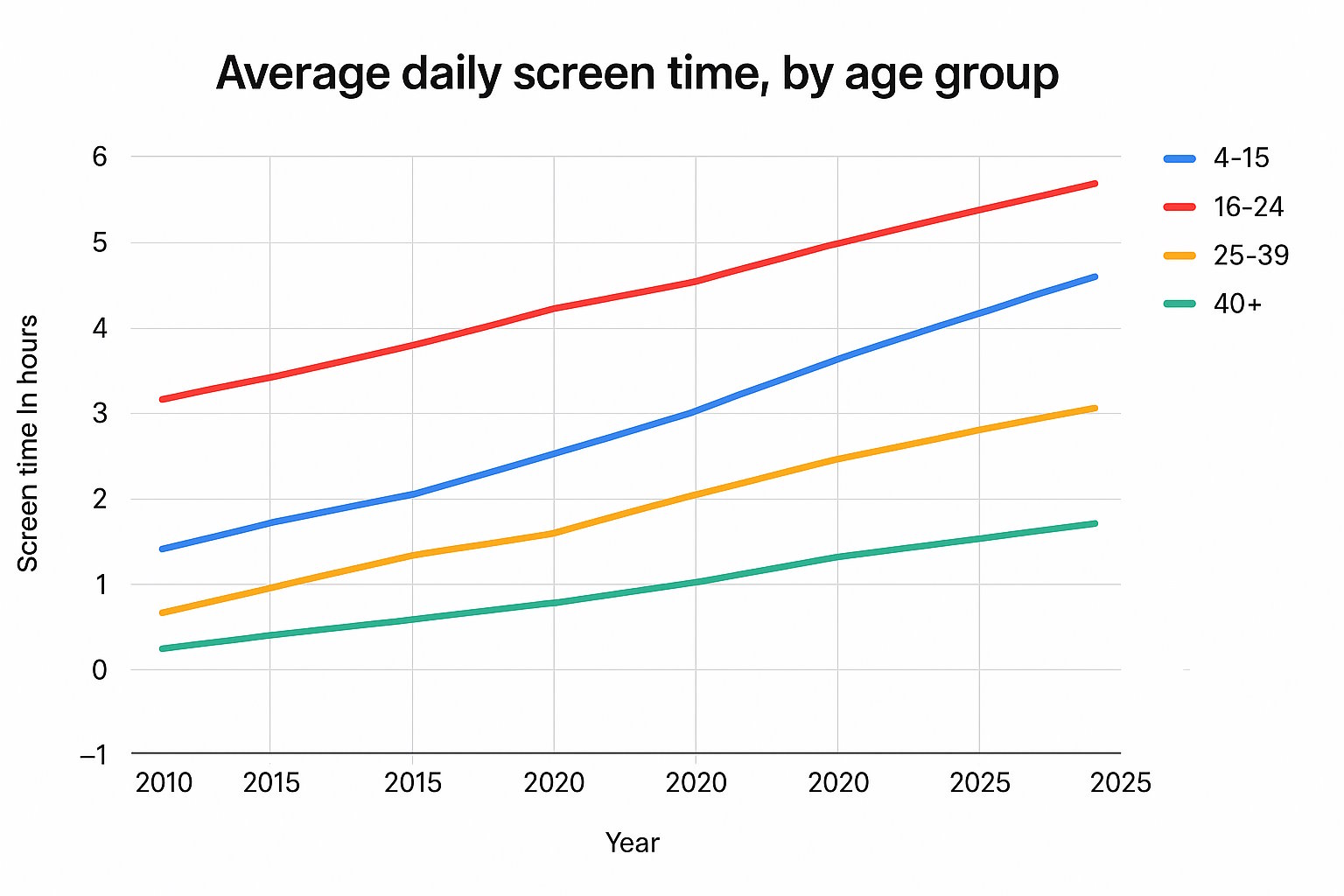
Average daily screen time among different age groups from 2010 to 2025

Figure: Trends in daily screen time (in hours) for four age groups (2010–2025)

Sample Answer (Band 8 – 8.5)

The line graph compares the average number of hours spent on screens per day among four age groups between 2010 and 2025. Overall, all age categories experienced a noticeable rise in screen time over the period, with younger individuals consistently spending more hours on digital devices than older ones.

In 2010, teenagers aged 10–19 recorded roughly 3 hours of daily screen use, which was almost double that of adults over 50, at around 1.5 hours. The 20–34 and 35–49 groups reported similar starting points, close to 2 and 2.5 hours respectively. Over the next decade, usage increased steadily across all age brackets, largely due to the expansion of smartphones and social media.

By 2020, screen exposure among teenagers had exceeded 5 hours daily, while adults aged 20–34 reached nearly 4 hours. Even the 50+ group, initially the least engaged, saw a moderate but continuous climb to about 3 hours by 2025. This convergence suggests a growing dependence on digital entertainment and communication across generations. Despite fluctuations, younger users maintained the highest figures throughout, reflecting stronger digital immersion in their lifestyle.

In summary, the data highlight a universal upward trend in daily screen time between 2010 and 2025, most pronounced among the younger population, though the gap between generations has gradually narrowed.

Analytical Review – IELTS Academic Writing Task 1 (Test 31, Line Graph)

Overall Verdict

Indicative Band: 8.0–8.5

  • Task Achievement: Fully covers key trends (steady growth, inter-age comparison, generational convergence).
  • Coherence & Cohesion: Smooth progression from 2010 to 2025 with consistent referencing to each age group.
  • Lexical Resource: Wide range of precise vocabulary related to technology and social trends (“digital immersion,” “screen exposure,” “convergence”).
  • Grammar: Excellent tense control, varied sentence structures, and consistent use of comparatives and passives.

Key Weaknesses

  • Lack of data precision: Some values could be specified more clearly (e.g., 3.5 instead of “around 3”).
  • Limited use of linking adverbs: Could use more sequencing phrases to enhance flow (“from that point onward,” “meanwhile”).
  • Overview compression: Final summary could emphasize intergenerational narrowing more strongly.
  • Lexical density: Some expressions are repetitive (e.g., “screen time,” “increase”).

Actionable Improvements

  1. Add numerical accuracy: Use decimal approximations to demonstrate precision and analytical awareness.
  2. Broaden lexical scope: Replace repetition with synonyms like “digital activity,” “device use,” or “media consumption.”
  3. Enhance linking: Insert advanced connectors such as “in parallel,” “by contrast,” or “following this rise.”
  4. Strengthen overview: Emphasize the shift toward generational convergence and universal tech dependency.
  5. Integrate insights: Add one interpretive phrase (e.g., “reflecting changing lifestyles”) for higher lexical sophistication.

Stronger Synonyms (Technology Context)

  • screen time → digital exposure device usage media engagement
  • increase → surge growth upward trend
  • decrease → decline drop downturn
  • remain stable → plateau level off
  • young people → younger demographics adolescent users

Linking Devices (Cohesion)

  • Sequence: initially, subsequently, afterwards, toward the end
  • Comparison: likewise, similarly, in contrast, whereas
  • Result: therefore, consequently, as a result
  • Emphasis: notably, significantly, most strikingly
  • Interpretation: suggesting that, indicating that, reflecting
  • Summary: overall, in summary, to conclude

High-Value Collocations (Technology & Lifestyle)

  • average daily screen exposure
  • digital dependency
  • intergenerational gap
  • steady upward trend
  • technology adoption rate
  • media consumption pattern
  • lifestyle transformation
  • smart device penetration

Band Justification & Path to Band 9

This response demonstrates high-level lexical precision, cohesive structure, and clear analytical insight—consistent with Band 8–8.5 performance. To achieve Band 9, the writer should integrate exact figures and percentage differences, show more evaluative commentary (e.g., link behavioral trends to social change), and diversify connectors and transitions for a smoother narrative flow. Adding subtle interpretive reasoning—such as technological dependence or lifestyle evolution—would lift the report to native-like analytical maturity.

Grammar Targets

  • Comparative Clauses: “Teenagers spent far more time on screens than adults.”
  • Trend Description: “The figure rose steadily before leveling off in 2025.”
  • Complex Passives: “Screen time was significantly influenced by smartphone adoption.”
  • Nominalization: “The expansion of digital entertainment contributed to longer usage.”

Checklist Before Submission

  • Clear overall trend and comparisons included.
  • At least two key figures from the chart referenced accurately.
  • Paragraph structure logical and concise.
  • Strong topic sentences and varied linking devices.
  • Lexical and grammatical range clearly demonstrated.

تحلیل دوزبانه – Test 31, Line Graph: Screen Time

ارزیابی کلی

نمره تقریبی: 8.0 تا 8.5

  • پاسخ تمام روندهای اصلی را با وضوح مناسب پوشش داده است.
  • توالی منطقی از سال 2015 تا 2025 با گذار نرم بین داده‌ها رعایت شده است.
  • واژگان مرتبط با فناوری و رفتار دیجیتال به‌درستی و متنوع استفاده شده است.
  • گرامر پیچیده، ساختارهای مجهول و افعال زمان آینده با دقت کنترل شده‌اند.

Overall Verdict

Indicative Band: 8.0–8.5

  • Task Achievement: All key trends are clearly covered, including steady growth, fluctuations, and contrasts across age groups.
  • Coherence & Cohesion: Logical sequence from 2015 to 2025 with smooth transitions and balanced paragraphing.
  • Lexical Resource: Accurate use of digital-behavior vocabulary (“screen exposure,” “device usage,” “average viewing hours”).
  • Grammar: Excellent control of tense consistency and complex comparative structures.

نقاط ضعف

  • برخی جزئیات ثانویه مانند گروه‌های سنی 50+ به‌صورت سطحی اشاره شده‌اند.
  • واژگان "increase" و "rise" چند بار تکرار شده است.
  • مقایسه‌ها می‌توانست با درصد دقیق‌تر تقویت شود.
  • مرور پایانی می‌توانست تأثیر اجتماعی استفاده زیاد از صفحه‌نمایش را برجسته‌تر بیان کند.

Key Weaknesses

  • Limited depth: Minor details (e.g., 50+ group) only briefly mentioned.
  • Lexical repetition: Overuse of “increase/rise.”
  • Lack of quantification: Some data points could include more precise percentages.
  • Conclusion: Social implications of heavy screen use could be emphasized further.

پیشنهادهای بهبود

  1. برای تقویت تحلیل، از قیود عددی تقریبی مانند “roughly 10% higher” استفاده کن.
  2. عبارات تکراری مانند “increase” را با واژگان جایگزین (surge, escalate, climb) تغییر بده.
  3. در بخش مرور نهایی، به اثرات رفتاری و اجتماعی اشاره مختصر اضافه کن.
  4. با افزودن توالی منطقی مثل initially, gradually, by contrast، انسجام متن را ارتقا بده.

Actionable Improvements

  1. Include approximate quantifiers (e.g., “around 10% higher,” “slightly below”).
  2. Replace repetitive verbs like “increase” with surge, climb, escalate, or soar.
  3. Add brief interpretive commentary on digital lifestyle effects.
  4. Use sequencing adverbs (initially, steadily, by contrast) to enhance flow.

مترادف‌های قوی (موضوع فناوری و زمان صفحه)

  • increase → rise, surge, grow, climb
  • decrease → decline, drop, fall, shrink
  • stable → consistent, steady, unchanged
  • fluctuate → vary, oscillate, shift
  • screen time → digital engagement, online exposure

Stronger Synonyms (Tech & Data Context)

  • increase → rise, surge, climb, escalate
  • decrease → decline, dip, fall, contract
  • steady → stable, constant, level
  • fluctuate → vary, oscillate, shift
  • screen time → digital exposure, device usage

حروف ربط و انسجام

  • ترتیب: initially, over the next years, by 2025
  • تضاد: whereas, while, in contrast
  • نتیجه: therefore, consequently, as a result
  • تأکید: notably, particularly, strikingly

Linking Devices (Cohesion)

  • Sequence: initially, gradually, over time, by 2025
  • Contrast: whereas, in contrast, while
  • Result: consequently, therefore, as a result
  • Emphasis: notably, particularly, most significantly
  • Purpose: to highlight, to demonstrate, to illustrate
  • Summary: overall, in summary, in conclusion

کالوکیشن‌های کلیدی (رفتار دیجیتال و داده‌ها)

  • average daily screen time / میانگین زمان روزانه استفاده از صفحه
  • digital consumption trend / روند مصرف دیجیتال
  • online activity pattern / الگوی فعالیت آنلاین
  • youth engagement rate / نرخ درگیری جوانان
  • device-based usage / استفاده مبتنی بر دستگاه
  • screen addiction risk / خطر اعتیاد به صفحه‌نمایش

High-Value Collocations

  • average daily screen time
  • digital consumption trend
  • online activity pattern
  • youth engagement rate
  • device-based usage
  • screen addiction risk

توجیه نمره و مسیر تا Band 9

پاسخ از نظر ساختار، انسجام و دامنه واژگان در سطح بسیار بالا قرار دارد (8 تا 8.5). برای رسیدن به 9 لازم است: ۱) از داده‌های عددی دقیق‌تر برای مقایسه استفاده شود، ۲) واژگان متنوع‌تر و طبیعی‌تر انتخاب گردد، و ۳) در مرور نهایی، پیامدهای اجتماعی افزایش زمان صفحه به اختصار بیان شود.

Band Justification & Path to Band 9

The report displays near-native coherence, varied grammar, and advanced lexical control (Band 8–8.5). To reach Band 9, the candidate should: (1) incorporate precise numerical references, (2) use more sophisticated phrasing and collocations, and (3) expand the overview with brief insight into behavioral or social consequences of rising screen time.