
IELTS Academic Writing Task 1 – Sample Test 29 (Pie Charts)

Task Question

The two pie charts below show the percentage of time people spent on online and offline activities in 2010 and 2020. Activities are divided into four categories: Work/Study, Social Interaction, Entertainment, and Shopping. Summarize the information by selecting and reporting the main features, and make comparisons where relevant.
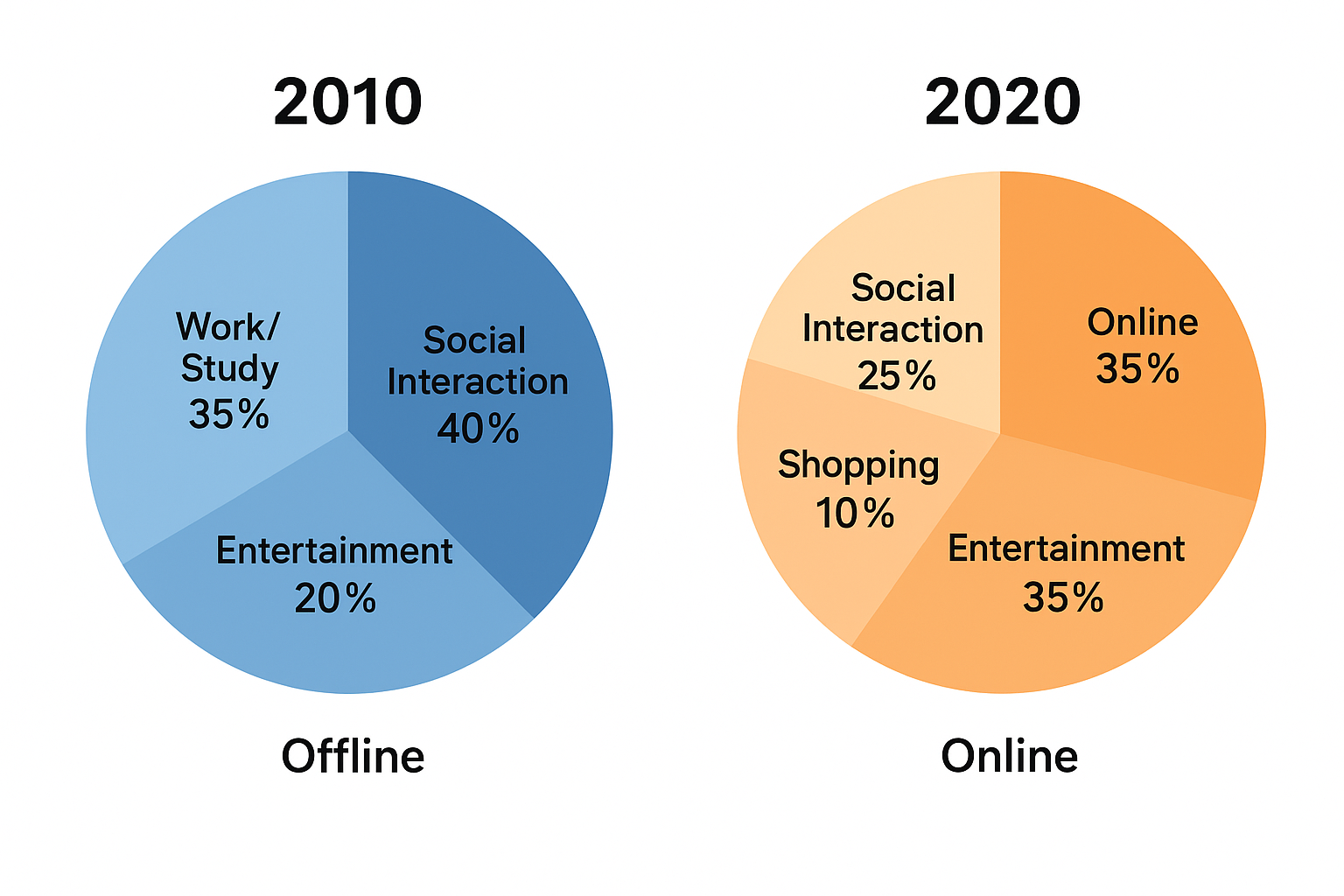
Comparison of time spent on online and offline activities in 2010 and 2020

Figure: Comparison of time spent on online and offline activities (2010 vs 2020)

Sample Answer (Band 8 – 8.5)

The two pie charts illustrate how people distributed their time between online and offline activities in 2010 and 2020. Overall, there was a clear transition from traditional, face-to-face interactions to digital forms of work, study, and entertainment over the decade.

In 2010, offline activities strongly dominated. The largest portion of time was devoted to social interaction at 40%, followed by work or study with 35%. Meanwhile, entertainment accounted for 20% and shopping represented only 10%. At that time, most of these activities were conducted in person, reflecting a lifestyle with limited internet dependency.

By 2020, the situation had changed dramatically. Online work and study rose sharply to about 35%, equaling the proportion of digital entertainment, which became a major part of people’s routines. In contrast, direct social contact dropped significantly to 25%, while traditional shopping maintained a small 10% share. These figures clearly indicate how technological progress and faster internet access have reshaped everyday behavior.

Overall, the data highlight a major lifestyle transformation. People in 2020 spent much more time engaged in virtual communication and leisure, suggesting a growing reliance on technology not only for work and education but also for social and recreational purposes.

Analytical Review – IELTS Academic Writing Task 1 (Test 29, Pie Charts)

Overall Verdict

Indicative Band: 8.0–8.5

  • Task Achievement: Fully addresses the key contrast between offline and online lifestyles, supported by logical comparisons and clear overview.
  • Coherence & Cohesion: Smooth flow between paragraphs, effective sequencing from 2010 to 2020, and consistent thematic focus.
  • Lexical Resource: Wide range of precise digital-era vocabulary (“remote work,” “digital entertainment,” “virtual communication”).
  • Grammar: Excellent control of tenses, accurate use of complex and compound structures, and consistent sentence variety.

Key Weaknesses

  • Quantitative detail: Percentages are described only approximately; explicit comparative ratios could improve analytical depth.
  • Interpretive depth: Limited discussion of causes (e.g., technological expansion, remote learning) and effects on human behavior.
  • Lexical repetition: Frequent reuse of “online/offline” rather than broader synonyms.
  • Overview limitation: Final paragraph could connect lifestyle change with socio-cultural impact more explicitly.

Actionable Improvements

  1. Add precise data references: Include relative increases (e.g., “a 25% rise in online activities”).
  2. Explain underlying causes: Briefly mention technological accessibility, e-learning, or mobile devices to enhance interpretive insight.
  3. Use varied expressions: Replace repetitive “online/offline” with “virtual,” “face-to-face,” or “in-person.”
  4. Strengthen the overview: Summarize the long-term lifestyle transformation rather than restating data.
  5. Link ideas analytically: Use cause–effect connectors to show relationships between categories.

Stronger Synonyms (Digital Context)

  • online activities → digital engagement virtual participation internet-based tasks
  • offline → traditional in-person face-to-face
  • increase → surge growth expansion
  • change → shift transition transformation
  • use → engagement involvement utilization

Linking Devices (Cohesion)

  • Sequence: initially, later, over the decade, subsequently
  • Contrast: whereas, while, by contrast, unlike
  • Result: therefore, consequently, as a result
  • Cause/Effect: due to, owing to, as a consequence of
  • Emphasis: notably, particularly, most strikingly
  • Summary: overall, in summary, to conclude

High-Value Collocations (Digital Trends)

  • digital transformation
  • remote learning
  • virtual communication
  • screen-based entertainment
  • technology-driven lifestyle
  • internet penetration
  • social connectivity
  • time allocation patterns

Band Justification & Path to Band 9

This essay effectively communicates complex information through logical sequencing, precise grammar, and accurate comparisons. The lexical control and topic-specific expressions justify a Band 8–8.5 rating. To move toward Band 9, the writer should integrate quantitative insights (specific percentages or changes), include causal commentary explaining why shifts occurred, and demonstrate greater lexical flexibility by substituting repetitive expressions with varied phrasing. Additionally, a more analytical overview that connects technology adoption with evolving social habits would enhance coherence and sophistication.

Grammar Targets

  • Complex Clauses: “People, who once relied on face-to-face interaction, increasingly engage in digital communication.”
  • Comparatives: “Online work became far more common than traditional office-based activity.”
  • Nominalizations: “The expansion of internet access has accelerated digital engagement.”
  • Passives: “Social interaction was replaced by virtual alternatives over the decade.”

Checklist Before Submission

  • All key features from both charts described clearly.
  • Accurate time comparison between 2010 and 2020.
  • Clear and insightful overview paragraph included.
  • Advanced vocabulary used for digital contexts.
  • Effective transitions linking contrast and cause–effect.

تحلیل دوزبانه – IELTS Academic Writing Task 1 (Test 29, Pie Charts)

ارزیابی کلی

نمره تقریبی: 8.0 تا 8.5

  • بیان روشن روند کلّی: گذار از فعالیت‌های حضوری به الگوی دیجیتال
  • انسجام منطقی: مرور منظم 2010 → 2020 با پیوندهای تحلیلی
  • دامنه واژگانی مناسب حوزه دیجیتال: «ارتباط مجازی»، «تفریح مبتنی بر صفحه»
  • دقت گرامری بالا و تنوع ساختار جمله (مجهول، قیاسی، گروه اسمی)

Overall Verdict

Indicative Band: 8.0–8.5

  • Task Achievement: Clear summary of the decade-long shift from offline to online engagement.
  • Coherence & Cohesion: Logical sequencing from 2010 to 2020 with purposeful paragraphing.
  • Lexical Resource: Precise digital-era lexis (e.g., “virtual communication,” “screen-based entertainment”).
  • Grammar: Accurate complex structures with controlled passives and nominalizations.

نقاط ضعف

  • کمی‌سازی محدود: عدم اشاره به میزان تغییر کلّ زمان آنلاین (مثلاً افزایش X٪)
  • تکرار واژگان «آنلاین/آفلاین» به‌جای تنوّع مترادف‌ها
  • تحلیل علّی مختصر: اشاره اندک به محرک‌ها (سرعت اینترنت، آموزش از راه دور)
  • مرور کلی پایانی می‌تواند پیامدهای اجتماعی را صریح‌تر جمع‌بندی کند

Key Weaknesses

  • Limited quantification: No explicit statement of overall rise in online time.
  • Lexical repetition: Overuse of “online/offline” instead of varied phrasing.
  • Shallow causation: Minimal reference to drivers such as broadband and mobile adoption.
  • Overview scope: Socio-cultural implications could be articulated more clearly.

پیشنهادهای بهبود

  1. افزودن تقریب‌های عددی مقایسه‌ای: «زمان آنلاین نسبت به 2010 حدود یک‌سوم افزایش یافت»
  2. تنوع‌بخشی واژگان: جایگزینی «آنلاین/آفلاین» با «مجازی/حضورى/چهره‌به‌چهره»
  3. تقویت پیوند علت—معلول: ربط تغییرات به فناوری، آموزش و کار از راه دور
  4. مرور پایانی تحلیلی‌تر: جمع‌بندی دلالت‌های رفتاری و سبک زندگی
  5. کاهش توصیف صرف: افزودن مقایسه‌های روشن بین دسته‌ها (مثلاً تفریح در برابر تعامل اجتماعی)

Actionable Improvements

  1. Add comparative quantifiers: e.g., “overall online time rose by roughly one-third.”
  2. Broaden vocabulary: alternate “online/offline” with “virtual,” “in-person,” and “face-to-face.”
  3. Strengthen causation: link shifts to broadband access, e-learning, and remote work adoption.
  4. Sharpen the overview: synthesize lifestyle implications, not just restate figures.
  5. Elevate comparison: juxtapose categories (entertainment vs social interaction) to show priorities.

مترادف‌های قوی (زمینه دیجیتال)

  • فعالیت آنلاین → درگیرى دیجیتال مشارکت مجازی کارهای اینترنت‌پایه
  • آفلاین → حضوری چهره‌به‌چهره سنتی
  • افزایش → خیزش رشد گسترش
  • تغییر → گذار دگردیسی تحول
  • استفاده → درگیری مشارکت بهره‌گیری

Stronger Synonyms (Digital Context)

  • online activities → digital engagement virtual participation internet-based tasks
  • offline → in-person face-to-face traditional
  • increase → surge growth expansion
  • change → shift transition transformation
  • use → engagement involvement utilization

حروف ربط و انسجام

  • ترتیب: ابتدا، سپس، در ادامه، طی دهه
  • تضاد: در حالی‌که، در مقابل، بر خلاف
  • علت—معلول: به‌دلیلِ، در نتیجهٔ، در پیِ
  • نتیجه: بنابراین، از این‌رو، نتیجتاً
  • تأکید: به‌ویژه، خصوصاً، بارزترین
  • جمع‌بندی: در کل، خلاصه اینکه

Linking Devices (Cohesion)

  • Sequence: initially, subsequently, later, over the decade
  • Contrast: whereas, while, by contrast, unlike
  • Cause–Effect: due to, owing to, as a consequence of
  • Result: therefore, consequently, as a result
  • Emphasis: notably, particularly, most strikingly
  • Summary: overall, in summary, to conclude

کالوکیشن‌های کلیدی (گرایش‌های دیجیتال)

  • تحول دیجیتال
  • آموزش از راه دور
  • ارتباطات مجازی
  • تفریح مبتنی بر صفحه
  • سبک زندگی فناوری‌محور
  • نفوذ اینترنت
  • اتصال اجتماعی
  • الگوهای تخصیص زمان

High-Value Collocations (Digital Trends)

  • digital transformation
  • remote learning
  • virtual communication
  • screen-based entertainment
  • technology-driven lifestyle
  • internet penetration
  • social connectivity
  • time-allocation patterns

توجیه نمره و مسیر تا Band 9

متن با خلاصه‌سازی دقیق، انسجام قوی و واژگان تخصصی، استانداردهای Band 8–8.5 را برآورده می‌کند. برای نزدیک‌شدن به 9: ۱) از تقریب‌های عددی مقایسه‌ای استفاده کن، ۲) رابطهٔ علّی با محرک‌های فناورانه را صریح بیان کن، ۳) جایگزین‌های واژگانی متنوّع برای «آنلاین/آفلاین» به‌کار ببر، و ۴) مروری تحلیلی در پایان بده که پیامدهای رفتاری و سبک زندگی را جمع‌بندی کند.

Band Justification & Path to Band 9

The response meets Band 8–8.5 through precise summarization, strong cohesion, and topic-specific lexis. To approach Band 9: (1) add comparative quantifiers, (2) articulate causal links to technology uptake, (3) diversify phrasing beyond “online/offline,” and (4) finalize with an analytical overview that synthesizes behavioral implications.

اهداف گرامری

  • روابط علّی: «افزایش دسترسی به اینترنت باعث رشد چشمگیر کار مجازی شد.»
  • مقایسه‌ها: «تفریح دیجیتال بسیار رایج‌تر از گذشته شد.»
  • اسم‌مصدرسازی: «گسترش پهن‌باند، درگیری دیجیتال را تسریع کرد.»
  • مجهول: «تعامل حضوری تا حدی توسط جایگزین‌های مجازی جایگزین شد

Quick Checklist (Before Submit)

  • Clear overview capturing the main shift.
  • Accurate year-to-year comparisons (2010 vs 2020).
  • Varied digital-era vocabulary used appropriately.
  • Logical linkers for contrast and cause–effect.
  • Concise analytical conclusion included.