
IELTS Academic Writing Task 1 – Sample Test 28 (Map)
Task Question
The maps below show the development of Riverside Town between 2010 and 2025. Summarize the information by selecting and reporting the main features, and make comparisons where relevant.
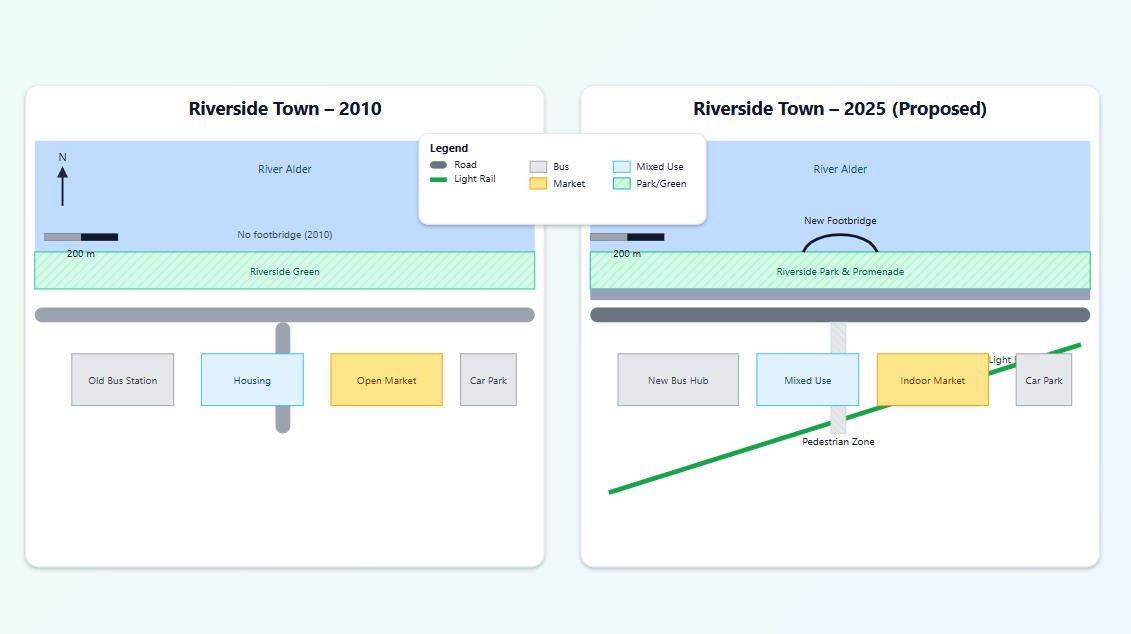
Figure: Comparison of Riverside Town in 2010 and 2025 (proposed redevelopment).
Sample Answer (Band 8 – 8.5)
The two maps illustrate how Riverside Town, a small settlement located beside the River Alder, is planned to transform between 2010 and 2025. Overall, the area is expected to become more accessible and pedestrian-friendly, with significant upgrades in public transport and recreational facilities.
In 2010, the town was centered around a single east-west road and a modest crossroad leading to an open market, a bus station, and several housing blocks. A car park occupied the eastern edge, while the riverside area consisted mainly of green space without any direct pedestrian connection across the river. The absence of a bridge limited movement between the two banks.
By 2025, a comprehensive redevelopment is proposed. A new light-rail line will run diagonally through the southern section, linking a modern rail station with the new bus hub. The old open market will be replaced by an indoor complex, and the central crossroads will become a pedestrian-only zone. Along the river, a promenade and park will be added, together with a footbridge connecting both sides, considerably enhancing accessibility. Commercial and mixed-use buildings will replace the former housing blocks, suggesting a clear shift toward urbanization and improved public amenities.
In summary, Riverside Town is projected to evolve from a small, car-oriented community into a well-connected urban area emphasizing public transport, leisure, and walkability.
Analytical Review – IELTS Academic Writing Task 1 (Test 28, Map)
Overall Verdict
Indicative Band: 8.0–8.5
- Task Achievement: Covers all major transformations—transport, green spaces, and facilities—with clear contrasts.
- Coherence & Cohesion: Excellent paragraphing; smooth sequencing from 2010 to 2025 with logical transitions.
- Lexical Resource: Advanced urban-planning lexis (“redevelopment,” “pedestrian-friendly,” “mixed-use block”).
- Grammar: Controlled use of complex and passive forms; precise verb tenses for timeline description.
Key Weaknesses
- Limited quantification: No numerical markers (e.g., size ratios or area coverage) were included.
- Moderate conclusion: Final overview could emphasize the social impact of redevelopment more strongly.
- Repetition: Some recurring phrases (“public transport,” “redevelopment”) reduce lexical variety.
- Missing minor details: Footbridge function and park usage could be mentioned briefly for completeness.
Actionable Improvements
- Add micro-details: Include brief quantifiers such as “a small section of the southern area” or “roughly half of the riverside.”
- Boost lexical variety: Replace repetition of “redevelopment” with alternatives like “urban renewal,” “modernization,” or “town overhaul.”
- Highlight human context: Comment on accessibility, tourism, and lifestyle improvement.
- Expand overview: Stress the transformation from car dependency to sustainable mobility.
- Refine cohesion: Use sequential adverbs (initially, subsequently, by 2025) to enhance timeline flow.
Stronger Synonyms (Urban Context)
- redevelopment → urban renewal modernization revamp
- transport system → transit network mobility infrastructure
- green area → eco-park recreational zone
- pedestrian-only → car-free walkable
- improvement → upgrade enhancement transformation
Linking Devices (Cohesion)
- Sequence: initially, subsequently, afterward, by 2025
- Contrast: whereas, while, by contrast, unlike
- Result: therefore, consequently, as a result
- Emphasis: notably, particularly, most strikingly
- Purpose: to improve access, to reduce congestion
- Summary: overall, in summary, to conclude
High-Value Collocations (Maps & Development)
- pedestrian-friendly zone
- public transport hub
- riverside promenade
- urban regeneration project
- light-rail connection
- green corridor
- mixed-use complex
- environmental sustainability
Band Justification & Path to Band 9
This response demonstrates advanced control of structure and lexis, easily reaching Band 8–8.5. To achieve Band 9, the candidate should integrate quantitative approximations, more interpretive commentary on socio-economic impact, and demonstrate greater lexical flexibility when describing spatial changes. Incorporating a succinct analytical overview—linking transport upgrades to lifestyle improvement— would elevate the overall coherence and insight to a near-native standard.
Grammar Targets
- Complex Clauses: “The town, which was previously car-oriented, is being redeveloped into a pedestrian hub.”
- Comparatives: “The new layout is far more accessible than before.”
- Nominalizations: “The modernization of the transport system has improved connectivity.”
- Passives: “A new light-rail line has been constructed through the southern area.”
Checklist Before Submission
- All main spatial changes described clearly.
- Accurate use of tenses (past vs. future plans).
- Strong overview paragraph included.
- Lexical variety across all map features.
- Appropriate linkers and concise structure.
تحلیل دوزبانه – IELTS Academic Writing Task 1 (Test 28, Map)
ارزیابی کلی
نمره تقریبی: 8.0 تا 8.5
- پوشش کامل دگرگونیهای اصلی: حملونقل، فضاهای سبز، و کاربریها
- توالی زمانی روشن: ابتدا 2010 → سپس تغییرات مرحلهای → وضعیت نهایی 2025
- واژگان شهری دقیق: «urban renewal»، «pedestrian-friendly»، «mixed-use»
- کنترل گرامری قوی با جملات مرکب و حالت مجهول
Overall Verdict
Indicative Band: 8.0–8.5
- Task Achievement: Major transformations (transport, green areas, facilities) are clearly identified and contrasted.
- Coherence & Cohesion: Logical timeline from the baseline to the final layout with smooth transitions.
- Lexical Resource: Urban-planning lexis used precisely (e.g., “urban renewal,” “pedestrian-friendly,” “mixed-use block”).
- Grammar: Accurate complex structures and well-controlled passives/tenses.
نقاط ضعف
- کمبود کمّیسازی (ذکر نسبتها/ابعاد تقریبی)
- تکرار برخی عبارات (مثلاً «redevelopment»)
- نتیجهگیری میتواند اثرات اجتماعی/زیستمحیطی را پررنگتر کند
- ذکر کوتاه کارکردهای فرعی (مثل پیادهراه یا اسکله) میتواند کاملتر باشد
Key Weaknesses
- Limited quantification: Lacks size/coverage approximations.
- Lexical repetition: Overuse of “redevelopment.”
- Moderate conclusion: Social or environmental impact could be emphasized more.
- Minor features: Functions of footbridges/promenades mentioned only briefly.
پیشنهادهای بهبود
- افزودن تقریبهای عددی: «حدود نیمی از نوار رودخانه»، «بخش کوچکی در جنوب»
- تنوعبخشی واژگانی: «urban renewal / revamp / modernization» بهجای تکرار
- تقویت بعد انسانی: دسترسپذیری، گردشگری، کیفیت زندگی
- مرور کلی قویتر: گذار از اتکای خودرویی به تحرک پایدار
- انسجام زمانی با قیدهای ترتیبی: initially, subsequently, by 2025
Actionable Improvements
- Add approximate quantifiers (e.g., “roughly half of the riverside”).
- Increase lexical variety (urban renewal, revamp, modernization).
- Highlight human context (accessibility, tourism, lifestyle).
- Strengthen the overview (shift to sustainable mobility).
- Use clear sequencing adverbs for timeline cohesion.
مترادفهای قوی (حوزه شهری)
- redevelopment → urban renewal, revamp, modernization
- transport system → transit network, mobility infrastructure
- green area → eco-park, recreational zone, green corridor
- pedestrian-only → car-free, walkable
- improvement → upgrade, enhancement, transformation
Stronger Synonyms (Urban Context)
- redevelopment → urban renewal, revamp, modernization
- transport system → transit network, mobility infrastructure
- green area → eco-park, recreational zone, green corridor
- pedestrian-only → car-free, walkable
- improvement → upgrade, enhancement, transformation
حروف ربط و انسجام
- ترتیب: initially, subsequently, afterward, by 2025
- تضاد: whereas, while, by contrast, unlike
- نتیجه: therefore, consequently, as a result
- تأکید: notably, particularly, most strikingly
Linking Devices (Cohesion)
- Sequence: initially, subsequently, afterward, by 2025
- Contrast: whereas, while, by contrast, unlike
- Result: therefore, consequently, as a result
- Emphasis: notably, particularly, most strikingly
- Purpose: to improve access, to reduce congestion
- Summary: overall, in summary, to conclude
کالوکیشنهای کلیدی (نقشه و توسعه)
- pedestrian-friendly zone / پیادهمحور
- public transport hub / قطب حملونقل عمومی
- riverside promenade / تفرجگاه رودخانهای
- urban regeneration project / بازآفرینی شهری
- green corridor / کریدور سبز
- mixed-use complex / مجموعه چندمنظوره
- environmental sustainability / پایداری محیطزیستی
High-Value Collocations
- pedestrian-friendly zone
- public transport hub
- riverside promenade
- urban regeneration project
- green corridor
- mixed-use complex
- environmental sustainability
توجیه نمره و مسیر تا Band 9
ساختار و واژگان پیشرفته، انسجام قوی، و گزارش دقیقِ تغییرات فضایی، پاسخ را در سطح 8–8.5 قرار میدهد. برای رسیدن به 9: ۱) تقریبهای عددیِ منطقی اضافه شود، ۲) پیامدهای اجتماعی/اقتصادی مختصر بیان گردد، ۳) تنوع واژگانی بیشتر برای پرهیز از تکرار بهکار رود، و ۴) مرور کلی نهایی، گذار به تحرک پایدار را پررنگ کند.
Band Justification & Path to Band 9
Advanced structure, precise urban lexis, and clear spatial contrasts justify Band 8–8.5. To reach Band 9, incorporate approximate quantifiers, add brief socio-environmental implications, increase lexical flexibility to avoid repetition, and end with a concise analytical overview that foregrounds sustainable mobility.
اهداف گرامری
- جملات مرکب: «شهر که قبلاً خودرو-محور بود، به هاب پیاده تبدیل شده است.»
- مقایسهای: «طرح جدید دسترسپذیرتر از گذشته است.»
- اسممصدرسازی: «modernization of the transit system باعث ارتقای اتصال شد.»
- مجهول: «a light-rail line has been constructed.»
Quick Checklist (Before Submit)
- Clear overview of the most striking changes.
- Accurate, consistent tense control for timelines.
- Lexical variety (avoid repeating “redevelopment”).
- Sequencing markers used effectively.
- Brief human-impact remark included.