
IELTS Academic Writing Task 1 – Sample Test 27 (Process Diagram)
Task Question
The diagram below illustrates the process of producing orange juice from freshly harvested oranges, showing the main stages from fruit collection to final distribution.
Summarize the information by selecting and reporting the main stages, and make comparisons where relevant.
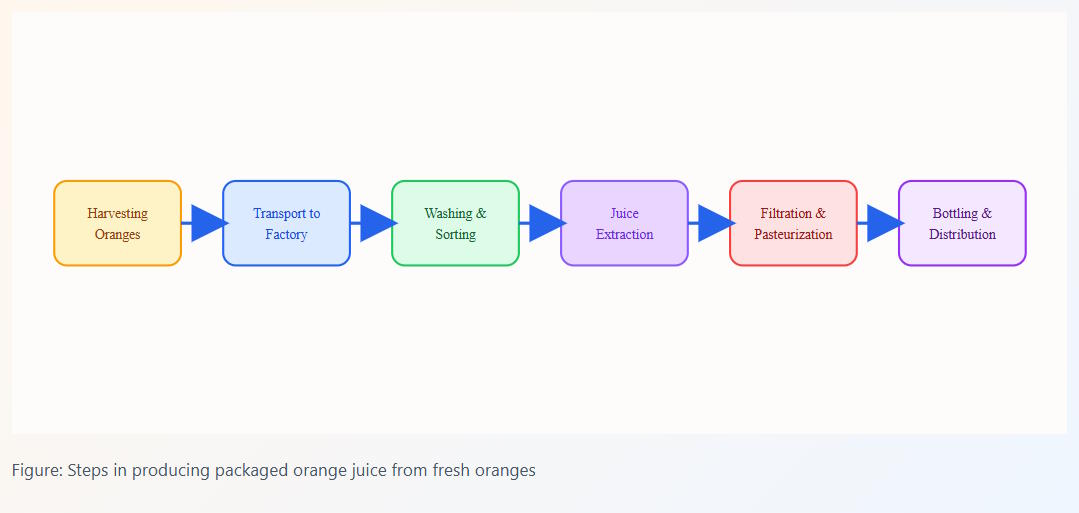
Figure: Steps in producing packaged orange juice from fresh oranges
Sample Answer (Band 8.0–8.5)
The diagram illustrates the series of stages involved in the commercial production of orange juice from fresh oranges. Overall, the process consists of six sequential stages, starting with the harvesting of fruit and ending with the distribution of packaged juice to supermarkets and consumers.
Initially, ripe oranges are harvested from farms and transported to the processing factory. At the factory, the fruits are washing and sorted to remove any damaged or unsuitable ones. They are then placed in mechanical presses where the juice is extracted from the pulp.
The extracted liquid undergoes filtration and pasteurization to eliminate impurities and harmful bacteria, ensuring the juice remains safe and fresh for consumption. After this purification process, the juice is packaged into sealed bottles or cartons that are properly labeled with nutritional information and expiry dates.
Finally, the finished products are stored and distributed to supermarkets and local stores, where they become available for consumers. In summary, the production of orange juice is a systematic, hygienic, and partly automated process designed to preserve freshness while meeting industrial safety standards.
Analytical Review – IELTS Academic Writing Task 1 (Test 27, Process Diagram)
Overall Verdict
Indicative Band: 8.0–8.5
- Task Achievement: Covers all six stages with clear sequencing, logical flow, and accurate technical detail.
- Coherence & Cohesion: Strong paragraphing and progression; each stage leads naturally to the next.
- Lexical Resource: Wide range of process-related terms such as “pasteurization,” “extraction,” and “filtration.”
- Grammar: Effective use of passive structures and sequencing adverbs (“initially,” “after this,” “finally”).
Key Weaknesses
- Interpretive Depth: Could include brief mention of industrial quality control or sustainability measures.
- Sentence Variety: A few sentences start similarly (“The process begins…” “The juice is…”), slightly reducing rhythm.
- Vocabulary Precision: Some verbs like “make” or “produce” could be replaced with more academic terms (“manufacture,” “process”).
- Data Absence: Lacks approximate quantities or time indicators that could enrich the process description.
Actionable Improvements (High-Impact)
- Add interpretive insight: Briefly mention how hygiene or automation ensures large-scale safety and efficiency.
- Diversify openers: Alternate sentence beginnings using adverbials (“Once harvested,” “Following filtration”).
- Elevate lexical range: Replace “make” or “produce” with “manufacture,” “transform,” or “process.”
- Clarify transitions: Use connectors such as “subsequently,” “in the next stage,” or “thereafter.”
- Expand conclusion: Add a concise reflection on modern food processing or quality assurance.
Stronger Synonyms (Topic-Fit)
- produce → manufacture process generate
- make clean → purify sterilize
- send → transport deliver dispatch
- filter → refine clarify
- final product → end product finished goods
Linking Devices (Cohesion)
- Sequence: initially, subsequently, thereafter, following this
- Addition: moreover, in addition, besides
- Result: therefore, consequently, as a result
- Contrast: whereas, while, unlike
- Emphasis: notably, importantly, significantly
- Summary: overall, to conclude, in summary
High-Value Collocations (Process & Manufacturing)
- mechanical extraction system
- industrial pasteurization unit
- filtration and purification process
- automated bottling line
- quality assurance protocol
- mass production facility
- final distribution chain
Rewrite Upgrades (Band-9 Polish)
-
Original: “The process begins with fresh oranges being harvested.”
Upgrade: “Initially, ripe oranges are collected manually and prepared for industrial processing.” -
Original: “The juice is filtered and pasteurized.”
Upgrade: “The extracted liquid undergoes systematic filtration and pasteurization to guarantee safety and purity.” -
Original: “The finished products are distributed.”
Upgrade: “Finally, the sealed cartons are dispatched through distribution networks to retail markets.”
Model Sentences (Precision & Process Description)
- “Once harvested, the fruits are transported by truck to the processing plant.”
- “During pasteurization, the juice is heated at controlled temperatures to remove harmful bacteria.”
- “Each bottle is sealed and labeled automatically before being sent to storage facilities.”
Grammar Targets
- Passives: “The oranges are transported,” “The juice is filtered.”
- Sequencing adverbs: initially, then, next, subsequently, finally.
- Complex clauses: “After being filtered, the juice is pasteurized for preservation.”
- Nominalisation: “Filtration and pasteurization ensure product safety.”
Quick Checklist (Before Submit)
- All process stages described in logical order.
- Transitions clear and progressive (start → end).
- Strong lexical variety and topic relevance.
- Grammar predominantly passive and accurate.
- Analytical tone in overview and conclusion.
Band Justification & How to Reach 9.0
This essay demonstrates strong command of structure, process description, and topic-specific vocabulary, consistent with Band 8–8.5. To reach Band 9, the writer should display higher lexical precision by integrating industrial or environmental context (e.g., waste reduction, energy efficiency), vary sentence rhythm through inversion and participle clauses, and craft a more interpretive conclusion that comments on efficiency or sustainability. A Band 9 essay in process tasks shows not just sequence accuracy but analytical understanding of the system’s design and purpose.
تحلیل دوزبانه – IELTS Academic Writing Task 1 (Test 27, Process Diagram)
ارزیابی کلی
نمره تقریبی: 8.0 تا 8.5
- توصیف کامل تمام مراحل با ترتیب زمانی دقیق و منطقی
- ساختار منسجم و روان که هر مرحله را به مرحلهی بعد پیوند میدهد
- بهکارگیری واژگان تخصصی مانند «pasteurization»، «filtration»، و «extraction»
- استفاده مناسب از حالت مجهول و قیدهای زمانی مانند «initially»، «afterwards»، «finally»
Overall Verdict
Indicative Band: 8.0–8.5
- Task Achievement: All six stages are explained clearly with precise sequence and technical accuracy.
- Coherence & Cohesion: Logical flow and natural progression from harvesting to packaging and distribution.
- Lexical Resource: Excellent range of process-related terminology such as “filtration,” “pasteurization,” and “extraction.”
- Grammar: Consistent use of passive forms and sequencing connectors for smooth transitions.
نقاط ضعف
- نبود اشاره به کنترل کیفیت یا جنبههای زیستمحیطی در فرایند تولید
- شباهت زیاد آغاز برخی جملهها که ریتم متن را کمی یکنواخت کرده
- تکرار برخی افعال عمومی مانند «produce» بهجای افعال آکادمیکتر مثل «manufacture» یا «transform»
- نبود اشاره به مقدار یا زمان تقریبی مراحل تولید برای غنیتر شدن متن
Key Weaknesses
- Interpretive Depth: Missing mention of quality control or environmental considerations.
- Stylistic Rhythm: Repetition in sentence openings slightly reduces variety.
- Verb Precision: Could replace “produce” with “manufacture” or “transform.”
- Data Enrichment: Lacks quantitative or time-based details for stronger realism.
پیشنهادهای بهبود
- اشاره کوتاه به بهداشت صنعتی یا پایداری زیستمحیطی اضافه شود
- شروع جملهها با قیدهای متنوع مثل «Once harvested» یا «Following this stage» انجام شود
- استفاده از افعال دقیقتر مانند «process»، «refine»، «manufacture»
- افزودن دادههای زمانی یا کمی برای اعتبار بیشتر متن
- نتیجهگیری تحلیلیتر درباره بهرهوری یا کیفیت تولید ارائه شود
Actionable Improvements
- Add reference to hygiene or environmental sustainability.
- Vary sentence openers using adverbials like “Once harvested” or “Following this step.”
- Replace general verbs with precise ones (“refine,” “manufacture,” “process”).
- Include minor numerical or time references for realism.
- Conclude with an analytical remark on industrial efficiency or product quality.
مترادفهای قوی
- produce → manufacture, process, generate
- filter → purify, refine, clarify
- send → deliver, dispatch, transport
- final product → end goods, finished output
- clean → sterilize, sanitize
Stronger Synonyms
- produce → manufacture, process, generate
- filter → purify, refine, clarify
- send → deliver, dispatch, transport
- final product → end goods, finished output
- clean → sterilize, sanitize
حروف ربط و انسجام
- توالی: initially, subsequently, afterwards, thereafter
- افزودن: moreover, in addition, besides
- نتیجه: therefore, consequently, as a result
- تأکید: notably, significantly, importantly
Linking Devices
- Sequence: initially, subsequently, thereafter, following this
- Addition: moreover, in addition, besides
- Result: therefore, consequently, as a result
- Emphasis: notably, significantly, importantly
- Summary: overall, in conclusion, to summarize
کالوکیشنهای کلیدی
- فرایند پالایش صنعتی → industrial purification process
- استخراج مکانیکی → mechanical extraction
- خط تولید خودکار → automated production line
- فرآیند پاستوریزهسازی → pasteurization process
- زنجیره توزیع نهایی → final distribution chain
High-Value Collocations
- industrial purification process
- mechanical extraction
- automated production line
- pasteurization process
- final distribution chain
توجیه نمره و مسیر تا Band 9
این پاسخ از نظر انسجام، واژگان تخصصی و ساختار مجهول در سطح Band 8 تا 8.5 قرار دارد. برای رسیدن به Band 9، نویسنده باید با افزودن تحلیلهای صنعتی و زیستمحیطی، از ساختارهای پیچیدهتر مانند جملات فشرده (reduced clauses) و وارونگی استفاده کند، و نتیجهگیری عمیقتری درباره کارایی و کیفیت فرآیند ارائه دهد.
Band Justification & Path to Band 9
This essay displays advanced control of structure, cohesion, and vocabulary, matching Band 8–8.5. To achieve Band 9, the writer should integrate industrial and environmental insights, employ inversion and reduced clauses for grammatical sophistication, and conclude with deeper evaluation of production efficiency and quality assurance.