
IELTS Academic Writing Task 1 – Sample Test 26 (Table Chart)
Task Question
The table below shows the average monthly household expenditure (in US dollars) on five categories in four countries in 2020.
Summarize the information by selecting and reporting the main features, and make comparisons where relevant.
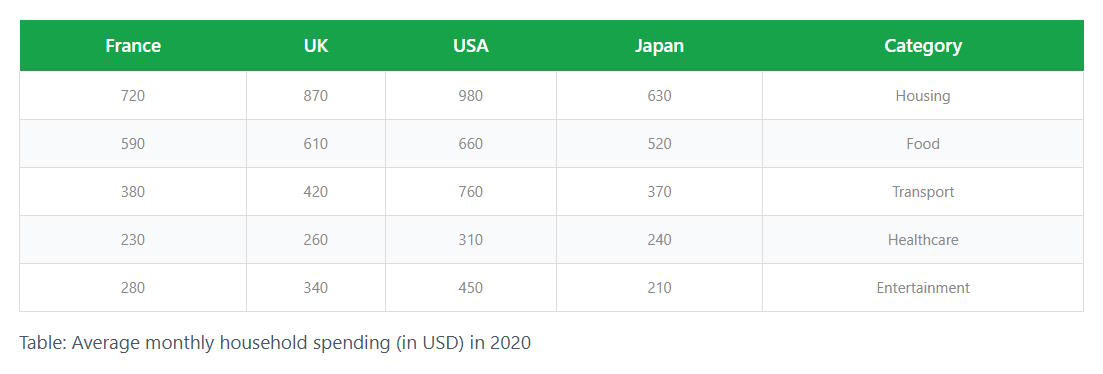
Figure: Average monthly household spending (in USD) in 2020
Sample Answer (Band 8.0–8.5)
The table compares the average monthly spending of households in Japan, the USA, the UK, and France across five categories in 2020. Overall, housing and food accounted for the largest shares of expenditure in all four countries, while healthcare and entertainment were consistently the least significant costs. The United States recorded the highest overall spending across nearly all categories.
In detail, Americans spent almost $980 per month on housing, far higher than the other countries, where figures ranged from $630 in Japan to $870 in the UK. Similarly, spending on food in the USA (at $660) exceeded that of Japan ($520) and France ($590). Transport also showed a marked difference, with the US figure ($760) being roughly double that of Japan ($370).
In contrast, healthcare and entertainment took up relatively small portions of household budgets. Healthcare costs were lowest in France ($230) and highest in the USA ($310), whereas entertainment expenses varied more noticeably, with the USA again leading at $450. Overall, the table demonstrates that households in the United States consistently spent more in every category, reflecting both a higher cost of living and greater disposable income.
To sum up, the data highlight a clear contrast between the USA and the other nations, with American households allocating significantly higher amounts to all areas of daily life.
Analytical Review – IELTS Academic Writing Task 1 (Test 26, Table Chart)
Overall Verdict
Indicative Band: 8.0–8.5
- Task Achievement: The main features are clearly identified with accurate numerical comparisons and relevant insights.
- Coherence & Cohesion: Well-organized — the writer moves logically from dominant categories to minor ones.
- Lexical Resource: Rich vocabulary such as “higher cost of living,” “disposable income,” and “marked difference.”
- Grammar: Accurate complex structures with effective use of comparatives and adverbial clauses.
Key Weaknesses
- Depth of Interpretation: Could include a brief comment on cultural or economic reasons behind higher US spending.
- Range of Verbs: Repetition of “spent” — could vary with “allocated,” “devoted,” or “distributed.”
- Sentence Length: Some long clauses could be divided for smoother readability.
- Comparative Emphasis: More quantifiers like “twice as high” or “significantly lower” could strengthen contrasts.
Actionable Improvements (High-Impact)
- Add interpretation: Briefly discuss what higher spending implies — e.g., stronger economy, higher prices, or lifestyle factors.
- Diversify verbs: Replace repetitive “spend” with “allocate,” “channel,” or “devote.”
- Use precise quantifiers: e.g., “almost double,” “slightly below,” “nearly equal.”
- Refine conclusion: Add an analytical observation about cost of living or consumption behavior.
- Shorten dense sentences: Split descriptive clauses to enhance flow and readability.
Stronger Synonyms (Topic-Fit)
- spend → allocate devote channel disburse
- expenditure → outlay household spending
- category → sector area of spending
- difference → disparity gap contrast
- high → elevated substantial considerable
Linking Devices (Cohesion)
- Contrast: whereas, while, by comparison, on the other hand
- Addition: furthermore, moreover, in addition
- Result: therefore, consequently, as a result
- Emphasis: notably, strikingly, particularly
- Quantification: twice as high, slightly lower, almost equal
- Summary: overall, in general, to sum up
High-Value Collocations (Economy & Spending)
- household consumption patterns
- cost of living index
- income distribution gap
- monthly expenditure profile
- consumer spending behaviour
- economic disparity among nations
- proportion of household budget
Rewrite Upgrades (Band-9 Polish)
-
Original: “Americans spent almost $980 per month on housing.”
Upgrade: “Households in the United States allocated nearly $980 monthly to housing, far surpassing other nations.” -
Original: “Healthcare and entertainment took up small portions of the budget.”
Upgrade: “Expenditure on healthcare and entertainment represented only a marginal share of total household spending.” -
Original: “The table demonstrates that households in the USA spent more.”
Upgrade: “The data clearly illustrate that American households consistently outspent their counterparts across all sectors.”
Model Sentences (Precision & Comparison)
- “Housing accounted for nearly one-third of household budgets in the USA.”
- “Japanese families spent almost half as much on transport as Americans did.”
- “Healthcare expenditure in France remained the lowest among the four nations.”
Grammar Targets
- Comparatives: “twice as high,” “slightly lower,” “almost equal.”
- Passives: “Expenditure was distributed across categories.”
- Nominalisation: “A notable disparity was observed between housing and healthcare costs.”
- Adverbials: “considerably higher,” “relatively minor,” “marginally greater.”
Quick Checklist (Before Submit)
- Clear overview highlighting dominant and minor categories.
- Comparisons supported by specific figures.
- Lexical range wide and topic-specific.
- Varied sentence structures with smooth cohesion.
- Analytical conclusion rather than a repetition of data.
Band Justification & How to Reach 9.0
This essay demonstrates advanced control over data description, structure, and vocabulary — consistent with Band 8.5 performance. To reach Band 9, the candidate should integrate subtle socio-economic insights (e.g., lifestyle and purchasing power differences), expand grammatical sophistication with inversion or reduced clauses, and ensure each paragraph presents a distinct analytical layer. Band 9 writing not only describes data accurately but interprets patterns with nuance and precision.
تحلیل دوزبانه – IELTS Academic Writing Task 1 (Test 26, Table Chart)
ارزیابی کلی
نمره تقریبی: 8.0 تا 8.5
- توصیف دقیق دادهها و مقایسهی صحیح بین کشورها
- توالی منطقی: شروع با بخشهای اصلی (مسکن و غذا) تا موارد فرعی (سلامت و تفریح)
- استفاده از واژگان آکادمیک مانند «disposable income»، «cost of living» و «marked difference»
- تنوع ساختارهای گرامری و استفاده مناسب از جملات مقایسهای و قیدی
Overall Verdict
Indicative Band: 8.0–8.5
- Task Achievement: The main features are clearly identified with accurate numerical comparisons and relevant insights.
- Coherence & Cohesion: Smooth flow from dominant to minor categories, maintaining logical sequencing.
- Lexical Resource: Rich academic expressions like “disposable income,” “higher cost of living,” and “marked contrast.”
- Grammar: Well-structured complex sentences with accurate use of adverbial clauses and comparatives.
نقاط ضعف
- نبود اشاره به دلایل اقتصادی یا فرهنگی برای تفاوت در مخارج کشورها
- تکرار افعال «spend» و «spent» بدون استفاده از افعال جایگزین
- برخی جملهها طولانیاند و میتوانند برای خوانایی بهتر تقسیم شوند
- نیاز به استفاده از کمیتسازها مثل «twice as high» یا «significantly lower»
Key Weaknesses
- Depth of Interpretation: Lacks commentary on economic or cultural factors affecting spending differences.
- Verb Variety: Overuse of “spend” — could use “allocate,” “devote,” or “channel.”
- Sentence Density: Some long sentences could be shortened for clarity.
- Comparative Precision: Needs more quantifiers like “twice as high” or “slightly below.”
پیشنهادهای بهبود
- اضافه کردن تفسیر کوتاه درباره سطح رفاه یا سبک زندگی هر کشور
- افزایش تنوع افعال و عبارات جایگزین برای واژههای پرتکرار
- بهکارگیری دقیقتر کمیتسازها برای تقویت مقایسهها
- خلاصهسازی جملههای طولانی برای افزایش شفافیت
- جمعبندی تحلیلی درباره «قدرت خرید» و «تفاوت سطح زندگی»
Actionable Improvements
- Add brief interpretation about lifestyle or economic context of each country.
- Use alternative verbs like “allocate,” “channel,” or “dedicate.”
- Include more precise quantifiers (“nearly double,” “slightly lower”).
- Simplify dense sentences for better readability.
- Conclude with an analytical remark about purchasing power or cost of living.
مترادفهای قوی
- spend → allocate, devote, channel
- difference → disparity, contrast, gap
- category → sector, area of spending
- high → substantial, elevated, notable
- low → modest, limited, minimal
Stronger Synonyms
- spend → allocate, devote, channel
- difference → disparity, contrast, gap
- category → sector, area of spending
- high → substantial, elevated, notable
- low → modest, limited, minimal
حروف ربط و انسجام
- تضاد: whereas, while, on the other hand
- افزودن: moreover, likewise, in addition
- نتیجه: therefore, consequently, as a result
- تأکید: notably, particularly, strikingly
Linking Devices
- Contrast: whereas, while, on the other hand
- Addition: moreover, likewise, in addition
- Result: therefore, consequently, as a result
- Emphasis: notably, particularly, strikingly
- Quantifiers: almost double, slightly higher, nearly equal
کالوکیشنهای کلیدی
- الگوی هزینه خانوار → household spending pattern
- شکاف اقتصادی → economic disparity
- قدرت خرید → purchasing power
- هزینه زندگی → cost of living
- رفتار مصرفکننده → consumer spending behaviour
High-Value Collocations
- household spending pattern
- economic disparity
- purchasing power
- cost of living
- consumer spending behaviour
توجیه نمره و مسیر تا Band 9
این پاسخ از نظر انسجام، توصیف عددی و واژگان تخصصی در سطح Band 8 تا 8.5 است. برای رسیدن به Band 9، باید تحلیلهای اقتصادی و اجتماعی دقیقتری ارائه شود، از ساختارهای گرامری پیچیدهتری مانند جملات وارونگی و clauses فشرده استفاده شود و هر پاراگراف شامل یک دیدگاه تحلیلی مجزا باشد.
Band Justification & Path to Band 9
This response shows high-level accuracy, coherence, and lexical control, aligning with Band 8–8.5. To reach Band 9, the candidate should integrate socio-economic analysis, employ advanced grammar such as inversion and reduced clauses, and ensure each paragraph conveys a distinct analytical insight.