
IELTS Academic Writing Task 1 – Sample Test17 (Table + Pie)
Task Question
The table below shows the number of international students studying in four countries (USA, UK, Australia, and Canada) in 2000 and 2020. The pie chart illustrates the percentage distribution by continent of origin in 2020.
Summarize the information by selecting and reporting the main features, and make comparisons where relevant.
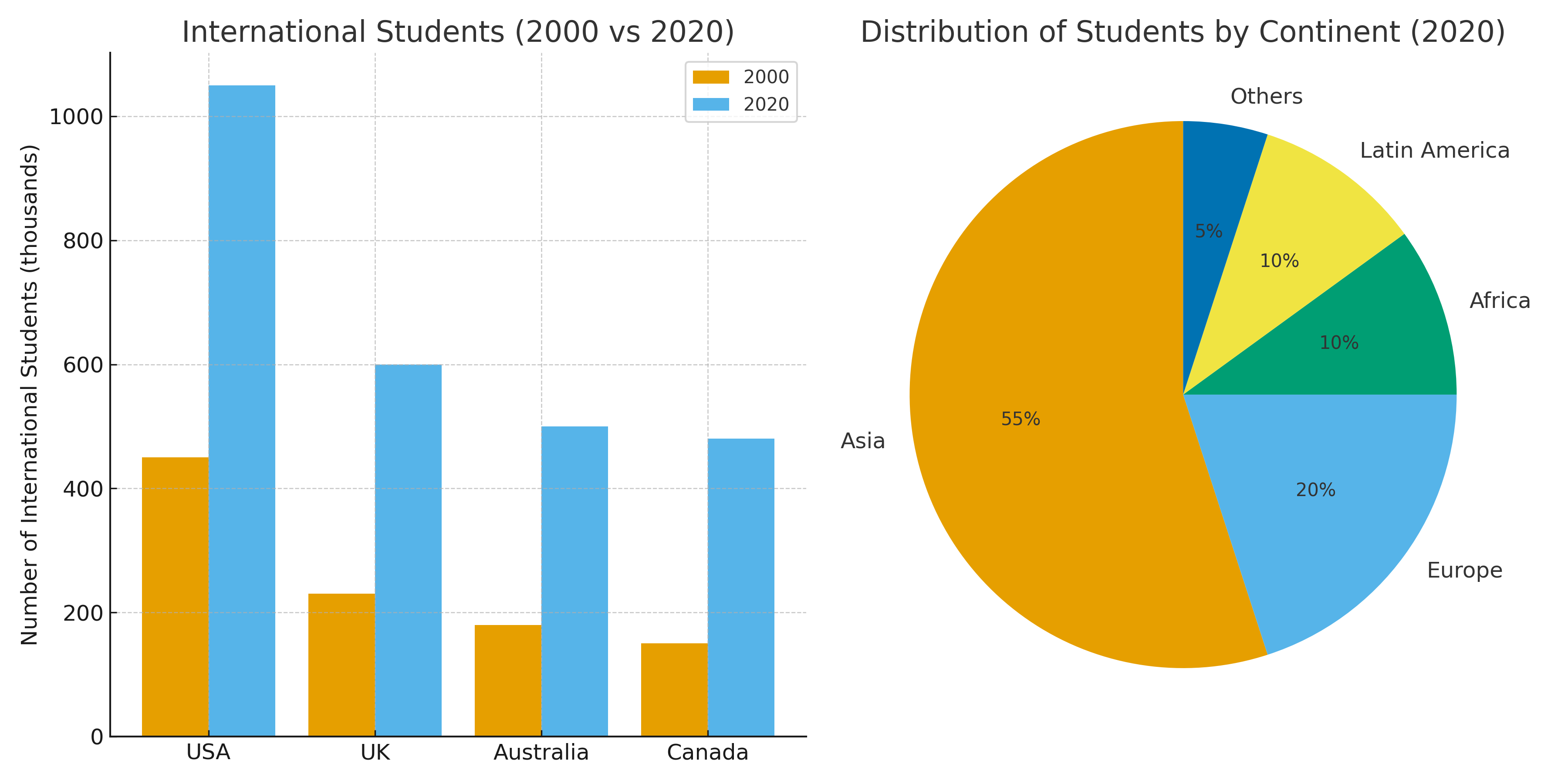
Figure: International students (2000 vs 2020) and origin distribution in 2020
Sample Answer (Band 8–8.5)
The table compares the numbers of international students in four English-speaking destinations in 2000 and 2020, while the pie chart breaks down their 2020 origins by continent. Overall, all countries expanded their foreign-student intakes, led by the USA throughout, and Asia dominated the source regions in 2020.
In 2000, the USA hosted 450,000 students, almost twice the UK total of 230,000. Australia and Canada received 180,000 and 150,000, respectively. By 2020, the USA more than doubled to 1,050,000, while the UK rose to 600,000. Australia reached 500,000 and Canada closely trailed at 480,000, suggesting a narrowing gap among the three non-US destinations.
Turning to the pie chart, Asia accounted for a clear majority at 55%. Europe provided a further 20%, whereas Africa and Latin America each contributed 10%. The residual 5% came from other regions. This composition implies that growth was primarily driven by Asian demand, with Europe supplying a sizeable but secondary share.
In short, although the USA remained the principal destination in absolute terms, the relative dispersion across the UK, Australia and Canada tightened by 2020. Concurrently, the origin profile became highly Asia-centric, indicating a structural shift in the international education market.
Analytical Review – IELTS Academic Writing Task 1 (Test 17)
Overall Verdict
Indicative band: 8.0–8.5
- Task Achievement: Full coverage of both the table and pie chart with a clear overview and strong synthesis.
- Coherence & Cohesion: Well-sequenced: table (2000 vs 2020) → pie chart → combined insights. Linking varied and accurate.
- Lexical Resource: Advanced lexis (“tightening gap,” “Asia-centric demand,” “relative dispersion,” “structural shift”).
- Grammar: Wide range of complex structures; effective passive and comparative phrasing; no major errors.
Key Weaknesses
- Numerical precision: Some phrases (“more than doubled”) could be quantified more explicitly (e.g., +600k).
- Comparisons: Limited detail on mid-tier contrasts (e.g., UK vs Australia vs Canada in 2020).
- Stylistic density: Some clauses are lengthy and could be split for clarity.
- Contextual insight: Minimal mention of broader causes (e.g., immigration policy, globalisation).
Actionable Improvements (High-Impact)
- Quantify precisely: “The USA grew by 600k, from 450k to 1.05m” instead of “more than doubled.”
- Expand cross-country contrasts: Note that the UK exceeded Australia by 100k in 2020, narrowing the gap.
- Vary sentence rhythm: Balance long analytical clauses with shorter impact statements.
- Add causal depth: Suggest drivers such as Asia’s expanding middle class or policy shifts.
- Highlight extremes: Emphasise Asia’s 55% share as the defining feature of 2020 origins.
Stronger Synonyms (Topic-Fit)
- increase → surge upswing escalation
- gap → disparity spread differential
- majority → dominant share overwhelming portion
- growth → expansion boom proliferation
- origin → source region provenance
Linking Devices (Cohesion)
- Contrast: whereas, by contrast, unlike, in comparison
- Addition: moreover, likewise, in parallel
- Result: therefore, consequently, as a result
- Time/Sequence: initially, by 2000, two decades later, in 2020
- Emphasis: notably, critically, strikingly, above all
- Quant cues: “rose by X,” “narrowed to Y,” “constituted Z percent”
High-Value Collocations (International Students)
- tightening gap
- Asia-centric demand
- structural shift in enrolment
- dominant source region
- cross-country competition
- relative dispersion
- market convergence
- educational migration trend
Rewrite Upgrades (Band-9 polish)
-
Original: “The USA more than doubled its intake.”
Upgrade: “The USA expanded from 450k to over 1.05m, a surge of roughly 600k in two decades.” -
Original: “Asia accounted for the majority.”
Upgrade: “Asia alone supplied over half of all students (55%), cementing its role as the overwhelming driver of demand.” -
Original: “The gap between countries narrowed.”
Upgrade: “By 2020, the UK, Australia and Canada clustered within a 120k window, reflecting a marked convergence below the US level.”
Model Sentences (Precise Quantification)
- “The USA’s intake grew by 600k, more than doubling its 2000 figure.”
- “Canada’s 2020 total of 480k was only 20k behind Australia, compared to a 30k deficit in 2000.”
- “Asia’s 55% share was more than five times Africa’s contribution.”
Grammar Targets
- Comparatives: “X was 20k higher than Y.”
- Passive style: “The majority of students were drawn from Asia.”
- Nominalisation: “A striking convergence was observed among the three smaller destinations.”
- Adverbials: “notably higher,” “substantially lower,” “relatively balanced.”
Quick Checklist (Before Submit)
- Overview integrates both table and pie chart.
- Figures reported with exact numbers and contrasts.
- Lexical variety: strong synonyms for growth, gap, majority.
- Sentences balanced: no over-dense phrasing.
- Charts cross-referenced, not described in isolation.
تحلیل دوزبانه – IELTS Academic Writing Task 1 (Test 17)
ارزیابی کلی
نمره تقریبی: 8 تا 8.5
- پوشش کامل جدول و نمودار دایرهای همراه با مقایسهها و جمعبندی قوی
- انسجام بالا: حرکت از جدول (2000 → 2020) → نمودار دایرهای → تحلیل ترکیبی
- واژگان پیشرفته: «شکاف در حال کاهش»، «تمرکز آسیامحور»، «تغییر ساختاری»
- گرامر متنوع: جملات پیچیده، مقایسهای و مجهول بدون خطای آشکار
Overall Verdict
Indicative band: 8.0–8.5
- Task Achievement: Full coverage of both the table and pie chart with a clear overview and strong synthesis.
- Coherence & Cohesion: Logical flow: 2000 → 2020 (table) → pie chart → synthesis; linkers accurate.
- Lexical Resource: Advanced vocabulary (“tightening gap,” “Asia-centric demand,” “structural shift”).
- Grammar: Effective passives and comparatives; wide range of complex sentences; error-free.
نقاط ضعف
- کمبود دقت عددی: عباراتی مثل «دو برابر شد» بهتر است با اعداد دقیق بیان شوند
- توجه کم به کشورهای میانی (انگلستان، استرالیا و کانادا در 2020)
- چند جمله طولانی که میتوانند وضوح را کاهش دهند
- کمبود تحلیل زمینهای (سیاستهای مهاجرتی، جهانیسازی)
Key Weaknesses
- Numerical detail: Some figures described vaguely (e.g., “more than doubled”) instead of +600k.
- Comparisons: Mid-tier contrasts underdeveloped (UK vs Australia vs Canada).
- Stylistic density: A few sentences too dense, readability could improve.
- Contextual depth: Limited mention of broader drivers (immigration, globalisation).
پیشنهادهای بهبود
- بیان دقیق تغییرات عددی: «آمریکا از 450k به 1.05m (افزایش 600k) رسید»
- مقایسه بیشتر کشورهای میانی (مثلاً فاصله انگلستان و استرالیا)
- تنوع در طول جملات برای وضوح بهتر
- افزودن تحلیل علتها (افزایش طبقه متوسط در آسیا)
- تاکید بر نقاط کلیدی مثل سهم 55 درصدی آسیا
Actionable Improvements
- Quantify precisely: “The USA grew by 600k, from 450k to 1.05m.”
- Expand contrasts: Note the UK surpassed Australia by 100k in 2020.
- Vary rhythm: Mix concise and longer sentences for balance.
- Add causal insight: Link growth to Asia’s middle-class boom.
- Stress extremes: Highlight Asia’s 55% share as defining feature.
مترادفهای قوی
- افزایش → surge, upswing, escalation
- شکاف → disparity, spread, differential
- اکثریت → dominant share, overwhelming portion
- رشد → expansion, boom, proliferation
- مبدأ → source region, provenance
Stronger Synonyms
- increase → surge upswing escalation
- gap → disparity spread differential
- majority → dominant share overwhelming portion
- growth → expansion boom proliferation
- origin → source region provenance
حروف ربط
- تضاد: whereas, by contrast, unlike
- افزودن: moreover, likewise, in parallel
- نتیجه: therefore, consequently
- زمان: initially, two decades later, in 2020
- تأکید: notably, critically, strikingly
Linking Devices
- Contrast: whereas, by contrast, unlike, in comparison
- Addition: moreover, likewise, in parallel
- Result: therefore, consequently, as a result
- Time: initially, by 2000, two decades later, in 2020
- Emphasis: notably, critically, strikingly
- Quant cues: “rose by X,” “narrowed to Y,” “accounted for Z%”
کالوکیشنهای کلیدی
- شکاف در حال کاهش → tightening gap
- تمرکز آسیامحور → Asia-centric demand
- تغییر ساختاری در ثبتنام → structural shift in enrolment
- منطقه مبدأ غالب → dominant source region
- رقابت بین کشورها → cross-country competition
- پراکندگی نسبی → relative dispersion
- همگرایی بازار → market convergence
- روند مهاجرت تحصیلی → educational migration trend
High-Value Collocations
- tightening gap
- Asia-centric demand
- structural shift in enrolment
- dominant source region
- cross-country competition
- relative dispersion
- market convergence
- educational migration trend