
IELTS Academic Writing Task 1 – Sample Test15 (Bar + Line)

Task Question

The bar chart compares average weekly working hours across four European countries in 2015. The line chart traces the evolution of weekly hours in Germany between 1975 and 2015.

Summarize the information by selecting and reporting the main features, and make comparisons where relevant.
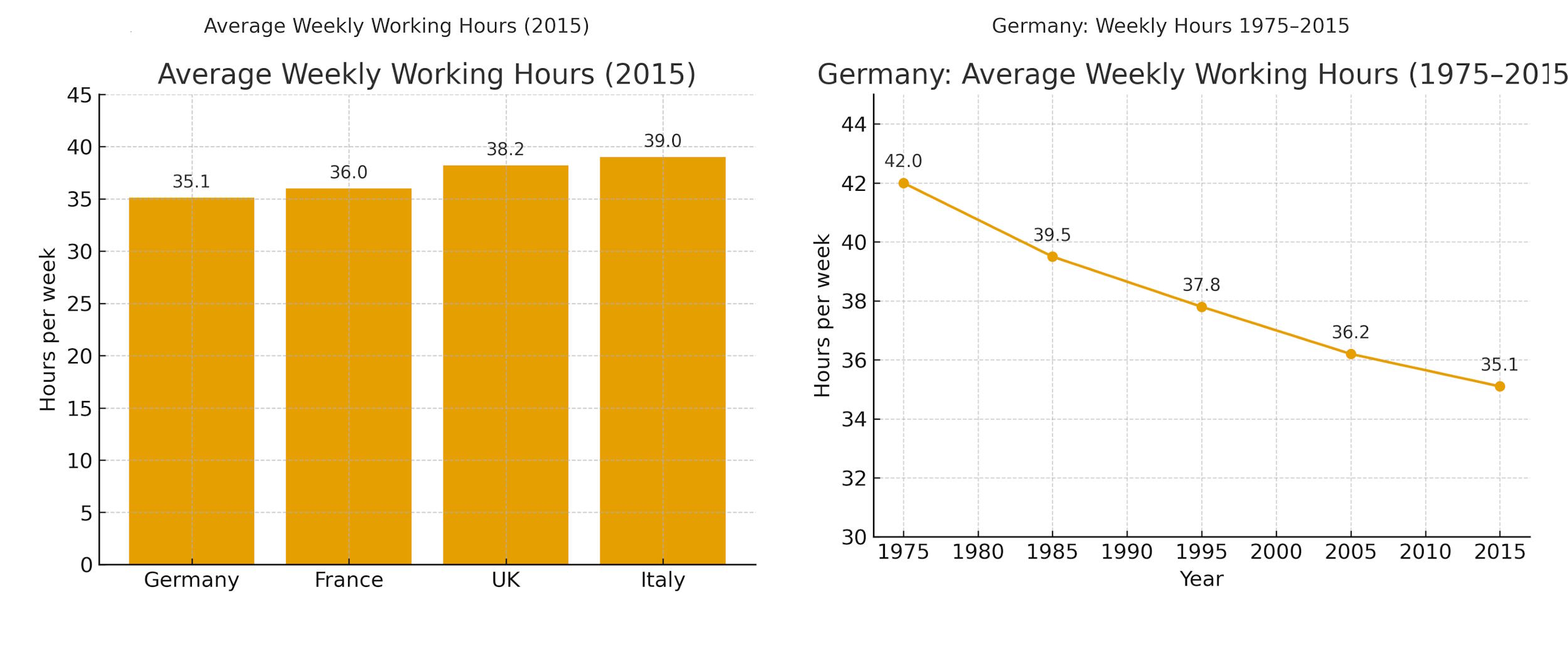
Bar chart: Average weekly working hours in 2015 (Germany, France, UK, Italy)

Figure: Cross-country comparison (2015) and Germany’s long-run trend (1975–2015)

Sample Answer (Band 8.5–9)

Taken together, the graphics indicate that Italy and the UK recorded the longest working weeks in 2015, while Germany and France operated on shorter schedules; in parallel, Germany’s weekly hours declined steadily over four decades. The overarching pattern is one of convergence towards mid-to-high-30s, with Germany exemplifying a gradual structural adjustment.

In 2015, average weekly hours ranged from about 39.0 in Italy to roughly 35.1 in Germany, with the UK and France positioned at approximately 38.2 and 36.0, respectively. The spread across countries was therefore modest—on the order of four hours— yet sufficient to distinguish Italy and the UK as higher-workload economies relative to their continental peers.

Germany’s historical profile shows a clear, near-linear decline from 42.0 hours in 1975 to 35.1 by 2015, a contraction of almost seven hours. The pace of reduction eased slightly after 1995, suggesting that the bulk of the adjustment occurred between the mid-1970s and mid-1990s. By the end of the period, Germany’s schedule had settled close to France’s contemporary level, underscoring a long-run shift towards shorter, more standardized working weeks. In short, the cross-section and the time series jointly point to downward pressure on hours and a narrowing cross-country gap.

Analytical Review – IELTS Academic Writing Task 1 (Test 15)

Overall Verdict

Indicative band: 8.5–9.0

  • Task Achievement: Comprehensive treatment of both charts (cross-country and time-series) with clear overview and insightful comparisons.
  • Coherence & Cohesion: Excellent sequencing: bar chart → line chart → synthesis. Linkers varied and accurate.
  • Lexical Resource: Sophisticated academic lexis (“structural convergence,” “gradual contraction,” “labour-market adjustment”).
  • Grammar: Wide range of complex sentences, precise comparative phrasing, no noticeable error.

Key Weaknesses

  • Numerical detail: Some figures could be given with more exact precision (e.g., “nearly 7 hours fewer” vs “almost seven”).
  • Stylistic density: A few long clauses may overwhelm weaker readers—splitting would enhance clarity.
  • Comparative layering: The analysis could expand on cross-country contrasts beyond Italy vs Germany.
  • Visual integration: More explicit cross-reference between bar and line data could reinforce the narrative.

Actionable Improvements (High-Impact)

  1. Add micro-contrasts: “Germany’s 35.1 hours was 3.9 fewer than Italy’s 39.0 in 2015.”
  2. Vary sentence rhythm: Mix concise sentences with longer analytical ones.
  3. Cross-link charts: Connect Germany’s decline directly to its 2015 standing relative to peers.
  4. Employ quant cues: Use precise phrases such as “contracted by 6.9 hours” instead of “declined steadily.”
  5. Highlight thematic insight: Emphasize broader socio-economic drivers (labour law, productivity shifts).

Stronger Synonyms (Topic-Fit)

  • decline → contraction reduction downward drift
  • increase → uptick expansion rise
  • stable → plateau hold steady remain constant
  • difference → gap disparity spread
  • trend → trajectory long-run pattern structural shift

Linking Devices (Cohesion)

  • Contrast: whereas, by contrast, unlike, in comparison
  • Addition: moreover, likewise, in parallel
  • Result: therefore, consequently, as a result
  • Time/Sequence: initially, over the next decade, thereafter, by 2015
  • Emphasis: notably, critically, in particular, strikingly
  • Quantitative cues: contracted by X hours, ~Ypp lower, narrowed to Z

High-Value Collocations (Work Hours)

  • working-hour contraction
  • labour-market convergence
  • cross-country spread
  • structural adjustment
  • employment pattern shift
  • historical trajectory
  • comparative workload
  • standardization of hours

Rewrite Upgrades (Band-9 polish)

  • Original: “Germany’s hours declined steadily from 42 to 35 over forty years.”
    Upgrade:Germany experienced a protracted contraction, with weekly hours shrinking by almost seven between 1975 and 2015, flattening only after the mid-1990s.”
  • Original: “Italy had the highest weekly hours in 2015.”
    Upgrade: “At 39 hours, Italy sustained the heaviest workload, exceeding Germany’s by nearly four hours and standing a clear outlier in the comparison.”
  • Original: “The cross-country spread was modest.”
    Upgrade: “The inter-country spread narrowed to a compact four-hour window, signaling convergence in working norms across Europe.”

Model Sentences (Precise Quantification)

  • “Germany’s working week contracted by 6.9 hours between 1975 and 2015.”
  • “In 2015, Italy exceeded Germany by 3.9 hours, while the UK outpaced France by just over two.”
  • “The decline in Germany slowed after 1995, stabilizing near mid-30s by 2015.”

Grammar Targets

  • Comparatives: “X was nearly four hours longer than Y.”
  • Passive style: “Weekly schedules were reduced progressively.”
  • Clause trimming: “Germany, which had led with 42 hours in 1975, contracted to 35 by 2015.”
  • Range markers: “fell from the low-40s to the mid-30s.”

Quick Checklist (Before Submit)

  • Overview captures both cross-sectional and time-series charts.
  • Figures precise, with quantified contrasts (hours, gaps).
  • Vocabulary varied; synonyms used for “decline,” “trend,” “difference.”
  • Sentences balanced in length; avoid over-density.
  • Charts integrated in narrative, not described separately.

تحلیل دوزبانه – IELTS Academic Writing Task 1 (Test 15)

ارزیابی کلی

نمره تقریبی: 8.5 تا 9

  • پوشش کامل هر دو نمودار (مقایسه کشوری و روند زمانی) با مقایسه‌های عمیق
  • انسجام قوی: شروع از نمودار میله‌ای → حرکت به نمودار خطی → جمع‌بندی ترکیبی
  • واژگان پیشرفته مانند «همگرایی ساختاری»، «انقباض تدریجی»، «تنظیمات بازار کار»
  • گرامر متنوع: جملات پیچیده، مقایسه‌های دقیق، بدون خطای آشکار

Overall Verdict

Indicative band: 8.5–9.0

  • Task Achievement: Comprehensive treatment of both charts (cross-country and time-series) with clear overview and insightful comparisons.
  • Coherence & Cohesion: Excellent sequencing: bar chart → line chart → synthesis. Linkers varied and accurate.
  • Lexical Resource: Sophisticated academic lexis (“structural convergence,” “gradual contraction,” “labour-market adjustment”).
  • Grammar: Wide range of complex sentences, precise comparative phrasing, no noticeable error.

نقاط ضعف

  • برخی اعداد می‌توانستند دقیق‌تر بیان شوند (مثلاً «۶.۹ ساعت کاهش» به جای «تقریباً هفت ساعت»)
  • چند جمله بیش‌ازحد طولانی که برای خواننده ضعیف‌تر دشوار می‌شود
  • تمرکز زیاد روی مقایسه ایتالیا و آلمان و کمبود جزئیات درباره بقیه کشورها
  • نیاز به ارجاع بیشتر بین داده‌های دو نمودار برای انسجام قوی‌تر

Key Weaknesses

  • Numerical detail: Some figures could be given with more exact precision (e.g., “contracted by 6.9 hours”).
  • Stylistic density: A few long clauses may overwhelm weaker readers.
  • Comparative layering: Limited cross-country contrasts beyond Italy vs Germany.
  • Visual integration: More explicit cross-reference between bar and line charts would reinforce clarity.

پیشنهادهای بهبود

  1. ذکر اختلاف‌های دقیق عددی (مثلاً ۳.۹ ساعت بیشتر از ...)
  2. تنوع در ریتم جمله‌ها: ترکیب جمله‌های کوتاه و بلند
  3. ایجاد ارتباط مستقیم بین دو نمودار در تحلیل
  4. استفاده از اصطلاحات کمی دقیق مثل «انقباض ۶.۹ ساعتی»
  5. توضیح عوامل اجتماعی-اقتصادی مؤثر مانند قوانین کار و بهره‌وری

Actionable Improvements

  1. Add micro-contrasts: “Germany’s 35.1 hours was 3.9 fewer than Italy’s 39.0 in 2015.”
  2. Vary sentence rhythm: Mix concise sentences with longer analytical ones.
  3. Cross-link charts: Connect Germany’s decline directly to its 2015 standing relative to peers.
  4. Employ quant cues: Use precise phrases such as “contracted by 6.9 hours.”
  5. Highlight thematic insight: Stress socio-economic drivers (labour law, productivity shifts).

مترادف‌های قوی

  • کاهش → contraction, reduction, downward drift
  • افزایش → uptick, expansion, rise
  • ثبات → plateau, hold steady, remain constant
  • تفاوت → gap, disparity, spread
  • روند → trajectory, long-run pattern, structural shift

Stronger Synonyms

  • decline → contraction reduction downward drift
  • increase → uptick expansion rise
  • stable → plateau hold steady remain constant
  • difference → gap disparity spread
  • trend → trajectory long-run pattern structural shift

حروف ربط

  • تضاد: whereas, by contrast, unlike
  • افزودن: moreover, likewise, in parallel
  • نتیجه: therefore, consequently
  • زمان: initially, thereafter, by 2015
  • تأکید: notably, critically, strikingly

Linking Devices

  • Contrast: whereas, by contrast, unlike, in comparison
  • Addition: moreover, likewise, in parallel
  • Result: therefore, consequently, as a result
  • Time: initially, over the next decade, thereafter, by 2015
  • Emphasis: notably, critically, strikingly
  • Quant cues: contracted by X hours, ~Ypp lower, narrowed to Z

کالوکیشن‌های کلیدی

  • انقباض ساعات کاری → working-hour contraction
  • همگرایی بازار کار → labour-market convergence
  • تفاوت بین کشورها → cross-country spread
  • تعدیل ساختاری → structural adjustment
  • تغییر الگوی اشتغال → employment pattern shift
  • مسیر تاریخی → historical trajectory
  • بار کاری مقایسه‌ای → comparative workload
  • استانداردسازی ساعات → standardization of hours

High-Value Collocations

  • working-hour contraction
  • labour-market convergence
  • cross-country spread
  • structural adjustment
  • employment pattern shift
  • historical trajectory
  • comparative workload
  • standardization of hours