
IELTS Academic Writing Task 1 – Sample Test14 (Line + Table)
Task Question
The line chart shows the unemployment rates for men and women in the USA, the UK and Japan between 2000 and 2020. The table presents graduate employment rates in the same countries in 2000 and 2020.
Summarize the information by selecting and reporting the main features, and make comparisons where relevant.
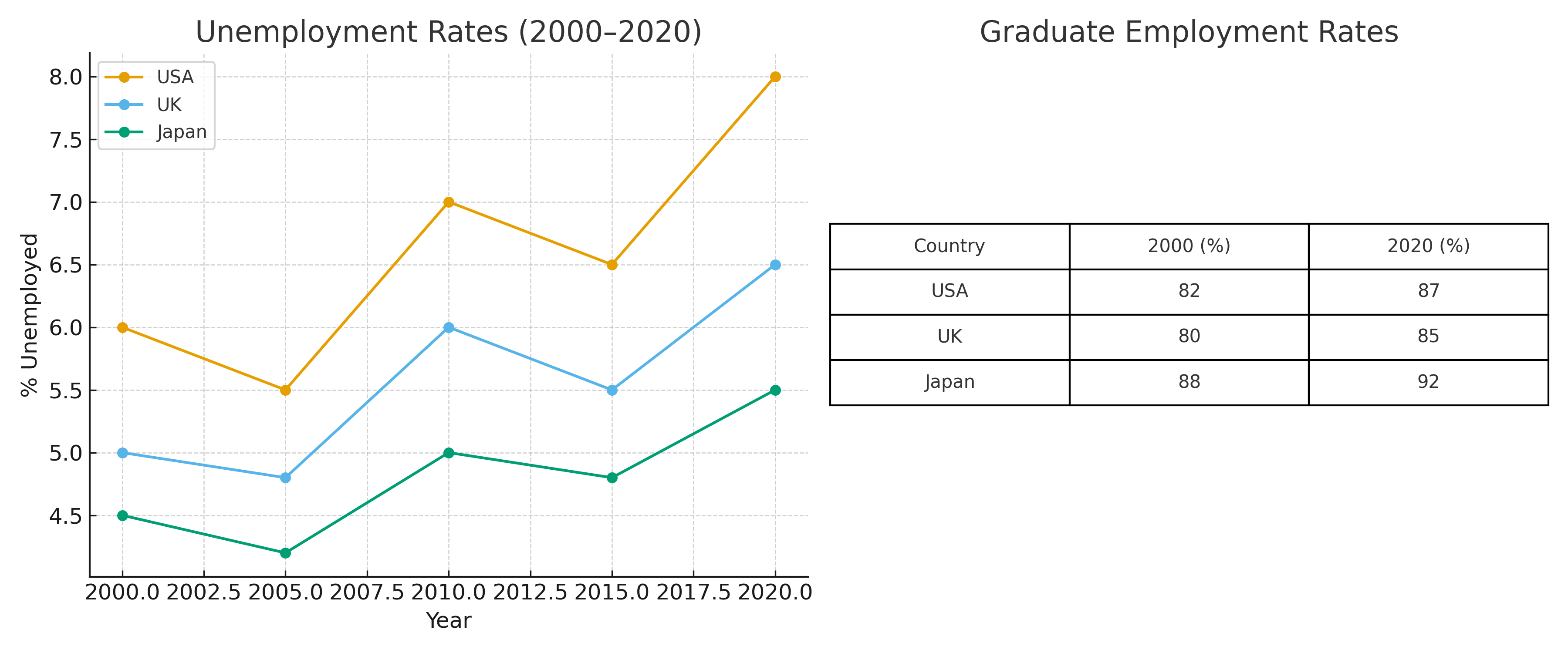
Figure: Unemployment trends (2000–2020) and graduate employment (2000 vs 2020)
Sample Answer (Band 7.5–8)
The graphics compare male and female unemployment trajectories across the USA, the UK and Japan from 2000 to 2020 and report graduate employment outcomes in 2000 and 2020. Overall, all three countries experienced a mild upturn in unemployment by the end of the period, with gender gaps remaining modest in the USA and the UK but more visible in Japan. Meanwhile, graduate employment improved steadily everywhere, most notably in Japan.
In the USA, unemployment fluctuated around mid–single digits, ending near 8% in 2020, with men and women following broadly parallel paths. The UK exhibited a similar pattern, finishing at approximately 6.5%. Japan recorded the lowest rates throughout (roughly 4.5–5.5%), yet the male advantage persisted slightly, particularly toward the end of the series.
Turning to graduate outcomes, employment rose from about 82% to 87% in the USA and from 80% to 85% in the UK between 2000 and 2020. Japan not only started higher (88%) but also advanced to around 92%, consolidating its lead. Taken together, the data suggest that although cyclical pressures lifted unemployment across the board by 2020, the labour-market premium associated with a degree strengthened over time—especially in Japan—helping to cushion graduates against broader job-market headwinds.
Analytical Review – IELTS Academic Writing Task 1 (Test 14)
Overall Verdict
Indicative band: 7.5–8.0
- Task Achievement: Clear coverage of both the line chart and table, with a strong emphasis on gender parity and cross-country contrasts.
- Coherence & Cohesion: Smooth transition from unemployment trends to graduate employment; logical sequencing of comparisons.
- Lexical Resource: Wide range of labour-market lexis (e.g., “trajectories,” “cyclical pressures,” “cushion graduates”).
- Grammar: Good mix of complex structures and precise quantification, minor density in phrasing.
Key Weaknesses
- Numerical clarity: Some sentences group ranges vaguely (“mid–single digits”) instead of specifying exact values.
- Comparisons: Could strengthen direct gender contrasts (e.g., “male unemployment exceeded female by 1pp in Japan”).
- Repetition: Words like “unemployment” and “employment” recur often; synonym variety needed.
- Sentence density: A few long clauses could be split for sharper readability.
Actionable Improvements (High-Impact)
- Use precise numbers: Replace vague phrases with exact percentages where available.
- Highlight gender contrasts: Example: “In Japan, male unemployment was consistently ~1% lower than female.”
- Lexical variation: Replace repetitive “employment” with “labour absorption,” “job placement,” or “workforce integration.”
- Shorten sentences: Break long multi-clause structures into concise, impactful statements.
- Show trends + outcomes: Explicitly connect falling/growing unemployment with graduate advantages.
Stronger Synonyms (Topic-Fit)
- employment → job placement labour absorption workforce integration
- unemployment → joblessness labour slack workforce exclusion
- increase → rise uptick climb
- decrease → drop decline fall
- advantage → edge premium benefit
Linking Devices (Cohesion)
- Contrast: whereas, by contrast, in comparison
- Addition: likewise, in addition, coupled with
- Result: as a consequence, therefore, thus
- Time/Sequence: initially, subsequently, by the end of the period
- Emphasis: notably, strikingly, critically
- Quantitative cues: roughly half, just under, marginally higher
High-Value Collocations (Labour Market)
- gender parity gap
- labour-market premium
- cyclical pressures
- graduate cushion effect
- workforce resilience
- cross-country divergence
- structural advantage
Rewrite Upgrades (Band-8 polish)
-
Original: “Unemployment in the USA ended near 8% in 2020.”
Upgrade: “By 2020, the US rate had climbed to almost 8%, underscoring a modest but persistent rise over two decades.” -
Original: “Graduate employment rose from 82% to 87% in the USA.”
Upgrade: “In the US, graduate employability improved by five percentage points, strengthening their relative labour-market edge.” -
Original: “Japan recorded the lowest unemployment.”
Upgrade: “Japan maintained the lowest joblessness, with men consistently outperforming women by a narrow margin.”
Model Sentences (Precise Quantification)
- “UK unemployment closed at 6.5%, roughly 1.5pp below the US rate.”
- “Graduate employment in Japan rose from 88% to 92%, consolidating its position as the regional leader.”
- “In 2020, US graduates enjoyed a labour-market premium, with their job rate nearly 80% higher than the overall employment baseline.”
Grammar Targets
- Comparatives: “X was slightly higher than Y,” “A rose 5pp more than B.”
- Passive voice: “advantages were enjoyed by graduates.”
- Nominal style: “a steady increase was observed in employability.”
- Adverbials: “marginally lower,” “notably higher,” “broadly aligned.”
Quick Checklist (Before Submit)
- Overview mentions both charts clearly.
- Data reported with precise numbers or pp gaps.
- Lexical variety: synonyms for “employment/unemployment” included.
- Sentences concise, no over-dense phrasing.
- Linkers varied; cohesion achieved naturally.