
IELTS Academic Writing Task 1 – Sample Test13 (Bar Chart)

Task Question

The bar chart below shows the proportion of male and female students enrolled in undergraduate, master’s, and PhD programs in Country Y in 2015.

Summarize the information by selecting and reporting the main features, and make comparisons where relevant.
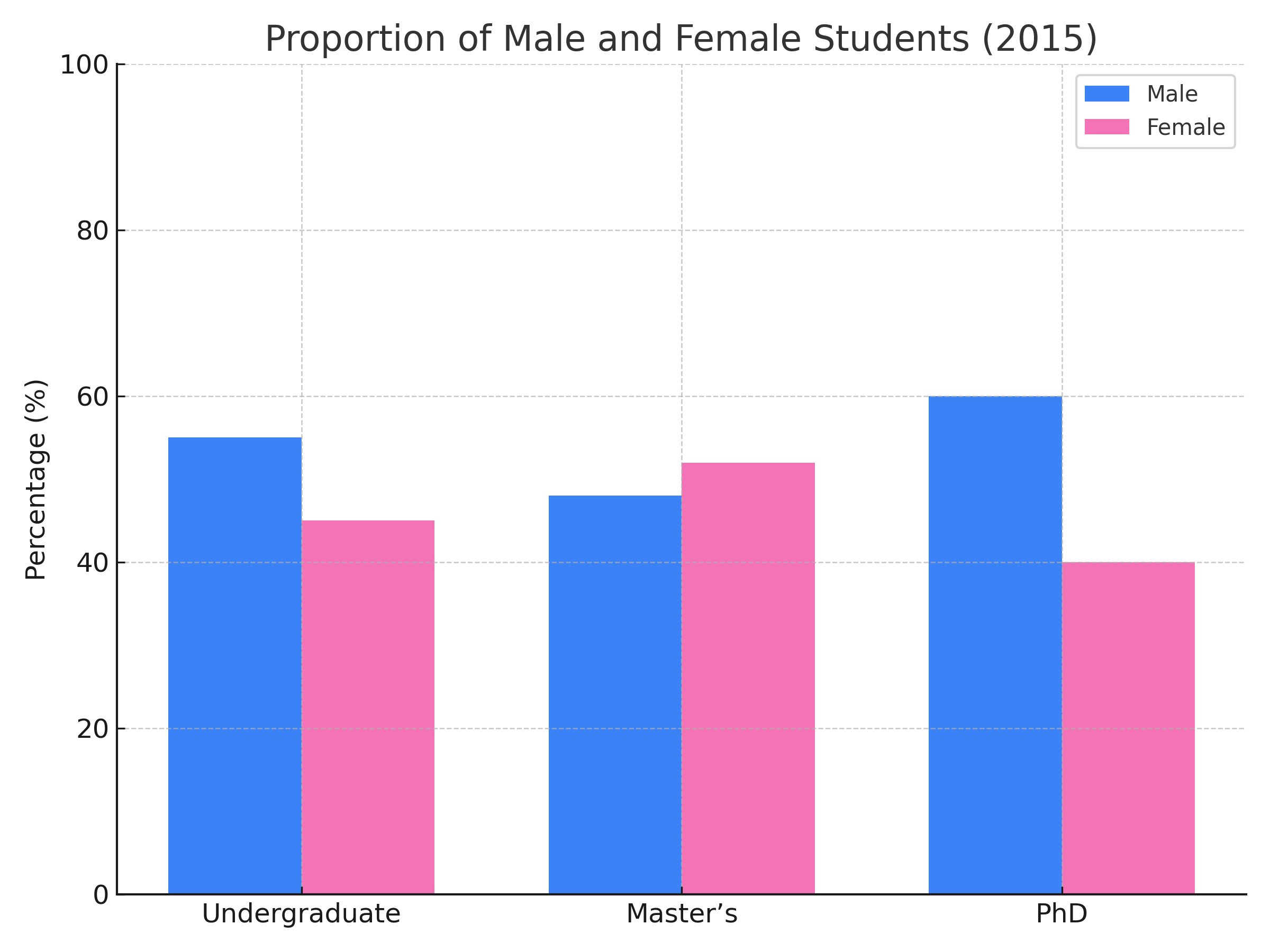
IELTS Writing Task 1 Test 13 – Bar chart (Male vs Female students in 2015)

Figure: Male vs Female participation in higher education (2015)

Sample Answer (Band 7.5–8)

The bar chart compares the percentage of male and female students enrolled in three levels of higher education in Country Y in 2015. Overall, women slightly outnumbered men at the master’s level, whereas men had higher participation in both undergraduate and doctoral programs.

At the undergraduate level, 55% of students were male, compared with 45% female, showing a modest gender gap. This trend was reversed at the master’s stage, where women accounted for just over half of enrolments (52%), slightly surpassing men at 48%.

By contrast, the PhD level demonstrated the most pronounced imbalance: 60% of doctoral candidates were male, while only 40% were female. This suggests that although women were well represented in postgraduate studies overall, their participation declined significantly at the highest academic tier.

In summary, the data highlights a gender reversal between undergraduate and master’s programs, but men continued to dominate at the doctoral level, indicating persistent barriers to women’s representation in advanced research degrees.

Analytical Review – IELTS Academic Writing Task 1 (Test 13)

Overall Verdict

Indicative band: 7.5–8.0

  • Task Achievement: Clear overview of gender distribution across all levels; contrasts highlighted (Master’s reversal vs. PhD imbalance).
  • Coherence & Cohesion: Logical flow from undergraduate to postgraduate; linking devices mostly accurate.
  • Lexical Resource: Strong lexis (e.g., “imbalance,” “representation,” “pronounced gap”); some repetition of “male/female.”
  • Grammar: Accurate tense control, range of comparatives; occasional sentence density.

Key Weaknesses

  • Repetition: Overuse of “male/female”; needs synonyms like “men/women,” “gender groups.”
  • Numerical detail: Few percentage-point comparisons given (e.g., “10pp higher”).
  • Sentence density: Some long sentences cover multiple contrasts; risk of reader fatigue.
  • Comparative sharpness: More explicit emphasis needed on the PhD gender gap.

Actionable Improvements (High-Impact)

  1. Quantify gaps: State exact pp differences (e.g., “PhD men exceeded women by 20pp”).
  2. Lexical variation: Rotate between “male/female,” “men/women,” “gender groups.”
  3. Highlight reversals: Emphasize Master’s as unique reversal where women outnumber men.
  4. Tighten phrasing: Break long comparative sentences into two concise ones.
  5. Emphasize barriers: Link data to implications (“persistent barriers to women in advanced research”).

Stronger Synonyms (Topic-Fit)

  • male/female → men/women gender groups
  • imbalance → disparity gap inequity
  • participation → enrolment attendance
  • dominate → outnumber prevail
  • decline → drop fall off shrink

Linking Devices (Cohesion)

  • Contrast: whereas, while, by contrast, on the other hand
  • Addition: moreover, in addition, similarly
  • Result: therefore, consequently, as a result
  • Time/Sequence: initially, subsequently, at the doctoral stage
  • Emphasis: notably, critically, in particular
  • Quantification: by 10pp, roughly half, just over/under

High-Value Collocations (Gender & Education)

  • gender disparity
  • reversal of trends
  • pronounced gap
  • female representation
  • dominant proportion
  • academic tiers
  • persistent imbalance
  • barriers to participation

Rewrite Upgrades (Band-8 polish)

  • Original: “At the PhD level, men were 60% and women 40%.”
    Upgrade:At the doctoral stage, men outnumbered women by a substantial 20pp margin (60% vs 40%), underscoring a persistent gender disparity.”
  • Original: “Women slightly outnumbered men at the Master’s level.”
    Upgrade:The Master’s tier marked the sole reversal, with women marginally surpassing men (52% vs 48%).”
  • Original: “Undergraduate figures show more men than women.”
    Upgrade: “Undergraduate enrolment showed a modest male advantage of 10pp (55% vs 45%).”

Model Sentences (Precise Quantification)

  • “Men outnumbered women in PhD programs by 20 percentage points.”
  • “Women held a slight majority at Master’s, accounting for 52%.”
  • “Undergraduate enrolment displayed a 10pp male advantage.”

Grammar Targets

  • Comparatives: “X was higher than Y by 10pp.”
  • Passives: “female participation was recorded at 40%.”
  • Nominalizations: “a persistent imbalance was evident at the doctoral stage.”
  • Adverbials: “marginally higher,” “significantly lower,” “substantially greater.”

Quick Checklist (Before Submit)

  • Overview covers all three levels with main contrasts.
  • Precise pp gaps included (10pp, 20pp).
  • Lexical variety beyond “male/female.”
  • Sentences concise, not overly dense.
  • Linkers varied; structure clear.

تحلیل دوزبانه – IELTS Academic Writing Task 1 (Test 13)

ارزیابی کلی

نمره تقریبی: 7.5 تا 8

  • پوشش کامل سه مقطع تحصیلی و اشاره به تفاوت‌های جنسیتی
  • انسجام منطقی از کارشناسی تا دکتری
  • واژگان تخصصی مانند «شکاف جنسیتی»، «نمایندگی زنان»، «تفاوت آشکار»
  • گرامر متنوع با استفاده از مقایسه‌ها و حالت مجهول

Overall Verdict

Indicative band: 7.5–8.0

  • Task Achievement: Clear coverage of all three levels with gender contrasts.
  • Coherence & Cohesion: Logical flow from undergraduate to PhD; effective linkers.
  • Lexical Resource: Strong lexis (“gender disparity,” “representation,” “pronounced gap”); some repetition.
  • Grammar: Accurate comparatives; some long sentences could be tightened.

نقاط ضعف

  • تکرار زیاد male/female بدون استفاده از مترادف
  • کمبود جزئیات عددی (مثلاً ۱۰ واحد درصد اختلاف)
  • تراکم بیش از حد جملات بلند
  • نیاز به تأکید بیشتر بر شکاف دکتری

Key Weaknesses

  • Overuse of “male/female” without synonyms.
  • Lack of precise numerical gaps (e.g., 10pp).
  • Sentence density too high in places.
  • PhD disparity could be stressed more explicitly.

پیشنهادهای بهبود

  1. گزارش اختلاف‌های دقیق درصدی
  2. استفاده از مترادف‌های متنوع برای تنوع واژگانی
  3. تقسیم جمله‌های بلند به دو جمله کوتاه‌تر
  4. تأکید بر وارونگی روند در مقطع کارشناسی ارشد

Actionable Improvements

  1. Report exact percentage-point gaps.
  2. Use varied synonyms for male/female.
  3. Break long sentences into two shorter ones.
  4. Highlight Master’s reversal more strongly.

مترادف‌های قوی

  • مرد/زن → men/women, gender groups
  • عدم توازن → disparity, gap, inequity
  • مشارکت → enrolment, attendance
  • غلبه کردن → outnumber, prevail
  • کاهش → drop, shrink

Stronger Synonyms

  • male/female → men/women, gender groups
  • imbalance → disparity, gap, inequity
  • participation → enrolment, attendance
  • dominate → outnumber, prevail
  • decline → drop, shrink, fall off

حروف ربط

  • تضاد: whereas, by contrast
  • افزودن: moreover, similarly
  • نتیجه: therefore, consequently
  • زمان: subsequently, at the doctoral stage

Linking Devices

  • Contrast: whereas, by contrast, while
  • Addition: moreover, similarly
  • Result: therefore, consequently
  • Time: subsequently, at the doctoral stage

کالوکیشن‌های کلیدی

  • شکاف جنسیتی → gender disparity
  • وارونگی روند → reversal of trends
  • تفاوت آشکار → pronounced gap
  • نمایندگی زنان → female representation
  • موانع پایدار → persistent barriers

High-Value Collocations

  • gender disparity
  • reversal of trends
  • pronounced gap
  • female representation
  • persistent barriers