
IELTS Reading Practice Test – Passage 1
Coral Farming for Reef Restoration
(1) Coral reefs, often called the “rainforests of the sea,” support a quarter of marine species despite covering less than one percent of the ocean floor. Yet warming waters, pollution, and destructive fishing have pushed many reefs to the brink of collapse. In response, scientists and community groups are turning to coral farming—cultivating young corals in nurseries and transplanting them onto damaged reefs—as a pragmatic way to accelerate natural recovery.
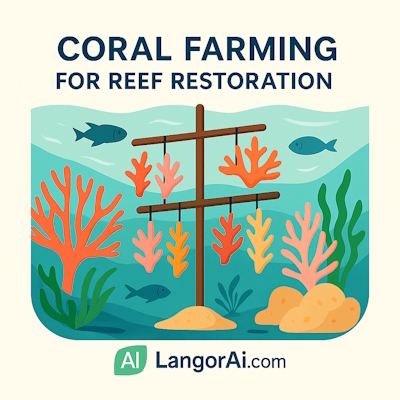
(2) Coral farming typically begins with the selection of healthy “parent” colonies from local reefs. Divers clip small fragments, each only a few centimetres long, and attach them to underwater structures such as ropes, trees of PVC, or metal frames. Suspended in clear water with good flow, the fragments experience reduced sedimentation and fewer predators, allowing them to grow rapidly. Alternatively, land-based hatcheries keep corals in tanks where temperature, light, and nutrients can be precisely controlled.
(3) A technique known as microfragmentation has transformed growth rates for slow-growing massive corals. By cutting a donor colony into thumbnail-sized pieces and spacing them a short distance apart on a ceramic tile, farmers exploit the coral’s healing response: as each piece expands, neighbouring fragments fuse, forming a single larger colony in a fraction of the usual time. This method can compress a decade of growth into just a few years, making once-impractical species viable for restoration.
(4) While most projects rely on asexual propagation—essentially cloning—a parallel effort focuses on sexual reproduction. During annual mass-spawning events, corals release eggs and sperm that can be collected and fertilised in the laboratory. The resulting larvae are settled onto small plugs or tiles and reared until they can withstand the open ocean. Sexual propagation introduces genetic diversity, which is crucial for resilience to heatwaves and disease; clones alone cannot provide the adaptive potential that reefs will need under climate change.
(5) Before outplanting, many programs genotype their stock to avoid planting large numbers of identical clones at one site. Managers try to mix lineages, pairing heat-tolerant strains with faster-growing ones to hedge bets against future conditions. Outplanting itself demands careful planning: technicians use marine epoxy or cement to fix nursery corals onto stable substrate and often install small meshes to deter grazing fish. Sites are chosen for moderate depth, good water quality, and low wave energy—conditions that improve survival during the first fragile months.
(6) Measuring success extends well beyond counting how many fragments survive. Project teams monitor growth, bleaching resistance, and, importantly, the return of ecological functions—such as the sheltering of juvenile fish and the cementing of loose rubble by coralline algae. Some initiatives deploy low-cost sensors or enlist recreational divers to report observations through citizen-science apps. Although early mortality can be high, especially after heat spikes, a subset of outplants consistently persists and begins to reproduce, seeding nearby areas naturally.
(7) The economics of coral farming are complex. Labour underwater is time-consuming, and materials are not cheap. However, costs fall with scale and standardisation. Community-based projects reduce expenses by training local fishers as coral gardeners, creating alternative livelihoods. For tourism-dependent regions, even modest improvements in reef condition can translate into economic benefits through sustained visitor interest and storm-buffering services. Funding is increasingly blended: public grants cover early setup, while private resorts or insurers pay for maintenance because healthy reefs protect shorelines.
(8) Critics argue that farming corals treats symptoms rather than causes: without aggressive action on greenhouse gas emissions and water quality, planted corals may bleach again. Practitioners largely agree but counter that restoration buys time. Many programs now combine outplanting with interventions such as shading experiments, selective breeding for heat tolerance, and the installation of wastewater filters upstream. As the field matures, best-practice manuals emphasise adaptive management—testing, measuring, and iterating—to refine methods for each location.
Questions 1–14
Questions 1–7
Choose the correct letter, A, B, C, or D.
A) To create new tourist attractions
B) To accelerate the recovery of damaged reefs
C) To replace natural reefs entirely
D) To harvest corals for the aquarium trade
A) They make corals more colourful
B) They reduce sediment and predation, improving growth
C) They eliminate the need for divers
D) They increase genetic diversity automatically
A) Increasing the amount of available sunlight
B) Triggering a healing response that fuses small pieces into one colony
C) Adding chemical fertilisers to the water
D) Training fish to defend the fragments
A) Guarantees faster growth than cloning
B) Produces corals that never bleach
C) Increases genetic diversity needed for resilience
D) Requires no specialised equipment
A) High wave energy and strong currents
B) Shallow waters exposed to midday sun
C) Moderate depth with good water quality
D) Areas frequented by grazing fish
A) Counting only the number of fragments attached
B) Recording growth and functional recovery of the reef
C) Measuring tourist numbers each season
D) Weighing the epoxy used at each site
A) It allows higher fishing quotas
B) It reduces the need for lifeguards
C) Healthier reefs help sustain tourism and coastal protection
D) It eliminates public funding requirements
Questions 8–10
Do the following statements agree with the information in the passage?
Write True if the statement agrees with the information;
False if it contradicts the information;
Not Given if there is no information.
Questions 11–14
Match the statements (11–14) with the correct paragraph (1–8).
Answer Key & Explanations
1 → B — Paragraph 1 states coral farming is used “as a pragmatic way to accelerate natural recovery.”
2 → B — Paragraph 2 explains that suspended structures reduce sedimentation and predation, improving growth.
3 → B — Paragraph 3: microfragmentation “exploits the healing response” so fragments fuse into a larger colony quickly.
4 → C — Paragraph 4 emphasises sexual reproduction introduces genetic diversity, vital for resilience.
5 → C — Paragraph 5 lists “moderate depth, good water quality, and low wave energy” as favourable conditions.
6 → B — Paragraph 6 describes monitoring growth, bleaching resistance, and the return of ecological functions.
7 → C — Paragraph 7: healthier reefs sustain visitor interest and provide storm-buffering, supporting finances.
8 → Not Given — The text contrasts control benefits of land-based hatcheries with underwater nurseries but does not compare costs.
9 → True — Paragraph 6: a subset of outplants “persists and begins to reproduce, seeding nearby areas.”
10 → False — Paragraph 8: practitioners acknowledge climate threats and pair restoration with other interventions.
11 → Paragraph 5 — It notes managers mix lineages and pair heat-tolerant with fast-growing strains.
12 → Paragraph 2 — Collection of fragments and attachment to nursery structures is detailed here.
13 → Paragraph 7 — Community-based projects train local fishers as coral gardeners to cut costs.
14 → Paragraph 8 — Critics claim farming treats symptoms; the paragraph addresses underlying causes like emissions.
کلید پاسخها و نکات – Coral Farming for Reef Restoration
🔎 Keywording: قبل از خواندن دقیق، کلیدواژههای خاص را هایلایت کن (microfragmentation, outplanting, genetic diversity).
❗ Trap patterns: واژههای مطلق (always/never/entirely) غالباً گزینهٔ غلط میسازند.
واژگان کلیدی / Key Vocabulary
Example: Microfragmentation compressed a decade of growth into a few years.
Collocation: microfragmentation technique / microfragment growth
Note: boosts slow-growing massive corals.
Example: Teams used marine epoxy for outplanting at moderate depths.
Collocation: outplant survival / outplant site
Note: planning of depth/wave energy is critical.
Example: Most projects rely on asexual propagation for scale.
Collocation: asexual clones / clonal stock
Note: low diversity if used alone.
Example: Lab-reared larvae were settled on ceramic tiles.
Collocation: mass spawning / larval settlement
Note: boosts resilience under climate stress.
Example: Rope nurseries reduced sediment accumulation.
Collocation: underwater nursery / land-based nursery
Note: control vs. cost trade-offs.
Example: Mixing heat-tolerant and fast-growing lineages increased genetic diversity.
Collocation: maintain diversity / genotype mix
Note: key for disease and heat resilience.
Example: Monitoring included bleaching resistance.
Collocation: bleaching event / bleaching resistance
Note: frequent during marine heatwaves.
Example: Diversity improved reef resilience to disease.
Collocation: ecological resilience / climate resilience
Note: product of traits + environment.
Example: Teams fixed fragments onto stable substrate with cement.
Collocation: stable substrate / rocky substrate
Note: stability reduces dislodgement.
Example: Marine epoxy improved early retention.
Collocation: epoxy plug / epoxy mount
Note: cure time matters for waves.
Example: Functional recovery included coralline algae coverage.
Collocation: coralline cover / rubble cementation
Note: indicator of habitat stability.
Example: Divers uploaded photos via a citizen-science app.
Collocation: citizen-science monitoring / volunteer divers
Note: expands monitoring coverage.
Example: Manuals emphasise adaptive management for each site.
Collocation: adaptive cycle / adaptive protocol
Note: crucial in changing climates.
Example: Sites with low wave energy had higher survival.
Collocation: high/low wave energy / wave-sheltered site
Note: a key site-selection filter.
Example: Resorts fund reefs for storm-buffering services.
Collocation: coastal buffering / natural defence
Note: ties ecology to finance.